


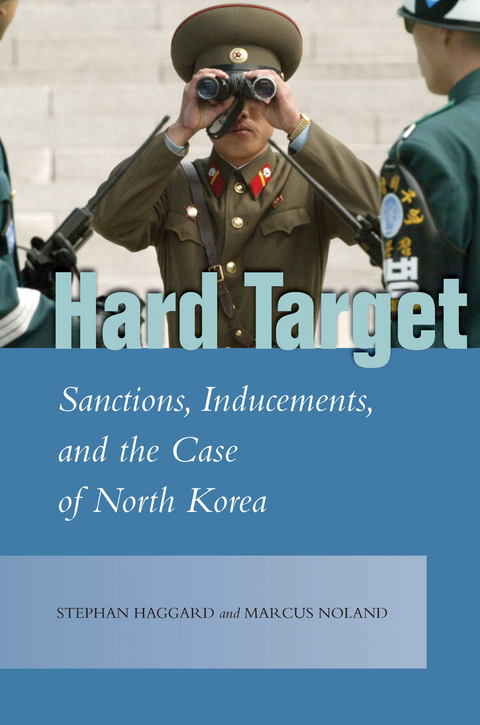
Hard Target (eBook)
344 Seiten
Stanford University Press (Verlag)
978-1-5036-0199-4 (ISBN)
Stephan Haggard is the Krause Distinguished Professor of Korea-Pacific Studies at the Graduate School of Global Policy and Strategy, University of California, San Diego. With Marcus Noland, he is the author of Famine in North Korea (2007), Witness to Transformation (2011) and the blog North Korea: Witness to Transformation. Marcus Noland is Executive Vice President and Director of Studies at the Peterson Institute for International Economics and Senior Fellow at the East–West Center. He is the author of Avoiding the Apocalypse (2000), which won the 2002 Masayoshi Ohira Memorial Prize.
Contents and Abstracts1Introduction: The Political Economy of Engagement chapter abstractThis chapter reviews the theoretical literature on the effectiveness of sanctions and inducements, with a particular emphasis on the latter. It distinguishes between quid pro quo models of engagement and more transformative models. With respect to the former, the chapter walks through coordination and bargaining problems as well as how the effectiveness of sanctions is affected by characteristics of the target state. It also calls into question the logic of transformative engagement with respect to certain types of authoritarian regimes, and provides an historical review of diplomacy around the Korean peninsula since 1990.2The Political Economy of North Korea: The Paradigmatic Hard Target chapter abstractThis chapter considers characteristics of authoritarian regimes in general, and North Korea in particular, that affect their vulnerability to sanctions. These include the core constituents of the regime, its capacity to repress, and its organizational structure. The chapter also includes a discussion of the path of reform and opening in North Korea, which is shown to be hesitant at best.3North Korea's External Economic Relations, 1990–2016 chapter abstractThis chapter considers a variety of indicators on the nature of North Korea's external economic relations, including its direction and composition of trade. These data suggest why coordination problems around sanctions and engagement have proven so difficult, as China has come to account for an increasing share of North Korea's trade. The chapter provides a balance-of-payments accounting of the country and demonstrates how the regime has been able to adjust to sanctions through illicit activities and securing external forces of foreign exchange, including capital inflows, despite its ambivalent posture toward foreign investors.4Humanitarian Dilemmas: The Political Economy of Food chapter abstractThis chapter considers humanitarian dilemmas surrounding aid to North Korea. It provides an overview of the food economy and the recurrence of shortages before turning to the political economy of food aid, which oscillated sharply between periods when aid was extended on both political and humanitarian grounds and periods when it was held in abeyance. The chapter considers the political economy of multilateral assistance and the politics of food aid in the United States, South Korea, and China. The regime's nuclear priorities and/or acute bargaining problems around the monitoring of assistance resulted in delays in reaching needed agreements, shortfalls in the delivery of assistance, and acute humanitarian distress.5The Microeconomics of Engagement chapter abstractThis chapter draws on two unprecedented surveys of firms based in China and South Korea engaged in trade and investment with North Korea. It examines both the nature of cross-border exchange as well as the formal and informal institutions that underpin it and provides evidence of ongoing state control. Chinese firms in particular report that the business environment is highly corrupt; a consideration of dispute settlement and measures of trust suggest how the development of cross-border exchange is limited by the regime's overall economic strategy. South Korean firms operate in an enclave setting that imports South Korean property rights, and China my be moving to such a model over time. These findings cast doubt on the engagement model.6Negotiating on Nuclear Weapons I: The Rise and Fall of the Six Party Talks (2001-2008) chapter abstractThis chapter and the next one consider direct negotiations over nuclear weapons and the strategic interplay around the peninsula in two distinct phases. The two administrations of George W. Bush correspond to the rise and fall of the Six Party Talks process, initiated in 2003 following the onset of the second nuclear crisis and ultimately breaking down in the last year of the second Bush term in 2008; we address that history in this chapter. We show that while there is some evidence of financial sanctions "working," they did so only in the context of wider inducements. 7Negotiating on Nuclear Weapons II: Permanent Crisis, 2009-2016 chapter abstractIn the second period (2009-2014), formal negotiations were in abeyance but the six parties nonetheless engaged in an intricate set of strategic interactions in which sanctions and inducements continued to play a significant role. By coincidence, this period largely corresponds with the two administrations of Barack Obama; we review this period in Chapter Seven. During this second period, multilateral sanctions deepened in the wake of further missile tests and three additional nuclear tests in May 2009, February 2013, and January 2016 but with little effect on reopening negotiations.8Conclusion: Whither North Korea? Whither Economic Statecraft? chapter abstractThis chapter looks back at our findings, measuring them against some of the analytic expectations established in the Introduction. It then asks two more speculative questions. First, what if North Korea were to change? How might that affect the conclusions drawn here? Particular consideration is given to economic reform processes. Second, what if the major parties undertook different strategies with respect to North Korea? These questions permit us to engage in some comparisons with other relevant cases, most notably Iran, and to consider how a new spate of diplomatic initiatives—including both sanctions and proposals for engagement—that were introduced in the wake of the fourth nuclear test in early 2016.
| Erscheint lt. Verlag | 30.5.2017 |
|---|---|
| Reihe/Serie | Studies in Asian Security | Studies in Asian Security |
| Zusatzinfo | 30 figures, 21 tables |
| Sprache | englisch |
| Themenwelt | Sozialwissenschaften ► Politik / Verwaltung ► Europäische / Internationale Politik |
| Sozialwissenschaften ► Politik / Verwaltung ► Politische Theorie | |
| Wirtschaft ► Volkswirtschaftslehre ► Makroökonomie | |
| Schlagworte | economic statecraft • foreign policy • North Korea • nuclear weapons • Proliferation • Sanctions |
| ISBN-10 | 1-5036-0199-4 / 1503601994 |
| ISBN-13 | 978-1-5036-0199-4 / 9781503601994 |
| Informationen gemäß Produktsicherheitsverordnung (GPSR) | |
| Haben Sie eine Frage zum Produkt? |
 EPUB (Adobe DRM)
Kopierschutz: Adobe-DRM
Adobe-DRM ist ein Kopierschutz, der das eBook vor Mißbrauch schützen soll. Dabei wird das eBook bereits beim Download auf Ihre persönliche Adobe-ID autorisiert. Lesen können Sie das eBook dann nur auf den Geräten, welche ebenfalls auf Ihre Adobe-ID registriert sind.
Details zum Adobe-DRM
Dateiformat: EPUB (Electronic Publication)
EPUB ist ein offener Standard für eBooks und eignet sich besonders zur Darstellung von Belletristik und Sachbüchern. Der Fließtext wird dynamisch an die Display- und Schriftgröße angepasst. Auch für mobile Lesegeräte ist EPUB daher gut geeignet.
Systemvoraussetzungen:
PC/Mac: Mit einem PC oder Mac können Sie dieses eBook lesen. Sie benötigen eine
eReader: Dieses eBook kann mit (fast) allen eBook-Readern gelesen werden. Mit dem amazon-Kindle ist es aber nicht kompatibel.
Smartphone/Tablet: Egal ob Apple oder Android, dieses eBook können Sie lesen. Sie benötigen eine
Geräteliste und zusätzliche Hinweise
Buying eBooks from abroad
For tax law reasons we can sell eBooks just within Germany and Switzerland. Regrettably we cannot fulfill eBook-orders from other countries.


