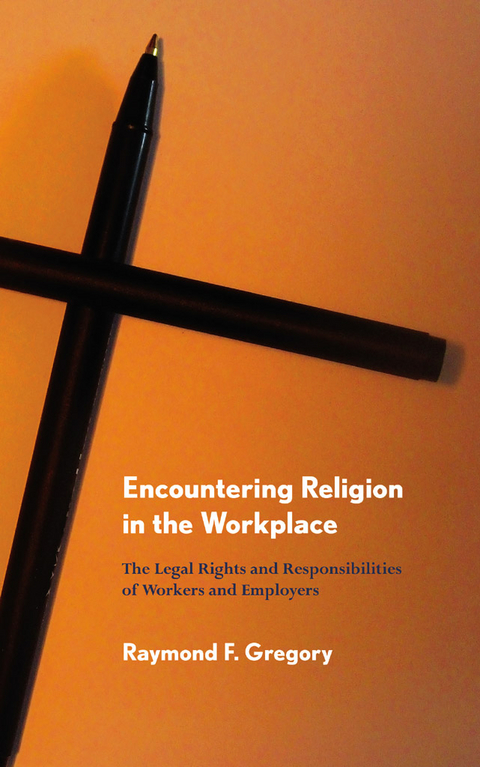
Encountering Religion in the Workplace (eBook)
280 Seiten
Cornell University Press (Verlag)
978-0-8014-6122-4 (ISBN)
Legal cases that cast light on the ramifications of mixing religion and work.
In a recent survey, 20 percent of the workers interviewed reported that they had either experienced religious prejudice while at work or knew of a coworker who had been subjected to some form of discriminatory conduct. Indeed, according to the Equal Employment Opportunity Commission, the filing of religious discrimination charges under Title VII of the Civil Rights Act of 1964 (which prohibits discrimination in employment based on race, color, national origin, sex, and religion) increased 75 percent between 1997 and 2008. The growing desire on the part of some religious groups to openly express their faith while at work has forced their employers and coworkers to reconsider the appropriateness of certain aspects of devotional conduct. Religion in the workplace does not sit well with all workers, and, from the employer's perspective, the presence of religious practice during the workday may be distracting and, at times, divisive. A thin line separates religious self-expression-by employees and employers-from unlawful proselytizing. In Encountering Religion in the Workplace, Raymond F. Gregory presents specific cases that cast light on the legal ramifications of mixing religion and work-in the office, on the factory floor, even within religious organizations. Court cases arising under Title VII and the First Amendment must be closely studied, Gregory argues, if we are to fully understand the difficulties that arise for employers and employees alike when they become involved in workplace disputes involving religion, and his book is an ideal resource for anyone hoping to understand this issue.
Raymond F. Gregory is the author of Unwelcome and Unlawful: Sexual Harassment in the American Workplace, also from Cornell, Norman Thomas: The Great Dissenter, Women and Workplace Discrimination, and Age Discrimination in the American Workplace.
IntroductionPart I. Religious Discrimination in the Workplace
1. Is There a Place for Religion in the Workplace?
2. What Is Religion as Defi ned by Law?
3. Religious Discrimination and the Civil Rights Act of 1964
4. Religious Discrimination at Various Stages of the Employment Relationship
5. Religious Discrimination Claims Arising Out of the Termination of Employment
6. Employee Proselytization
7. Employer Proselytization
8. Employer Liability for Employee Acts of Religious Harassment
9. Workplace Discrimination and Certain Religious GroupsPart II. Religion and the Public-Sector Workplace
10. Religion in the Public-Sector Workplace
11. Proselytizing in the Public-Sector WorkplacePart III. Exemptions to Discrimination Laws
12. Exemptions from the Discrimination Laws Granted to Religious Organizations
13. The Ministerial Exception
14. Questionable Applications of the Ministerial ExceptionPart IV. Accommodating Worker Religious Practices
15. General Principles of Accommodation
16. Accommodation in Practice
17. Accommodation in Out-of-the-Ordinary CircumstancesPart V. Retaliation and Other Issues
18. Religious Discrimination and Retaliation
19. Some Additional Issues
20. Religion and the Law in the Workplace of the FutureNotes
List of Cases Discussed in the Book
Index
| Erscheint lt. Verlag | 15.1.2011 |
|---|---|
| Verlagsort | Ithaca |
| Sprache | englisch |
| Maße | 150 x 150 mm |
| Themenwelt | Geisteswissenschaften ► Religion / Theologie |
| Recht / Steuern ► Arbeits- / Sozialrecht ► Arbeitsrecht | |
| Recht / Steuern ► EU / Internationales Recht | |
| Wirtschaft ► Betriebswirtschaft / Management ► Personalwesen | |
| Schlagworte | religious prejudice at work, Equal Employment Opportunity Commission, filing of religious discrimination charges, religious freedom, expression of faith, proselytizing, religious self-expression |
| ISBN-10 | 0-8014-6122-7 / 0801461227 |
| ISBN-13 | 978-0-8014-6122-4 / 9780801461224 |
| Informationen gemäß Produktsicherheitsverordnung (GPSR) | |
| Haben Sie eine Frage zum Produkt? |
 EPUB (Adobe DRM)
Kopierschutz: Adobe-DRM
Adobe-DRM ist ein Kopierschutz, der das eBook vor Mißbrauch schützen soll. Dabei wird das eBook bereits beim Download auf Ihre persönliche Adobe-ID autorisiert. Lesen können Sie das eBook dann nur auf den Geräten, welche ebenfalls auf Ihre Adobe-ID registriert sind.
Details zum Adobe-DRM
Dateiformat: EPUB (Electronic Publication)
EPUB ist ein offener Standard für eBooks und eignet sich besonders zur Darstellung von Belletristik und Sachbüchern. Der Fließtext wird dynamisch an die Display- und Schriftgröße angepasst. Auch für mobile Lesegeräte ist EPUB daher gut geeignet.
Systemvoraussetzungen:
PC/Mac: Mit einem PC oder Mac können Sie dieses eBook lesen. Sie benötigen eine
eReader: Dieses eBook kann mit (fast) allen eBook-Readern gelesen werden. Mit dem amazon-Kindle ist es aber nicht kompatibel.
Smartphone/Tablet: Egal ob Apple oder Android, dieses eBook können Sie lesen. Sie benötigen eine
Geräteliste und zusätzliche Hinweise
Buying eBooks from abroad
For tax law reasons we can sell eBooks just within Germany and Switzerland. Regrettably we cannot fulfill eBook-orders from other countries.
aus dem Bereich