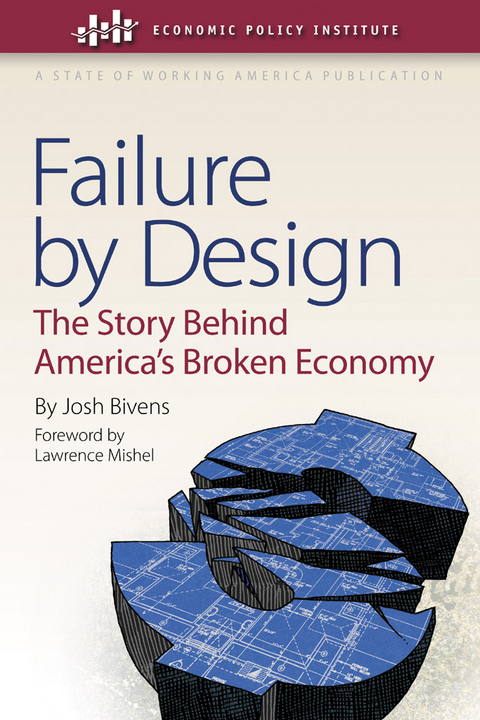
Failure by Design (eBook)
120 Seiten
Ilr Press (Verlag)
978-0-8014-6113-2 (ISBN)
Explaining the causes and impact on working Americans of the most catastrophic economic policy failure since the 1920s.
In Failure by Design, the Economic Policy Institute's Josh Bivens takes a step back from the acclaimed State of Working America series, building on its wealth of data to relate a compelling narrative of the U.S. economy's struggle to emerge from the Great Recession of 2008. Bivens explains the causes and impact on working Americans of the most catastrophic economic policy failure since the 1920s.
As outlined clearly here, economic growth since the late 1970s has been slow and inequitably distributed, largely as a result of poor policy choices. These choices only got worse in the 2000s, leading to an anemic economic expansion. What growth we did see in the economy was fueled by staggering increases in private-sector debt and a housing bubble that artificially inflated wealth by trillions of dollars. As had been predicted, the bursting of the housing bubble had disastrous consequences for the broader economy, spurring a financial crisis and a rise in joblessness that dwarfed those resulting from any recession since the Great Depression. The fallout from the Great Recession makes it near certain that there will be yet another lost decade of income growth for typical families, whose incomes had not been boosted by the previous decade's sluggish and localized economic expansion.
In its broad narrative of how the economy has failed to deliver for most Americans over much of the past three decades, Failure by Design also offers compelling graphic evidence on jobs, incomes, wages, and other measures of economic well-being most relevant to low- and middle-income workers. Josh Bivens tracks these trends carefully, giving a lesson in economic history that is readable yet rigorous in its analysis. Intended as both a stand-alone volume and a companion to the new State of Working America website that presents all of the data underlying this cogent analysis, Failure by Design will become required reading as a road map to the economic problems that confront working Americans.
In Failure by Design, the Economic Policy Institute's Josh Bivens takes a step back from the acclaimed State of Working America series, building on its wealth of data to relate a compelling narrative of the U.S. economy's struggle to emerge from the Great Recession of 2008. Bivens explains the causes and impact on working Americans of the most catastrophic economic policy failure since the 1920s.
As outlined clearly here, economic growth since the late 1970s has been slow and inequitably distributed, largely as a result of poor policy choices. These choices only got worse in the 2000s, leading to an anemic economic expansion. What growth we did see in the economy was fueled by staggering increases in private-sector debt and a housing bubble that artificially inflated wealth by trillions of dollars. As had been predicted, the bursting of the housing bubble had disastrous consequences for the broader economy, spurring a financial crisis and a rise in joblessness that dwarfed those resulting from any recession since the Great Depression. The fallout from the Great Recession makes it near certain that there will be yet another lost decade of income growth for typical families, whose incomes had not been boosted by the previous decade's sluggish and localized economic expansion.
In its broad narrative of how the economy has failed to deliver for most Americans over much of the past three decades, Failure by Design also offers compelling graphical evidence on jobs, incomes, wages, and other measures of economic well-being most relevant to low- and middle-income workers. Josh Bivens tracks these trends carefully, giving a lesson in economic history that is readable yet rigorous in its analysis. Intended as both a stand-alone volume and a companion to the new State of Working America website that presents all of the data underlying this cogent analysis, Failure by Design will become required reading as a road map to the economic problems that confront working Americans.
Josh Bivens has been an economist at the Economic Policy Institute since 2002. He is the author most recently of Everybody Wins, Except for Most of Us—What Economics Teaches About Globalization. Lawrence Mishel is the president of the Economic Policy Institute and its research director from 1987 to 1999. He is the coauthor of every edition of The State of Working America.
Foreword by Lawrence MishelI. The Great Recession: The Damage Done and the Rot RevealedII. The Great Recession's Trigger: Housing Bubble Leads to Jobs Crisis
Fallout: The Job Market
Fallout: Broader Measures of Economic Security—Poverty, Health Insurance, and Net WealthIII. The Policy Response to the Great Recession: What Was Done, and Did It Work?
The Dynamics of the Great Recession
Recovery Act Controversies: What Was in It?
Recovery Act Controversies: Did It Work at All?
Recovery Act Controversies: Why Has Consumer and Not Government Spending Led the Recovery? IV. The Great Recession Ended More Than a Year Ago—So, "Mission Accomplished"?
Apathy, Not Overreach
Exchange Rate Policy
Monetary Policy
Fiscal Policy
Clear Economics, Fuzzy Politics V. The Cracked Foundation Revealed by the Great Recession
Falling Minimum Wage
Assault on Workers' Right to Organize
Global Integration for America's Workers and Insulation for Elites
The Rise of Finance
Abandoning Full Employment as a Target
You Get the Economy You Choose
Incomes in the 30 Years before the Great Recession: Growing Slower and Less Equal
Is Everybody Getting Richer but the Rich Are Just Getting Richer Faster?
Why Have Typical Families' Incomes and Overall Economic Growth De-linked?
The Arithmetic of Rising Inequality: Falling Wage Growth for Most American Workers
The Economics of Rising Inequality
Lower Wage Growth Did Not Buy Greater Economic Security or Sustained Progress in Closing Racial Gaps
How Did American Families Cope with Lower Wage Gowth and Rising Insecurity?VI. Where to from Here?Bibliography
About EPI
About the Author
The State of Working America Website
| Erscheint lt. Verlag | 15.2.2011 |
|---|---|
| Reihe/Serie | Economic Policy Institute | Economic Policy Institute |
| Vorwort | Lawrence Mishel |
| Verlagsort | Ithaca |
| Sprache | englisch |
| Maße | 150 x 150 mm |
| Themenwelt | Sachbuch/Ratgeber ► Beruf / Finanzen / Recht / Wirtschaft ► Wirtschaft |
| Wirtschaft ► Allgemeines / Lexika | |
| Wirtschaft ► Volkswirtschaftslehre ► Wirtschaftspolitik | |
| Schlagworte | Economic growth since the 1970s, increases in private-sector debt, housing bubble, financial crisis, rise in joblessness, Great Recession, working Americans |
| ISBN-10 | 0-8014-6113-8 / 0801461138 |
| ISBN-13 | 978-0-8014-6113-2 / 9780801461132 |
| Informationen gemäß Produktsicherheitsverordnung (GPSR) | |
| Haben Sie eine Frage zum Produkt? |
 EPUB (Adobe DRM)
Kopierschutz: Adobe-DRM
Adobe-DRM ist ein Kopierschutz, der das eBook vor Mißbrauch schützen soll. Dabei wird das eBook bereits beim Download auf Ihre persönliche Adobe-ID autorisiert. Lesen können Sie das eBook dann nur auf den Geräten, welche ebenfalls auf Ihre Adobe-ID registriert sind.
Details zum Adobe-DRM
Dateiformat: EPUB (Electronic Publication)
EPUB ist ein offener Standard für eBooks und eignet sich besonders zur Darstellung von Belletristik und Sachbüchern. Der Fließtext wird dynamisch an die Display- und Schriftgröße angepasst. Auch für mobile Lesegeräte ist EPUB daher gut geeignet.
Systemvoraussetzungen:
PC/Mac: Mit einem PC oder Mac können Sie dieses eBook lesen. Sie benötigen eine
eReader: Dieses eBook kann mit (fast) allen eBook-Readern gelesen werden. Mit dem amazon-Kindle ist es aber nicht kompatibel.
Smartphone/Tablet: Egal ob Apple oder Android, dieses eBook können Sie lesen. Sie benötigen eine
Geräteliste und zusätzliche Hinweise
Buying eBooks from abroad
For tax law reasons we can sell eBooks just within Germany and Switzerland. Regrettably we cannot fulfill eBook-orders from other countries.
aus dem Bereich