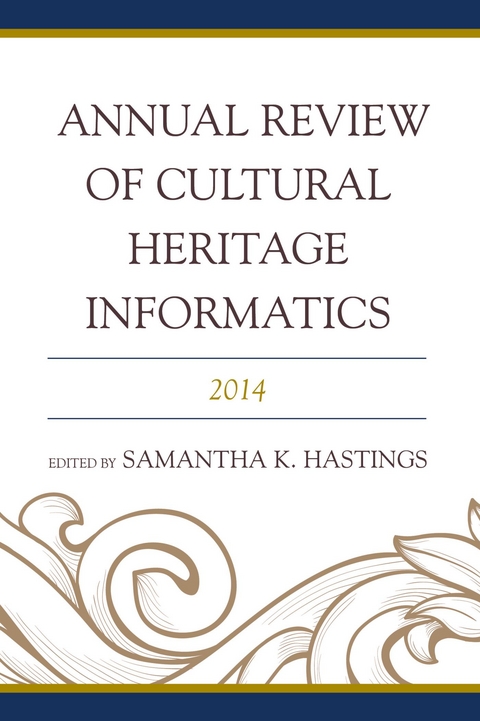
Annual Review of Cultural Heritage Informatics (eBook)
230 Seiten
Rowman & Littlefield Publishers (Verlag)
978-1-4422-5012-3 (ISBN)
Produced by The University of South Carolina's School of Library and Information Science this is the authoritative annual compilation of research, best practices, and a review of literature in the fields of cultural heritage, imaging for museums and libraries, and digital humanities. The scope is international. The Annual will build on the commonality of interests between museums, archives and libraries, and scholarship in the arts and humanities. An editorial board will be comprised of four to seven scholars in the field to include but not limited to researchers and information professionals with previous work in the field of cultural heritage and informatics. Each issue will contain three major parts: * Original research articles* Literature reviews on the three main research areas in the field:, Social networking and cultural institutions, the value of culture, and open source resources* Overview of trends and technologies in the fieldThe Annual Review is an essential overview and synthesis of this nascent and growing field.
Samantha K. Hastings joined the faculty at the University of South Carolina, School of Library and Information Science as director and professor in August 2006. She served as president of the American Society for Information Science and Technology (www.asist.org) in 2004 and is the current president for the Association of Library and Information Science Education (www.alise.org/.) Her current research interests include the use of 3D images in cultural heritage institutions.
Best PracticesPerspectives on Museum Informatics: Curatorial Voice re-imagined through Gatekeeper theory; Museum as Place re-envisioned through Nonaka’s SECI baLaura-Edythe S. ColemanRestaging the Record: Opportunities for Collaboration in Event-Based ArchivyTonia SutherlandTechnicolor Shades: Considering Privilege in Modeling of Information BehaviorSimon TarrCultural Heritage Informatics and Intellectual Property RightsDick Kawooya and Tucker TaylorParticipatory Culture“Knit and the World Knits with You”: Studying Participatory Culture in US Newspapers Through World War IJennifer Burek PierceCommunity ArchivesAndrea J. CopelandSocial Media and Participatory Culture: Opportunities and Challenges for Reforming the Contemporary MuseumStan A. Trembach and Liya DengEducationHHA: Using Handheld Technology to Foster Interdisciplinary Learning between Art and the HumanitiesKaren Heid and Jessica DameField ReportsGrey Literature at the Center for the History of Psychology, A Case StudyJodi Kearns and Cathy FayeThe Emerging Tradition of Digital ClassicsSarah A. BuchananPerception of Researchers about Institutional Repositories to Archive Indigenous Scholarly Literature: A Case of PakistanNosheen Fatima WarraichReviewsAllied Media Conference: An Interchange Leading to Possibilities for Another World; Review of the 16th Annual Allied Media Conference, June 19–22, 2014, Detroit, MichiganCeleste Â-ReSCFM 2014 Conference ReviewPorchia MooreDigital Preservation—Not a “One Size Fits All” Solution: A Critical Review of Preserving Digital Materials by Ross Harvey, Second Edition, 2011Carol Lynn PriceAbout the EditorIndex
| Erscheint lt. Verlag | 9.6.2015 |
|---|---|
| Sprache | englisch |
| Themenwelt | Kunst / Musik / Theater |
| Schulbuch / Wörterbuch ► Lexikon / Chroniken | |
| Geisteswissenschaften ► Archäologie | |
| Geisteswissenschaften ► Geschichte ► Hilfswissenschaften | |
| Geisteswissenschaften ► Sprach- / Literaturwissenschaft | |
| Sozialwissenschaften ► Kommunikation / Medien ► Buchhandel / Bibliothekswesen | |
| Wirtschaft ► Betriebswirtschaft / Management ► Unternehmensführung / Management | |
| Schlagworte | archives • Culture • libraries • Museums |
| ISBN-10 | 1-4422-5012-7 / 1442250127 |
| ISBN-13 | 978-1-4422-5012-3 / 9781442250123 |
| Informationen gemäß Produktsicherheitsverordnung (GPSR) | |
| Haben Sie eine Frage zum Produkt? |
 EPUB (Adobe DRM)
Kopierschutz: Adobe-DRM
Adobe-DRM ist ein Kopierschutz, der das eBook vor Mißbrauch schützen soll. Dabei wird das eBook bereits beim Download auf Ihre persönliche Adobe-ID autorisiert. Lesen können Sie das eBook dann nur auf den Geräten, welche ebenfalls auf Ihre Adobe-ID registriert sind.
Details zum Adobe-DRM
Dateiformat: EPUB (Electronic Publication)
EPUB ist ein offener Standard für eBooks und eignet sich besonders zur Darstellung von Belletristik und Sachbüchern. Der Fließtext wird dynamisch an die Display- und Schriftgröße angepasst. Auch für mobile Lesegeräte ist EPUB daher gut geeignet.
Systemvoraussetzungen:
PC/Mac: Mit einem PC oder Mac können Sie dieses eBook lesen. Sie benötigen eine
eReader: Dieses eBook kann mit (fast) allen eBook-Readern gelesen werden. Mit dem amazon-Kindle ist es aber nicht kompatibel.
Smartphone/Tablet: Egal ob Apple oder Android, dieses eBook können Sie lesen. Sie benötigen eine
Geräteliste und zusätzliche Hinweise
Buying eBooks from abroad
For tax law reasons we can sell eBooks just within Germany and Switzerland. Regrettably we cannot fulfill eBook-orders from other countries.
aus dem Bereich