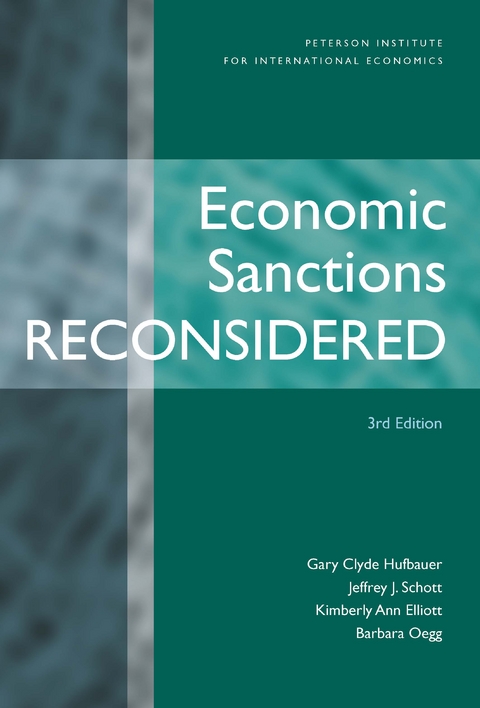
Economic Sanctions Reconsidered (eBook)
Peterson Institute for International Economics (Verlag)
978-0-88132-482-2 (ISBN)
Gary Clyde Hufbauer, Reginald Jones Senior Fellow since 1992, was formerly the Maurice Greenberg Chair and Director of Studies at the Council on Foreign Relations (1996–98), the Marcus Wallenberg Professor of International Finance Diplomacy at Georgetown University (1985–92), senior fellow at the Institute (1981–85), deputy director of the International Law Institute at Georgetown University (1979–81); deputy assistant secretary for international trade and investment policy of the US Treasury (1977–79); and director of the international tax staff at the Treasury (1974–76).Jeffrey J. Schott joined the Peterson Institute for International Economics in 1983 and is a senior fellow working on international trade policy and economic sanctions. During his tenure at the Institute, Schott was also a visiting lecturer at Princeton University (1994) and an adjunct professor at Georgetown University (1986–88). He was a senior associate at the Carnegie Endowment for International Peace (1982–83) and an official of the US Treasury Department (1974–82) in international trade and energy policy. During the Tokyo Round of multilateral trade negotiations, he was a member of the US delegation that negotiated the GATT Subsidies Code. Since January 2003, he has been a member of the Trade and Environment Policy Advisory Committee of the US government. He is also a member of the State Department's Advisory Committee on International Economic Policy.Kimberly Ann Elliott, former visiting fellow, is a senior fellow at the Center for Global Development. She is the author or coauthor of numerous books and articles on a variety of trade policy and globalization issues. Much of her work focuses on the uses of economic leverage in international negotiations, including both economic sanctions for foreign policy goals and trade threats and sanctions in commercial disputes.Barbara Oegg is a consultant to the Peterson Institute for International Economics. She was a research associate at the Institute from 1998 to 2004. She has coauthored numerous articles on economic sanctions, including The Impact of Economic Sanctions on US Trade: Andrew Rose's Gravity Model (2003), Capital-Market Access: New Frontier in the Sanctions Debate (2002), and Using Sanctions to Fight Terrorism (2001).
Preface Acknowledgments 1. Introduction2. Analyzing the Utility of Sanctions 3. Political Variables 4. Economic Variables 5. Sanctions after the Cold War 6. Conclusions and Policy Recommendations Appendix A Appendix B Appendix C Bibliography About the Authors Index
| Erscheint lt. Verlag | 15.6.2009 |
|---|---|
| Sprache | englisch |
| Themenwelt | Sachbuch/Ratgeber ► Beruf / Finanzen / Recht / Wirtschaft ► Geld / Bank / Börse |
| Sozialwissenschaften ► Politik / Verwaltung ► Europäische / Internationale Politik | |
| Sozialwissenschaften ► Politik / Verwaltung ► Staat / Verwaltung | |
| Wirtschaft ► Volkswirtschaftslehre ► Makroökonomie | |
| Wirtschaft ► Volkswirtschaftslehre ► Wirtschaftspolitik | |
| ISBN-10 | 0-88132-482-5 / 0881324825 |
| ISBN-13 | 978-0-88132-482-2 / 9780881324822 |
| Informationen gemäß Produktsicherheitsverordnung (GPSR) | |
| Haben Sie eine Frage zum Produkt? |
 PDF (Adobe DRM)
Kopierschutz: Adobe-DRM
Adobe-DRM ist ein Kopierschutz, der das eBook vor Mißbrauch schützen soll. Dabei wird das eBook bereits beim Download auf Ihre persönliche Adobe-ID autorisiert. Lesen können Sie das eBook dann nur auf den Geräten, welche ebenfalls auf Ihre Adobe-ID registriert sind.
Details zum Adobe-DRM
Dateiformat: PDF (Portable Document Format)
Mit einem festen Seitenlayout eignet sich die PDF besonders für Fachbücher mit Spalten, Tabellen und Abbildungen. Eine PDF kann auf fast allen Geräten angezeigt werden, ist aber für kleine Displays (Smartphone, eReader) nur eingeschränkt geeignet.
Systemvoraussetzungen:
PC/Mac: Mit einem PC oder Mac können Sie dieses eBook lesen. Sie benötigen eine
eReader: Dieses eBook kann mit (fast) allen eBook-Readern gelesen werden. Mit dem amazon-Kindle ist es aber nicht kompatibel.
Smartphone/Tablet: Egal ob Apple oder Android, dieses eBook können Sie lesen. Sie benötigen eine
Geräteliste und zusätzliche Hinweise
Buying eBooks from abroad
For tax law reasons we can sell eBooks just within Germany and Switzerland. Regrettably we cannot fulfill eBook-orders from other countries.
aus dem Bereich