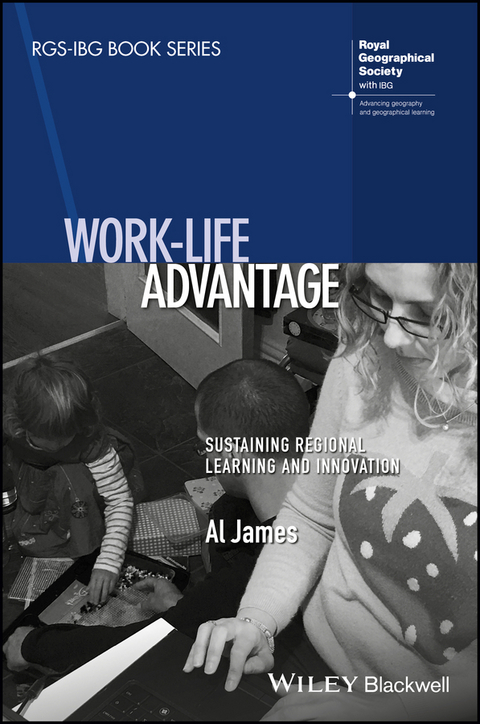
Work-Life Advantage (eBook)
John Wiley & Sons (Verlag)
978-1-118-94481-3 (ISBN)
Work-Life Advantage analyses how employer-provision of 'family-friendly' working arrangements - designed to help workers better reconcile work, home and family - can also enhance firms' capacities for learning and innovation, in pursuit of long-term competitive advantage and socially inclusive growth.
- Brings together major debates in labour geography, feminist geography, and regional learning in novel ways, through a focus on the shifting boundaries between work, home, and family
- Addresses a major gap in the scholarly research surrounding the narrow 'business case' for work-life balance by developing a more socially progressive, workerist 'dual agenda'
- Challenges and disrupts masculinist assumptions of the 'ideal worker' and the associated labour market marginalization of workers with significant home and family commitments
- Based on 10 years of research with over 300 IT workers and 150 IT firms in the UK and Ireland, with important insights for professional workers and knowledge-intensive companies around the world
Al James is Reader in Economic Geography at Newcastle University, UK. His research interests include gendered labour geographies of work-life and socially inclusive growth; the regional cultural economy of learning and innovation; and the hybrid economic/development geographies of India's new service economy. His work has been funded by the UK's Economic and Social Research Council, Nuffield Foundation, Arts and Humanities Research Council and Isaac Newton Trust. He has published in a wide range of leading international journals, including Progress in Human Geography, Journal of Economic Geography, Regional Studies, Geoforum, Gender Work and Organization, Gender Place and Culture, Environment and Planning A and Development and Change. From 2008-2011, he was Secretary of the RGS-IBG's Economic Geography Research Group.
Work-Life Advantage analyses how employer-provision of family-friendly working arrangements - designed to help workers better reconcile work, home and family - can also enhance firms capacities for learning and innovation, in pursuit of long-term competitive advantage and socially inclusive growth. Brings together major debates in labour geography, feminist geography, and regional learning in novel ways, through a focus on the shifting boundaries between work, home, and family Addresses a major gap in the scholarly research surrounding the narrow business case for work-life balance by developing a more socially progressive, workerist dual agenda Challenges and disrupts masculinist assumptions of the ideal worker and the associated labour market marginalization of workers with significant home and family commitments Based on 10 years of research with over 300 IT workers and 150 IT firms in the UK and Ireland, with important insights for professional workers and knowledge-intensive companies around the world
Al James is Reader in Economic Geography at Newcastle University, UK. His research interests include gendered labour geographies of work-life and socially inclusive growth; the regional cultural economy of learning and innovation; and the hybrid economic/development geographies of India's new service economy. His work has been funded by the UK's Economic and Social Research Council, Nuffield Foundation, Arts and Humanities Research Council and Isaac Newton Trust. He has published in a wide range of leading international journals, including Progress in Human Geography, Journal of Economic Geography, Regional Studies, Geoforum, Gender Work and Organization, Gender Place and Culture, Environment and Planning A and Development and Change. From 2008-2011, he was Secretary of the RGS-IBG's Economic Geography Research Group.
List of Figures viii
List of Tables ix
Series Editor's Preface xi
Preface and Acknowledgements xii
List of Abbreviations xv
1 Inclusive Regional Learning? 1
2 Recentering Regional Learning: Beyond Masculinist Geographies of Regional Advantage 16
3 Work?]Life Balance and its Uncertain 'Business Case' 38
4 Researching Labour Geographies of Work?-Life and Learning in Ireland and the UK 67
5 Juggling Work, Home and Family in the Knowledge Economy 86
6 Overcoming Work?-Life Conflict and the Gendered Limits to Learning and Innovation? 117
7 Work?-Life Balance, Cross?-Firm Worker Mobility and Gendered Knowledge Spillovers 145
8 Conclusions: Gendered Regional Learning and Work?-Life Advantage 176
References 197
Index 000
'Who thought the topic of work-life balance could be so interesting? Al James makes it riveting. His sometimes-poignant, sometimes heart-rending, sometimes outrageous (how can they get away with that?) stories of the collision of work lives and every-day lives of high-tech workers in Dublin and Cambridge make for utterly compelling reading. James' ability to bring together seamlessly gender, work, corporate life, and the geography of the everyday is a great achievement. It exemplifies yet again the power of economic geography in understanding crucial issues of our present moment.'
Trevor Barnes, Professor of Geography, Department of Geography, University of British Columbia, Canada
'The changing nature of employment, the growing diversity of the workforce and the implications for individuals and households are the questions of our time. In this fascinating book, feminist and regional economics meet head-on as James provides insights into the implications of the growth of 'knowledge work' for firms and for families in Cambridge and Dublin.'
Linda McDowell, Research Professor of Geography, University of Oxford and Honorary Professor of Geography, University of Exeter, U
Chapter One
Inclusive Regional Learning?
Introduction
The fruits of a rapidly growing economy based on innovations and hard work are patently obvious. Less obvious are the costs absorbed by individuals as they take on the attributes required to succeed … Sustaining the new economy means building a new set of social institutions to support it.
(Carnoy 2002: x)
‘It’s important that people talk about these work‐life challenges. There are a lot of women, like myself, who are just so busy getting on with it, just so busy just trying to stay quiet. This type of material, it needs to be fed back, people need to stop and think about it’. Software Business Development Manager, female, two young children, 3‐day work week, IT MNC, Dublin
Over the last two decades, the shifting spatial and temporal boundaries between work, home and family that have accompanied the transition to the so‐called ‘new economy’ have been hotly debated. As firms reorganise work in response to globalisation and new technological opportunities, ‘flexibility’ for many workers has come to mean increased workloads, less predictable work schedules and more unsocial work hours as firms demand they work longer and harder to minimise labour costs. Simultaneously, household life has also become more complex as female labourforce participation rates continue to grow and an ever‐increasing proportion of workers are part of dual‐earner households. These problems are reinforced by the decline of the extended family, increasing lone‐parent households and greater eldercare responsibilities through increased life expectancy. Simultaneously, the neoliberal attack on social provisioning has transferred the burden of care down to the ‘natural’ level of home (Bakker and Gill 2003) where most women retain the major responsibility for the ‘messy and fleshy’ components of domestic and family life (Katz 2001; Crompton and Brockmann 2006). The overall result is a complex, gendered, multi‐variable balancing act between the competing demands of paid work and responsibilities, commitments and life interests beyond the workplace, for which workers have only ‘finite resources in terms of time and energy’ (Cooper et al. 2001: 50).
In response, the desirability and means of achieving an appropriate ‘work‐life balance’ (WLB) has received widespread attention from governments, managers, trade unions, academics and the media. At the individual level, WLB refers to ‘the absence of unacceptable levels of conflict between work and non‐work demands’ (Greenblatt 2002: 179). While encompassing earlier family‐friendly perspectives, the work‐life balance term was intended to broaden the debate beyond working mothers to include all workers, and hence a wider diversity of personal life needs, interests and responsibilities such as religious attendance, sports, hobbies, and community and charity work. Alternative WLB monikers include work‐life reconciliation, work‐personal life integration, work‐personal life harmonisation and work‐life articulation. But whatever the label used, the societal and moral significance of the successful integration of paid work with other meaningful parts of life is profound. Study after study has documented how a lack of work‐life balance can result in increased stress, deleterious effects on psychological and physical well‐being, and increased family and marital tensions (e.g. Burchell et al. 1999, 2002; Frone et al. 1994; Lewis and Cooper 1999; Scase and Scales 1998). Moreover, given persistent gender variations in work‐life stress as women make the greatest compromises to fit paid work around family (Moen 2003; McDowell et al. 2005), studies have also highlighted the importance of work‐life provision by employers as a means for improving gender equity in market employment and household caring (Wise and Bond 2003; World Economic Forum 2005). The labour movement has also emphasised the social importance of WLB as a means of improving workers’ quality of life and combating the increasing work pressures that are destabilising households and societal integration.
Employer‐provided WLB arrangements are typically split across four categories, in terms of those providing workers with greater temporal flexibility of work, greater spatial flexibility of work, reduced total work hours and childcare assistance. But despite government efforts, evidence of progress in employers providing comprehensive suites of work‐life arrangements remains uneven, resulting in continuing hardship for many workers and their families. Indeed, these problems have also been exacerbated in the aftermath of the ‘global’ economic downturn which created new gendered work‐life demands through rapid and dramatic labour market change, heightened fears of job loss, increased workloads and understaffing (e.g. Fawcett Society 2009; TUC 2009). With employers keen to effect cost savings, workplace arrangements designed to help reconcile workers’ competing commitments around work, home and family have not been immune (Galinksy and Bond 2009). At the heart of this disjuncture, many scholars argue that employers are simply unlikely to implement meaningful WLB arrangements unless they can identify bottom‐line economic advantages that arise from doing so (e.g. Healy 2004; Hyman and Summers 2004; Dex and Scheibl 1999; Dex and Smith 2002). Importantly, this ‘WLB business case’ also lies at the heart of UK, Irish and US government policy interventions in this area, with employer benefits from WLB provision widely touted by policy‐makers as improved recruitment, retention, morale and productivity, and reduced stress, absenteeism and costs. Yet despite its popularity, there remains a relative dearth of empirical evidence to support these claims in practice (Beauregard and Henry 2009). In addition, ‘few scholars have demonstrated the mechanisms through which such [WLB] policies function (or do not) to enhance firm performance’ (Eaton 2003: 145–146).
Work‐Life Advantage takes issue with this major knowledge gap and its negative social consequences for workers and their families, whose collective labours are ultimately responsible for (re)producing and sustaining some of the world’s most high‐profile high‐tech regional economies. In so doing, the book develops a new analytical approach that connects the burgeoning research agenda on gendered labour geographies of work‐life balance, social reproduction and care with an equally expansive research agenda on regional learning and innovation. Importantly, both agendas ultimately respond to the emergence of ‘flexible’ production processes in the wake of Fordism from the late 1970s onwards: one then exploring the territorial forms of flexible production (firm‐centric focus), and the other, dramatic changes in the organisation of flexible paid work and working times as experienced by workers and their families (workerist focus). Yet despite these common roots, these two research agendas remain oddly disconnected. In seeking to bridge them, the hybrid analysis developed in this book answers four major research questions. What are the common, everyday experiences and outcomes of gendered work‐life conflict amongst knowledge workers and their families in high‐tech regional economies? What kinds of employer‐provided WLB arrangements do different cohorts of knowledge workers find most useful in overcoming those conflicts? How does the uptake of these worker‐preferred WLB arrangements enhance (vs. constrain) the kinds of intra‐firm and cross‐firm learning and innovation processes widely identified as enabling regional advantage? And do those WLB learning outcomes vary both within and between regional economies, particularly as a function of national welfare regimes? In so doing, the book responds to earlier calls by Lewis et al. (2003) to develop a ‘dual agenda’ that moves beyond either/or thinking to consider both business and social imperatives in pursuit of optimal work‐life balance outcomes, set within a regional learning framework.
This analysis is developed through a case study of information technology (IT) workers and firms in Dublin, Ireland and Cambridge, UK prior to and after the onset of the Great Recession in 2008. Crucially, both regions have figured prominently in regional learning and innovation studies to date, and are recognised as important European clusters of IT growth of interest to policy‐makers elsewhere. Additionally, IT represents a knowledge‐intensive industry at the vanguard of new working practices, in which firms compete to bring new products to market quickest and in which ‘work’ and ‘life’ are significantly blurred. Work‐life balance has also come to assume a strong national significance in both Ireland and the UK, as a function of long average work hours relative to other EU member states. The book builds on 10 years of research, including an ESRC‐funded research project (2006–2009): The Impacts of Work‐Life (Im)Balance on Innovation and Learning in Regional Economies (RES‐000‐22‐1574‐A). Its critical analysis draws on a rich, multi‐method evidence base comprising two regional surveys of IT employers (150 firms with combined local employment of 8,068 workers); 68 in‐depth interviews with female and...
| Erscheint lt. Verlag | 24.10.2017 |
|---|---|
| Reihe/Serie | RGS-IBG Book Series |
| RGS-IBG Book Series | RGS-IBG Book Series |
| Sprache | englisch |
| Themenwelt | Naturwissenschaften ► Geowissenschaften ► Geografie / Kartografie |
| Sozialwissenschaften ► Politik / Verwaltung | |
| Sozialwissenschaften ► Soziologie ► Mikrosoziologie | |
| Wirtschaft ► Betriebswirtschaft / Management ► Personalwesen | |
| Schlagworte | alternative working arrangements • Economic Geography • European politics • Family Well-being • Feminist geography • Gender Inequality • Geographie • Geography • Innovation • Political Geography • Political Science • Politik • Politik / Europa • Politikwissenschaft • Politische Geographie • quality of life • regional learning • Social & Cultural Geography • Sozio- u. Kulturgeographie • work-life balance |
| ISBN-10 | 1-118-94481-X / 111894481X |
| ISBN-13 | 978-1-118-94481-3 / 9781118944813 |
| Informationen gemäß Produktsicherheitsverordnung (GPSR) | |
| Haben Sie eine Frage zum Produkt? |
 EPUB (Adobe DRM)
Kopierschutz: Adobe-DRM
Adobe-DRM ist ein Kopierschutz, der das eBook vor Mißbrauch schützen soll. Dabei wird das eBook bereits beim Download auf Ihre persönliche Adobe-ID autorisiert. Lesen können Sie das eBook dann nur auf den Geräten, welche ebenfalls auf Ihre Adobe-ID registriert sind.
Details zum Adobe-DRM
Dateiformat: EPUB (Electronic Publication)
EPUB ist ein offener Standard für eBooks und eignet sich besonders zur Darstellung von Belletristik und Sachbüchern. Der Fließtext wird dynamisch an die Display- und Schriftgröße angepasst. Auch für mobile Lesegeräte ist EPUB daher gut geeignet.
Systemvoraussetzungen:
PC/Mac: Mit einem PC oder Mac können Sie dieses eBook lesen. Sie benötigen eine
eReader: Dieses eBook kann mit (fast) allen eBook-Readern gelesen werden. Mit dem amazon-Kindle ist es aber nicht kompatibel.
Smartphone/Tablet: Egal ob Apple oder Android, dieses eBook können Sie lesen. Sie benötigen eine
Geräteliste und zusätzliche Hinweise
Buying eBooks from abroad
For tax law reasons we can sell eBooks just within Germany and Switzerland. Regrettably we cannot fulfill eBook-orders from other countries.
aus dem Bereich