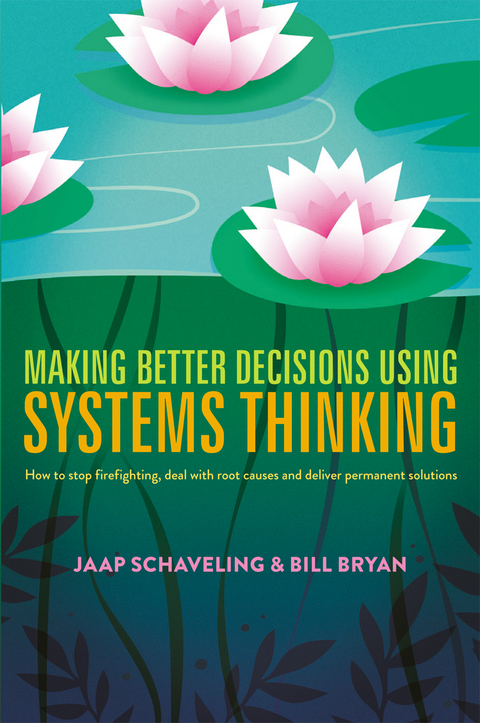
Making Better Decisions Using Systems Thinking (eBook)
173 Seiten
Springer International Publishing (Verlag)
978-3-319-63880-5 (ISBN)

This book provides a framework to help managers go beyond simply fighting fires every day, offering the tools to address the underlying causes of recurring problems and deliver long-term solutions.
The most obvious part of any problem is the pain it causes. The desire to end the pain and find a solution – any solution – that will make it go away now is usually so great that it blinds managers to the underlying systemic cause of the problem. The result is that we ‘solve’ the problem today and then it comes back again tomorrow or next week, again and again.
We are only addressing the symptoms but never understanding the cause – like picking the flower heads off weeds but not digging them out at the roots.
Schaveling and Bryan offer the insights and tools managers and leaders need to achieve a longer term and more effective approach by stepping back and analysing the system as a whole. And at the heart of any system are human beings – notoriously short-term and pain-averse creatures who will behave in whatever way minimises pain today even at the expense of pain tomorrow.
They show how to detect the behavior patterns that have become engrained in the organisation and which underlie complex situations so that root causes of problems can be identified. Once the system responsible for the problem is understood smarter decisions can be made to devise interventions that solve the core problem instead of wasting energy fighting the symptoms.
Dr. Jaap Schaveling (Dutch, 1956) is associate professor Leadership & Cooperation. He teaches Cooperation on team, organization and inter-organizational level, Social Psychology, Organizational Dynamics and Leadership. As a business coach he facilitates the management teams of various companies. His research work at this moment is about multiparty situations, inter-team processes, innovative behavior and higher order skills. His mission is to co-create living teams and organizations i.e. to stimulate teams and organizations to develop into learning and sustainable bodies by strengthening certain disciplines, in particular personal mastery, social psychology, organizational dynamics and systems thinking.Bill Bryan is a now-retired plant manager of large chemical plants. He studied chemistry at Leiden University and forged a career in the chemical industry with DSM. Starting in fundamental research and then moving onto big semi-industrial development projects, Bryan specialized in basic materials like solvents, melamine and caprolactam. From there he moved his career towards the production plants of ABS and PVC. Last years of career he spent as management consultant.
1. Making better decisions using Systems Thinking2. What is systems thinking? Looking at the whole picture Unintended side effects Uncover the underlying dynamics Looking below the surface of the lily pond Reacting Adaptation 3. The evolutionary heritage Reacting Two systems Theory of reality Compression of data Groupsize 4. Good management: dealing wisely with dilemmas Time dilemma: Do you make short- or long-term choices? Scope dilemma: Do you choose a narrow or a broad scope? Awareness dilemma: do you choose to face the facts or take refuge in fantasies? Dealing with dilemmas: leadership and wisdom Leadership What should we understand by wisdom? Dealing wisely with organisations 5. A systemic view of organisations Reinforcing effects: why do things get out of hand? The Pygmalion effect: higher expectations lead to higher performance Exponential growth Balancing feedback: why things don’t budge 6. Impatient managers create chaos The effects of time delays Systems thinking and time delays What are our steering criteria? 7. The Value Creation Model What is the Value Creation Model? Why, What, How Creating value with distinctive competences Internal and external developments The strategic function typology 8. The value creation model in action Laboratory for bakery ingredients Employment agency for surveillance duties Public agency Dealing wisely with your reinforcing loop Pitfalls 9. What has been done when the work is done? The current situation The vision And what do you do next? 10. Driving forces that generate and sustain patterns Genetic disposition and system Our early years and system Our tribe and system The rational system Vision Reality check 11. Two driving forces in depth: Mental models and Team learning Mental models: what are the dominant mental models? Team learning: which group dynamics play a role? The results of our dive into the lily pond 12. Looking under the surface of the lily pond: Applying systems thinking in six steps Going under the water level: assessing reality and the driving structure Step 1: tell the whole story Step 2: describe the behaviour over time in graphs Step 3: formulate the focusing question and your scope Step 4: identify archetypes or fixed patterns Step 5: increase your understanding by looking closer at the driving forces Step 6: planning an intervention 13. Pitfalls of short time horizon Fixes that backfire Shifting the burden 14. Pitfalls of not looking far enough around you Escalation Success to the successful 15. Pitfalls of fear of facing reality Drifting goals Limits to growth 16. Pitfall of a combination of short time horizon and not looking far enough around you Accidental adversaries Not building trust 17. Pitfalls of a combination of short time horizon, not looking far enough around you and fear of facing reality Growth and under-investment Tragedy of the commons 18. Adaptive leadership Sit still Know the value creation model of your organisation Don’t think you can make the system perfect Sometimes you have to begin a new system or organisation Think holistically: keep the whole system in mind Make an honest assessment of the situation Discover the hidden assumptions; verify if everybody is discussing the same subject Bring the whole system into the room Look for actions with leverage; don’t use a bigger hammer Ask yourself the questions of the system thinker 19. Systemic Pitfalls in Cooperation; The pitfalls from a bird’s eye view..... The Value Creation Model Fixes that backfire Shifting the burden Escalation Success to the successful Drifting goals Limits to growth Accidental adversaries Growth and underinvestment Tragedy of the commons The patterns from a bird’s eye view on 1 A4 References Annexe: Language of systems thinking Variables and causal relations Causal relations: same and opposite Looping technique
| Erscheint lt. Verlag | 26.10.2017 |
|---|---|
| Zusatzinfo | XV, 173 p. 72 illus. |
| Verlagsort | Cham |
| Sprache | englisch |
| Themenwelt | Wirtschaft ► Allgemeines / Lexika |
| Wirtschaft ► Betriebswirtschaft / Management ► Planung / Organisation | |
| Wirtschaft ► Betriebswirtschaft / Management ► Wirtschaftsinformatik | |
| Schlagworte | Decision Making • Pareto Diagrams • Problem Solving • Root Causes • System Thinking |
| ISBN-10 | 3-319-63880-7 / 3319638807 |
| ISBN-13 | 978-3-319-63880-5 / 9783319638805 |
| Informationen gemäß Produktsicherheitsverordnung (GPSR) | |
| Haben Sie eine Frage zum Produkt? |
 PDF (Wasserzeichen)
DRM: Digitales Wasserzeichen
Dieses eBook enthält ein digitales Wasserzeichen und ist damit für Sie personalisiert. Bei einer missbräuchlichen Weitergabe des eBooks an Dritte ist eine Rückverfolgung an die Quelle möglich.
Dateiformat: PDF (Portable Document Format)
Mit einem festen Seitenlayout eignet sich die PDF besonders für Fachbücher mit Spalten, Tabellen und Abbildungen. Eine PDF kann auf fast allen Geräten angezeigt werden, ist aber für kleine Displays (Smartphone, eReader) nur eingeschränkt geeignet.
Systemvoraussetzungen:
PC/Mac: Mit einem PC oder Mac können Sie dieses eBook lesen. Sie benötigen dafür einen PDF-Viewer - z.B. den Adobe Reader oder Adobe Digital Editions.
eReader: Dieses eBook kann mit (fast) allen eBook-Readern gelesen werden. Mit dem amazon-Kindle ist es aber nicht kompatibel.
Smartphone/Tablet: Egal ob Apple oder Android, dieses eBook können Sie lesen. Sie benötigen dafür einen PDF-Viewer - z.B. die kostenlose Adobe Digital Editions-App.
Buying eBooks from abroad
For tax law reasons we can sell eBooks just within Germany and Switzerland. Regrettably we cannot fulfill eBook-orders from other countries.
aus dem Bereich