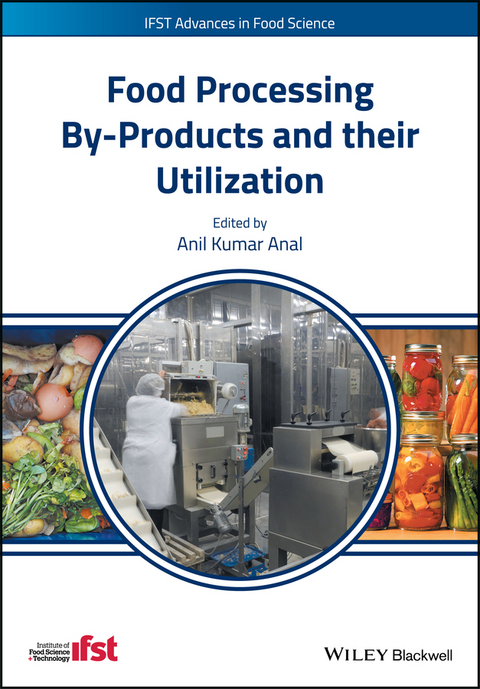
Food Processing By-Products and their Utilization (eBook)
John Wiley & Sons (Verlag)
978-1-118-43289-1 (ISBN)
Food Processing By-Products and their Utilization
An in-depth look at the economic and environmental benefits that food companies can achieve-and the challenges and opportunities they may face-by utilizing food processing by-products
Food Processing By-Products and their Utilization is the first book dedicated to food processing by-products and their utilization in a broad spectrum. It provides a comprehensive overview on food processing by-products and their utilization as source of novel functional ingredients. It discusses food groups, including cereals, pulses, fruits, vegetables, meat, dairy, marine, sugarcane, winery, and plantation by-products; addresses processing challenges relevant to food by-products; and delivers insight into the current state of art and emerging technologies to extract valuable phytochemicals from food processing by-products.
Food Processing By-Products and their Utilization offers in-depth chapter coverage of fruit processing by-products; the application of food by-products in medical and pharmaceutical industries; prebiotics and dietary fibers from food processing by-products; bioactive compounds and their health effects from honey processing industries; advances in milk fractionation for value addition; seafood by-products in applications of biomedicine and cosmeticuals; food industry by-products as nutrient replacements in aquaculture diets and agricultural crops; regulatory and legislative issues for food waste utilization; and much more.
- The first reference text to bring together essential information on the processing technology and incorporation of by-products into various food applications
- Concentrates on the challenges and opportunities for utilizing by-products, including many novel and potential uses for the by-products and waste materials generated by food processing
- Focuses on the nutritional composition and biochemistry of by-products, which are key to establishing their functional health benefits as foods
- Part of the 'IFST Advances in Food Science' series, co-published with the Institute of Food Science and Technology (UK)
This bookserves as a comprehensive reference for students, educators, researchers, food processors, and industry personnel looking for up-to-date insight into the field. Additionally, the covered range of techniques for by-product utilization will provide engineers and scientists working in the food industry with a valuable resource for their work.
About the Editor
Anil Kumar Anal, is Associate Professor and Head of the Department of Food, Agriculture and Bioresources, School of Environment, Resources and Development, at the Asian Institute of Technology (AIT), Thailand
Food Processing By-Products and their Utilization An in-depth look at the economic and environmental benefits that food companies can achieve and the challenges and opportunities they may face by utilizing food processing by-products Food Processing By-Products and their Utilization is the first book dedicated to food processing by-products and their utilization in a broad spectrum. It provides a comprehensive overview on food processing by-products and their utilization as source of novel functional ingredients. It discusses food groups, including cereals, pulses, fruits, vegetables, meat, dairy, marine, sugarcane, winery, and plantation by-products; addresses processing challenges relevant to food by-products; and delivers insight into the current state of art and emerging technologies to extract valuable phytochemicals from food processing by-products. Food Processing By-Products and their Utilization offers in-depth chapter coverage of fruit processing by-products; the application of food by-products in medical and pharmaceutical industries; prebiotics and dietary fibers from food processing by-products; bioactive compounds and their health effects from honey processing industries; advances in milk fractionation for value addition; seafood by-products in applications of biomedicine and cosmeticuals; food industry by-products as nutrient replacements in aquaculture diets and agricultural crops; regulatory and legislative issues for food waste utilization; and much more. The first reference text to bring together essential information on the processing technology and incorporation of by-products into various food applications Concentrates on the challenges and opportunities for utilizing by-products, including many novel and potential uses for the by-products and waste materials generated by food processing Focuses on the nutritional composition and biochemistry of by-products, which are key to establishing their functional health benefits as foods Part of the "e;IFST Advances in Food Science"e; series, co-published with the Institute of Food Science and Technology (UK) This bookserves as a comprehensive reference for students, educators, researchers, food processors, and industry personnel looking for up-to-date insight into the field. Additionally, the covered range of techniques for by-product utilization will provide engineers and scientists working in the food industry with a valuable resource for their work.
About the Editor Anil Kumar Anal, is Associate Professor and Head of the Department of Food, Agriculture and Bioresources, School of Environment, Resources and Development, at the Asian Institute of Technology (AIT), Thailand
Chapter 1
Food Processing By-Products and their Utilization: Introduction
Anil Kumar Anal
Asian Institute of Technology, Klong Luang, Pathumthani, Thailand
1.1 Introduction
Food industries are growing rapidly to huge numbers due to globalization and population increase and are providing a wider range of food products to satisfy the needs of the consumers. The major food industries of the world include dairy, fruits and vegetables, meat and poultry, seafood and cereal. However, these industries generate huge amounts of by-products and wastes, which consist of high amounts of organic matter leading to problems regarding disposal, environmental pollution and sustainability (Russ and Pittroff, 2004). In addition, there is the loss of biomass and valuable nutrients that can be used for developing value-added products. Food industries are currently focusing on solving the problems of waste management and recycling by valorization, i.e. utilization of the by-products and discarded materials and developing new value-added products from them for commercial applications. Waste valorization is an interesting new concept that offers a range of alternatives for management of waste other than disposal or land-filling. Valorization allows exploration of the possibility of reusing nutrients in the production of main products, and thus highlights the potential gains that can be achieved. Traditional methods of waste utilization include their use as animal feed, fertilizer or disposal (Jayathilakan et al., 2012). However, their use has been limited due to legal restrictions, ecological problems and cost issues. Therefore, efficient, cheap and ecologically sound methods for utilization of wastes are being focused upon, which can minimize the quantities of wastes exposed to the environment and the subsequent health hazards.
Wastes from the food industries generally comprise of dietary fibers, proteins and peptides, lipids, fatty acids and phenolic compounds, depending on the nature of the product produced. For example, the wastes from meat and poultry industries comprise of proteins and lipids, while waste from fruit and vegetable processing industries and cereal industries comprise of phenolic compounds and dietary fibers. The recovery of these bioactive compounds is important for their commercialization, so that they can be utilized as nutraceuticals and pharmaceutical products.
1.2 Food Processing Wastes and By-Products for Industrial Applications
Food-processing wastes and by-products are generated during processing of the various food products by the industries, which have not already been used for other purposes and have not been recycled. Crude raw materials such as cereals, fruits, vegetables and animals are processed to final products with the production of large amounts of materials in the form of wastes (Ezejiofor et al., 2014). These wastes emerging from the food processing industries differ from one another, depending on the type of product being produced and the production technique used. Even the amount and concentrations of wastes differ and do not remain constant. For example, wastes from the fruit and vegetable processing industries comprise of high concentrations of polyphenols and dietary fibers, whereas wastes from meat processing industries comprise of high protein and fat content. The food processing wastes also possess characteristics, such as large amounts of organic materials in the form of lipids, proteins and carbohydrates and high chemical oxygen demand (COD) and biochemical oxygen demand (BOD) (Ezejiofor et al., 2014). Hence, they are harmful and affect the environment and human health. Appropriate technologies that focus on their reuse for creation of valuable products, whose costs exceed the costs of reprocessing, should be considered. The different types of wastes produced by the different food processing industries are listed in Table 1.1.
Table 1.1 Different food processing industries and their wastes (Ezejiofor et al., 2014)
| Food processing industry | Waste materials generated |
| Cereal processing Fruits and vegetable processing | Husks, hull, rice bran Skin, peels, pulp, seeds, stem, fiber |
| Poultry processing | Skin, bones, blood, feathers, liver, intestines |
| Marine products processing | Viscera, heads, backbones, blood and shells |
| Dairy products processing | Whey, lactose |
1.3 By-Products from Cereal Processing Industries
Cereals are the edible seeds derived from plants, which are a good source of carbohydrates. They contribute to 60% of the total world food production (Krishna and Chandrasekaran, 2013), with the main seeds being maize and wheat. Wastes from cereal processing are produced during the harvesting period, post-harvesting and the production period. Presently, these by-products are used as animal feed. However, they need to be utilized more efficiently as they comprise of proteins, dietary fibers and small amounts of unsaturated fatty acids.
Rice bran is an important cereal industry by-product, which is generated during the production of white rice. It is generated during the milling process, where it is separated from the rice to produce white rice. The rice bran production is 60–66 million tonnes annually (Ryan, 2011) and it is mostly used as animal feed or in the production of edible cooking oil. Rice bran is a rich source of nutrients, proteins and peptides, with a wide range of nutritional and functional applications. Defatted rice bran is another by-product, which is produced after oil extraction from the rice bran, also a good source of proteins and dietary fibers (Anal, 2013a). It are currently being utilized in food supplements and in the production of bakery items.
1.4 Fruits and Vegetables By-Products
The world production of fruits and vegetables has increased rapidly. As crop production increases, there is a concomitant increase in the quantity of by-products generated (FAO, 2009). The fruit and vegetable processing by-products are regarded as waste and disposed of in the environment, which causes ecosystem problems as they are prone to microbial degradation. However, fruit and vegetable by-products and wastes are very good sources of bioactive compounds, such as dietary fibers and phenolic compounds with antibacterial, cardio-protective and antitumor activities (Khao and Chen, 2013). Efforts are being made to develop methods to reuse these wastes and by-products by obtaining bioactive compounds for health benefits, profit-making and allowing their environmental-friendly disposal.
The total worldwide production of citrus fruits was reported as 7.78 million tonnes in 2009 (FAO, 2009). These include oranges, lemons, grapefruits and limes They are commonly used forms are as fresh pulps or juice, but following their processing, the by-products such as peels, pulp and seeds remain that make up 50% of the fresh fruit weight (Khao and Chen, 2013). From these wastes, fibers, flavanoids, pectins and limonene can be produced. The major flavanoids found in the citrus peels and seeds include hesperidin, narirutin, naringin and eriocitrin (Mouly et al., 1994). These flavanoids have found to have antioxidant activities (Manthey et al., 2001). Limonin, nimolin and nomilinic acid are major limonoids found mainly in the peels, and demonstrate antibacterial, antiviral and antimicrobial activities (Djilas et al., 2009).
Banana is the largest growing tropical fruit following citrus fruits, contributing to 16% of total fruit production worldwide (Mohapatra et al., 2010). Waste from banana products includes the peels that represent about 40% of the total weight of the fresh bananas (Tchobanoglous et al., 1993). These peels are utilized in animal feed and the preparation of banana chips and banana powder. However, still huge amounts of the peels are being under-utilized and disposed of, resulting in environmental pollution. These banana wastes contain dietary fibers, proteins and different bioactive compounds such as phenolic compounds with reported antioxidant activities (Anal et al., 2014). Hence they need to be recycled so that they can be used for producing various valuable products.
Mango (Mangifera indica L., Anacardiaceae) is a common seasonal fruit, which is mainly processed to produce products such as juices, pickles, purees and canned products (Aslam et al., 2014). Recent researches have indicated that mango wastes, which mostly include the peels (7–24%) and the kernels (9–40%), are good sources of bioactive compounds. The mango peels comprise of functional compounds such as polyphenols, carotenoids, vitamins C and E, dietary fibers and natural antioxidants (Ajila et al., 2007), whereas the kernels are sources of essential amino acids like lysine, valine and leucine (Abdalla et al., 2007), phenolic compounds, edible oils and high amounts of unsaturated fatty acids. These wastes show huge potential to be used as valuable ingredients for the purpose of making functional foods.
Mangosteen (Garcinia mangostana L) is a popular fruit of several Asian countries. However, the increasing consumption of this fruit has led to the generation of ample abandoned mangosteen pericarps. It has been reported that 10 kg of harvested mangosteens lead to the generation of about 6 kg of pericarps (Mohammad et al., 2014). These pericarps are woody in texture,...
| Erscheint lt. Verlag | 23.10.2017 |
|---|---|
| Reihe/Serie | IFST Advances in Food Science |
| IFST Advances in Food Science | IFST Advances in Food Science |
| Sprache | englisch |
| Themenwelt | Naturwissenschaften ► Biologie |
| Technik ► Lebensmitteltechnologie | |
| Wirtschaft ► Betriebswirtschaft / Management | |
| Weitere Fachgebiete ► Land- / Forstwirtschaft / Fischerei | |
| Schlagworte | bioactive phytochemicals • biocapsules • bioenergy • bioprocessing of beverage industry waste • bioprocessing of food • Bioprocess Technology • by-product generation • by-products as waste materials • by-products utilization • by-product utilisation • food by-products • food engineering • food industry • Food Marketing & Product Development • Food Processing • Food Processing by-products • Food Processing By-Products and their Utilization • Food Processing, Production & Manufacture • food processing waste management • food processors • food production • food science • Food Science & Technology • Food waste • Herstellung u. Verarbeitung von Lebensmitteln • Lebensmittelforschung u. -technologie • Lebensmitteltechnik • Lebensmittelverarbeitung • Lebensmittel-Vermarktung u. -Produktentwicklung • meat waste bioprocessing • micro-/nanoencapsulation technology • Microspheres • non-waste by-products • Probiotics • processing by-products • secondary metabolites • utilization of by-products • valorization of food waste • waste material treatment • Waste Utilization |
| ISBN-10 | 1-118-43289-4 / 1118432894 |
| ISBN-13 | 978-1-118-43289-1 / 9781118432891 |
| Informationen gemäß Produktsicherheitsverordnung (GPSR) | |
| Haben Sie eine Frage zum Produkt? |
 EPUB (Adobe DRM)
Kopierschutz: Adobe-DRM
Adobe-DRM ist ein Kopierschutz, der das eBook vor Mißbrauch schützen soll. Dabei wird das eBook bereits beim Download auf Ihre persönliche Adobe-ID autorisiert. Lesen können Sie das eBook dann nur auf den Geräten, welche ebenfalls auf Ihre Adobe-ID registriert sind.
Details zum Adobe-DRM
Dateiformat: EPUB (Electronic Publication)
EPUB ist ein offener Standard für eBooks und eignet sich besonders zur Darstellung von Belletristik und Sachbüchern. Der Fließtext wird dynamisch an die Display- und Schriftgröße angepasst. Auch für mobile Lesegeräte ist EPUB daher gut geeignet.
Systemvoraussetzungen:
PC/Mac: Mit einem PC oder Mac können Sie dieses eBook lesen. Sie benötigen eine
eReader: Dieses eBook kann mit (fast) allen eBook-Readern gelesen werden. Mit dem amazon-Kindle ist es aber nicht kompatibel.
Smartphone/Tablet: Egal ob Apple oder Android, dieses eBook können Sie lesen. Sie benötigen eine
Geräteliste und zusätzliche Hinweise
Buying eBooks from abroad
For tax law reasons we can sell eBooks just within Germany and Switzerland. Regrettably we cannot fulfill eBook-orders from other countries.
aus dem Bereich