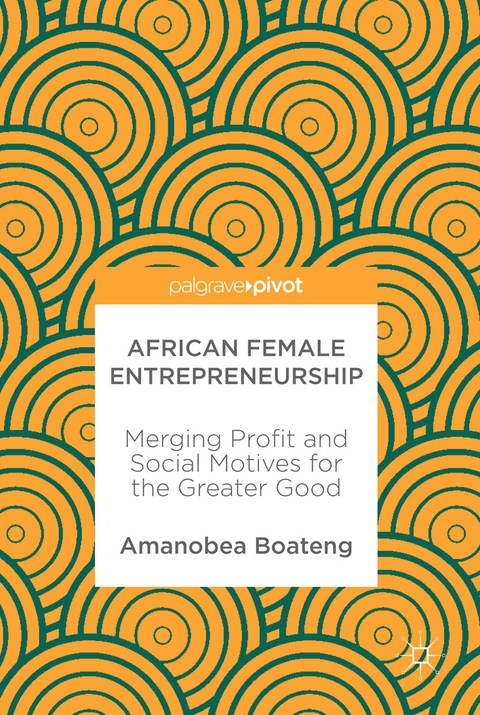
African Female Entrepreneurship (eBook)
XIX, 146 Seiten
Springer International Publishing (Verlag)
978-3-319-65846-9 (ISBN)
Contributing to academic discussions on entrepreneurship and gender in Africa, this book provides coverage of recent trends and an exploration of the evolution of female entrepreneurship over time. This innovative new text, written from an African woman's perspective, fills a gap in the current literature on this topic and places important focus on the role of female entrepreneurship in Africa's development as a continent. Focussing on key issues such as social feminism and the capability approach, the author addresses the possibility of a potential overlap between social entrepreneurship and female entrepreneurship in Africa. Insightful accounts of women from countries such as South Africa, Namibia and Ghana, along with theoretical research into the further development and advancement of female entrepreneurs, make this book an important must-read for those interested in entrepreneurship and gender in Africa.
Amanobea Boateng holds a doctorate in Business Administration from the Grenoble Ecole de Management, France.
Amanobea Boateng holds a doctorate in Business Administration from the Grenoble Ecole de Management, France.
Foreword 5
Acknowledgements 9
Contents 10
List of Figures 11
Introduction 12
Part I Setting the Scene 17
1 Contextualising Women’s Entrepreneurship in Africa 18
Abstract 18
1.1Why Does Female Entrepreneurship Matter? 19
1.2The Importance of Entrepreneurship to Africa 23
1.3Entrepreneurship Driving Growth and Development 26
1.4Trends in the Broader Entrepreneurship Literature Compared to Trends in African Entrepreneurship Research 31
1.5Tracing the Roots of African Female Entrepreneurship 38
1.6The Gendering of Women’s Enterprise and the Effects of Colonialism 40
Bibliography 44
2 A Theoretical Research Framework 49
Abstract 49
2.1An Integrated Framework for Female Entrepreneurship Research 50
2.2Value of Capability Approach, Social Feminism and Social Entrepreneurship to the Integrated Theoretical Framework 51
2.2.1The Capability Approach 51
2.2.2Social Feminism 52
2.2.3Social Entrepreneurship 53
2.2.4Resultant Framework and Expected Contribution 54
2.3The Elements of the Integrated Framework in More Depth 55
2.3.1The Capability Approach 55
2.3.2Debates Around the Capability Approach 61
2.3.3Social Feminism 61
Bibliography 68
Part II A Close-Up View of African Female Entrepreneurs 73
3 Female Entrepreneurship in Africa and Research Insights from Different Regions of the Continent 74
Abstract 74
3.1The Knowledge Debate and Research Trends from the Broader Literature 75
3.1.1Entrepreneurship Is a Gendered Phenomenon 77
3.1.2Entrepreneurship Is Embedded Within Families 77
3.1.3Entrepreneurship Results from Both Necessity and Opportunity 78
3.1.4Entrepreneurs Pursue Non-economic Goals 78
3.2Knowledge Debate and Research Trends in Africa 79
3.3Insights from African Female Entrepreneurs 83
3.3.1Capabilities Identified Among Women Entrepreneurs 83
Prior Work Experience 84
Self-Development 85
Networks 86
3.3.2Conversion Factors 88
Motivation 89
Male Life-Partner Dynamics 91
Challenges 92
Government Policies and Support Initiatives 93
Funding 95
Issues of Gender in Business Dealings 97
Females in Business 99
Issues of Womanhood 99
Culture 101
3.3.3Personal Ethos 103
Core Values 103
Business Culture/Model 104
Community/Other-Centric Involvement 106
Advice for Other Women 106
Impact of Spiritual Belief 107
Definition of Success and Fulfilment 109
Desired Functionings 109
Desired Capabilities 110
3.4The Entrepreneurial Journey 110
3.5The Working of the Female Entrepreneurship Development Pyramid 112
Bibliography 113
4 Social Entrepreneurship and the Possible Intersect with Female Entrepreneurship 115
Abstract 115
4.1Social Entrepreneurship—The Broader Knowledge Debate and the Relevance of Gender 116
4.2Social Entrepreneurship Research in the African Context 121
4.3Female Entrepreneurs Impacting the Lives of Others 125
4.4African Women Entrepreneurs as Hybrid Social Entrepreneurs 132
4.4.1Boosting the Socio-economic Development Potential of Women Entrepreneurs 133
Bibliography 134
5 A Theory for the Development of African Female Entrepreneurship 138
Abstract 138
5.1A Theory of Female Entrepreneurship Development and Poverty Alleviation Through Targeted Support 139
5.1.1Becoming an Entrepreneur 139
5.1.2Female Entrepreneurship Develops and Incorporates Life Enhancing Initiatives 140
5.1.3Increased Entrepreneurial Success Expands Potential to Positively Impact Others and Her Own Well-Being 141
5.1.4Interventions to Validate, Support and Optimise Her Role in Business will Extend Her Impact on Poverty 144
5.2Conclusion 145
5.2.1A Future Research Agenda for African Female Entrepreneurship 146
The History of Entrepreneurship and Female Entrepreneurship in Africa 146
Female Social Entrepreneurship in Africa 147
Female Entrepreneurship in Non Anglophone Africa 147
How Women Overcome Institutional Voids and Other Challenges to Become Successful 147
Women Entrepreneurs in Male-Dominated Sectors 148
Research on Entrepreneurship Education and Support for Women 148
Research on the Contribution of Entrepreneurs Returning from the Diaspora 148
Bibliography 149
Index 151
| Erscheint lt. Verlag | 11.10.2017 |
|---|---|
| Zusatzinfo | XIX, 146 p. 2 illus. |
| Verlagsort | Cham |
| Sprache | englisch |
| Themenwelt | Wirtschaft ► Betriebswirtschaft / Management ► Personalwesen |
| Schlagworte | African Culture • Capability Approach • Development • Economic Development • Emerging Markets • Gender • Social Entrepreneurship • social feminism |
| ISBN-10 | 3-319-65846-8 / 3319658468 |
| ISBN-13 | 978-3-319-65846-9 / 9783319658469 |
| Informationen gemäß Produktsicherheitsverordnung (GPSR) | |
| Haben Sie eine Frage zum Produkt? |
 PDF (Wasserzeichen)
DRM: Digitales Wasserzeichen
Dieses eBook enthält ein digitales Wasserzeichen und ist damit für Sie personalisiert. Bei einer missbräuchlichen Weitergabe des eBooks an Dritte ist eine Rückverfolgung an die Quelle möglich.
Dateiformat: PDF (Portable Document Format)
Mit einem festen Seitenlayout eignet sich die PDF besonders für Fachbücher mit Spalten, Tabellen und Abbildungen. Eine PDF kann auf fast allen Geräten angezeigt werden, ist aber für kleine Displays (Smartphone, eReader) nur eingeschränkt geeignet.
Systemvoraussetzungen:
PC/Mac: Mit einem PC oder Mac können Sie dieses eBook lesen. Sie benötigen dafür einen PDF-Viewer - z.B. den Adobe Reader oder Adobe Digital Editions.
eReader: Dieses eBook kann mit (fast) allen eBook-Readern gelesen werden. Mit dem amazon-Kindle ist es aber nicht kompatibel.
Smartphone/Tablet: Egal ob Apple oder Android, dieses eBook können Sie lesen. Sie benötigen dafür einen PDF-Viewer - z.B. die kostenlose Adobe Digital Editions-App.
Buying eBooks from abroad
For tax law reasons we can sell eBooks just within Germany and Switzerland. Regrettably we cannot fulfill eBook-orders from other countries.
aus dem Bereich