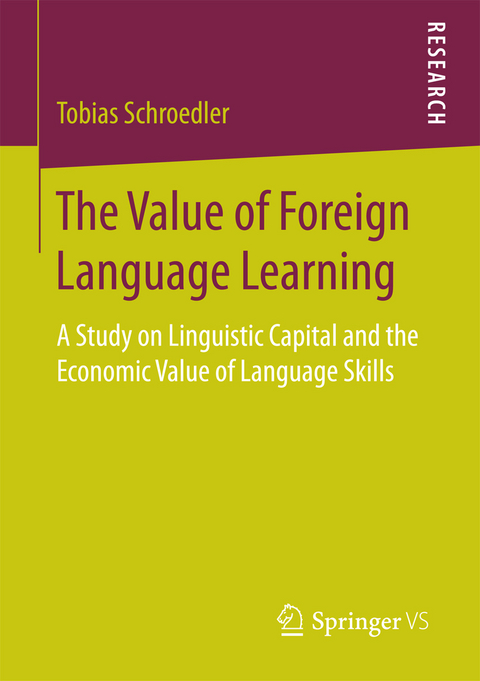
The Value of Foreign Language Learning (eBook)
XVI, 234 Seiten
Springer Fachmedien Wiesbaden (Verlag)
978-3-658-19736-0 (ISBN)
Dr. Tobias Schroedler completed his Ph.D. at the University of Dublin, Trinity College in the School of Linguistic, Speech and Communication Science. He is now a postdoctoral research fellow in the Institute for International Comparative and Intercultural Education at the University of Hamburg.
Dr. Tobias Schroedler completed his Ph.D. at the University of Dublin, Trinity College in the School of Linguistic, Speech and Communication Science. He is now a postdoctoral research fellow in the Institute for International Comparative and Intercultural Education at the University of Hamburg.
Acknowledgements 5
Table of Contents 6
List of Figures 12
List of Tables 14
1 Introduction 16
1.1 The Potential Economic Value of Language Education in Present-Day Ireland 17
1.2 Structure of This Book 19
2 Theories on Language, Value, Economics and Policy 22
2.1 Human Capital Theory – Linking Economics to Education 22
2.1.1 History of Human Capital Theory 23
2.1.2 Alternative Models 23
2.1.3 Defining Human Capital Theory 24
2.2 The Notion of Language as Economic Capital 26
2.2.1 Market Value and Non-Market Value of Languages 26
2.2.2 Language and Earnings 27
2.2.3 Economic Power of Languages 28
2.3 The Sociological Approach of Defining Language as Capital 28
2.3.1 Bourdieu’s Conceptual Triad 29
2.3.2 Linguistic Capital, Market and Exchange 31
2.3.3 Combining the Economic and Sociological Approach 32
2.4 Psychic Distance Theory 34
2.4.1 History and Definition of Psychic Distance Theory 34
2.4.2 Linguistic Distance within Psychic Distance 37
2.4.3 The Relevance of Psychic and Linguistic Distance to this Study 38
2.4.4 Summary of the Multidisciplinary Conceptualisations of Value of Language 39
2.5 Language Education Policy – A Theoretical Basis 39
2.5.1 Defining Language Policy 40
2.5.2 Education Policy 42
2.5.3 Language Education Policy 43
2.5.4 European Aims and the Irish Language Education Policy Situation 45
2.5.5 Summarising a Language Education Policy Analysis Approach 46
3 Research Phase I: The Quantitative Macroeconomic Data Collection and Presentation 49
3.1 Macroeconomic Measurement Procedures 49
3.1.1 Gross Domestic Product 50
System of National Accounts 50
3.1.2 Gross Domestic Product per capita 51
3.1.3 Foreign Direct Investment 52
3.1.4 The Global Competitiveness Index 53
3.1.5 Index Selection and Limitations 54
3.2 Defining the Target Language Markets 55
3.2.1 The ‘French-Speaking World’ 55
3.2.2 The ‘Spanish-Speaking World’ 58
3.3 Data Collection 61
3.4 Quality Assurance and Limitations 62
3.4.1 Quality Assurance 62
3.4.2 Validity Assurance 63
3.4.3 Validity Limitations of the Macroeconomic Data Collection 64
3.5 The Macroeconomic Data Presentation 66
3.5.1 Excel Processing 66
3.5.2 Data for the Spanish-Speaking World 67
3.5.3 Data for the French-Speaking World 75
3.5.4 Data for the German-Speaking World 84
3.5.5 Data for the English-Speaking World 90
3.6 Summary of Macroeconomic Data Collection and Presentation 98
4 Research Phase II - Methodology and Data Collection 99
4.1 Research Design – The Expert Interview 99
4.1.1 The Expert Interview as a Qualitative Research Method 100
4.1.2 Qualitative Research and the Interview 101
4.1.3 The Expert Interview 102
the 103
4.1.4 What is Expertise – The Validation of the Expert Interview 104
4.2 The Interview 106
4.2.1 Interviewer – Interviewee Relations 106
4.2.2 Openness and Structure 108
4.2.3 The Theory-Generating Approach 109
4.3 Data Collection 110
4.3.1 Research Questions and the Development of a Topic Guide 110
4.3.2 Ethical Constraints 112
4.3.3 Selection of Experts 113
4.3.4 Field Work 114
4.3.5 Transcription 117
5 Research Phase II - Expert Interview Data Presentation 119
5.1 Interview Data Presentation 119
5.1.1 Tony Donohoe 121
5.1.2 Colin Smyth 123
5.1.3 Nora Condon 126
5.1.4 Ralf Lissek and Tonia Spollen 129
5.1.5 Cliona McGowan 132
5.1.6 Javier Moral Escudero 134
5.1.7 Georgia Herlt 136
5.1.8 Philippe Milloux 138
5.1.9 Summary of Expert Interview Data Presentation 140
5.2 Coding 141
5.2.1 Coding Theory 141
5.2.2 Development of the Code Book 142
5.2.3 Reliability and Validity 149
6 Data Analysis: Research Phase I 151
6.1 Accumulated GDP Developments 151
6.2 GDP per capita 154
6.3 Foreign Direct Investment 156
6.4 Global Competitiveness Index 157
6.5 Summary of Macroeconomic Analysis 159
7 Data Analysis: Research Phase II 161
7.1 Applying the Coding Framework to the Analysis 161
7.2 The Language Role in the General Business and Employers Context 163
7.2.1 Language Skills in the MNC Sector 164
7.2.2 Language Skills in the Export- and SME-Sector 166
language path 168
language path, 169
7.2.3 Summary of the Language Role in the General Business and Employers Context 172
7.3 The Role of Language Skills in Daily Business Dealings 172
7.3.1 Competitiveness 173
7.3.2 Business Linguae Francae 175
7.3.3 Sustainability 178
7.3.4 Identifying and Exploiting Further Opportunities 180
7.3.5 Summary of the Role of Language Skills in Daily Business Dealings 182
7.4 The Importance of Language Skills for the Job Market and the Individual’s Employability 183
7.4.1 Language Skills and the Irish Job Market 184
7.4.2 The Importance of Particular Language Skills on the Job Market 186
7.4.3 Language Skills and Employability 191
7.4.4 Summary of the Importance of Language Skills for the Job Market 194
7.5 The Language Influence on Migration and Mobility 194
7.5.1 Language Skills and Demographic Development 195
7.5.2 Language Skills and Mobility 198
7.5.3 Summary of the Language Influence on Migration and Mobility 201
7.6 Language Institute Work and Education 202
7.6.1 A ‘Lesson’ from the Dublin-Based Language Institutes 202
7.6.2 Education 207
7.6.3 Summary of the Language Institute Work and General Educational Matters 218
7.7 Synopsis of Expert Interview Data Analysis 219
8 Discussion and Conclusion 221
8.1 Language as Human Capital and the Market Value of Languages 221
8.2 The Sociological Dimension 224
8.3 The Importance of Languages for Psychic Distance Considerations 225
8.4 The Education Debate 226
8.5 The Perceived Economic Value of Foreign Languages and Potential Implications for Language Education Policy-Making 227
8.6 Conclusion of the Expert Perceptions on Language Education Policy Matters 231
8.7 Limitations of the Study 232
8.8 Outlook 233
Bibliography 235
| Erscheint lt. Verlag | 10.10.2017 |
|---|---|
| Zusatzinfo | XVI, 234 p. 27 illus. |
| Verlagsort | Wiesbaden |
| Sprache | englisch |
| Themenwelt | Sozialwissenschaften ► Pädagogik ► Bildungstheorie |
| Wirtschaft | |
| Schlagworte | Economics of Language Education Policy • Language economics • Languages as Human Capital • Languages in Psychic Distance Theory • Value of Languages • Value of Multilingualism |
| ISBN-10 | 3-658-19736-6 / 3658197366 |
| ISBN-13 | 978-3-658-19736-0 / 9783658197360 |
| Informationen gemäß Produktsicherheitsverordnung (GPSR) | |
| Haben Sie eine Frage zum Produkt? |
 PDF (Wasserzeichen)
DRM: Digitales Wasserzeichen
Dieses eBook enthält ein digitales Wasserzeichen und ist damit für Sie personalisiert. Bei einer missbräuchlichen Weitergabe des eBooks an Dritte ist eine Rückverfolgung an die Quelle möglich.
Dateiformat: PDF (Portable Document Format)
Mit einem festen Seitenlayout eignet sich die PDF besonders für Fachbücher mit Spalten, Tabellen und Abbildungen. Eine PDF kann auf fast allen Geräten angezeigt werden, ist aber für kleine Displays (Smartphone, eReader) nur eingeschränkt geeignet.
Systemvoraussetzungen:
PC/Mac: Mit einem PC oder Mac können Sie dieses eBook lesen. Sie benötigen dafür einen PDF-Viewer - z.B. den Adobe Reader oder Adobe Digital Editions.
eReader: Dieses eBook kann mit (fast) allen eBook-Readern gelesen werden. Mit dem amazon-Kindle ist es aber nicht kompatibel.
Smartphone/Tablet: Egal ob Apple oder Android, dieses eBook können Sie lesen. Sie benötigen dafür einen PDF-Viewer - z.B. die kostenlose Adobe Digital Editions-App.
Buying eBooks from abroad
For tax law reasons we can sell eBooks just within Germany and Switzerland. Regrettably we cannot fulfill eBook-orders from other countries.
aus dem Bereich