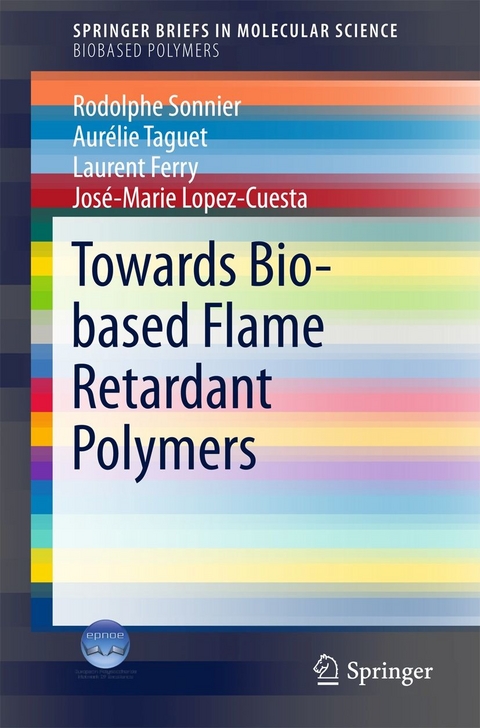
Towards Bio-based Flame Retardant Polymers (eBook)
XVI, 100 Seiten
Springer International Publishing (Verlag)
978-3-319-67083-6 (ISBN)

Rodolphe SonnierBorn in France in 1979, he obtained a Master degree (engineer) from ENSAIT (first school of textile engineer in France) and a PhD in material chemistry from Montpellier University in 2006 (supervisors: J-M. Lopez-Cuesta and A. Bergeret at the Ecole des Mines d’Alès). After a postdoctoral fellowship in Lyon (INSA, Laboratoire des Matériaux Macromoléculaires) supervised by Pr. Ph. Cassagnau and Dr. V. Massardier from 2006 to 2008, he became research engineer and then associate professor in the Materials Center in Ecole des Mines d’Alès from 2008 up to now. His main research field is the flame retardancy of polymers and composites. He works also on the characterization of polymer blends and the effect of ionizing radiations on polymers.He supervised (as co-supervisor) 7 PhD including three current ones. He reviewed in several journals (Polymer Degradation and Stability, Journal of Applied Polymer Science) and he has been guest editor of special issues in Materials. Scopus values: 49 publications, 218 citations by 162 documents, h-index: 8José-Marie Lopez-CuestaBorn in Paris and 57 years old, he is engineer and PhD in applied physical chemistry (1985) of the Institut National Polytechnique de Grenoble (France). Full professor at Ecole des Mines d’Alès (EMA) since 2007, he works since 1990 on particulate polymer composites (micro and nanocomposites) and he is the head of the research centre of materials in EMA (C2MA) since 2009 (82 people including 30 researchers and lecturers as permanent staff). He works mainly in the areas of physical chemistry of interfaces, durability of composites, and particularly on thermal degradation, fire reaction and behavior of polymer blends containing micro- and nanocomposites. He is co-author of around 120 articles in international journals and has supervised around 30 PhD works. He is the secretary of a thematic group of the Société Chimique de France (SCF) about the thermal degradation and fire behavior of organic materials. He is member of the scientific committee of various international conferences (FRPM, Eurofillers, ISFRMT, BiPoCo). He was recently the co-chairman of the international conference Eurofillers Polymer Blends 2015 in Montpellier (France).Scopus values: 116 articles, 2033 citations, h-index 24Laurent FERRYBorn in France 1967, he obtained a Master degree (engineer) in Materials Science from INSA Lyon in 1990 and a PhD in Materials Science from INSA Lyon in 1996. In 1998, he got a permanent position at Ecole des Mines d’Alès in the Materials Center. He became full professor in 2013. Since 2009 he is leader of the group working on flame retardancy of polymers.His main expertise is in the field of fire behavior of polymers. This has led him to investigate different kinds of flame retardants such as micro and nano-sized mineral particles, phosphorous compounds and more recently bio-based products. He has also worked on polymer and composites ageing.He has supervised 20 PhD (4 still in progress) and 4 Masters. Scopus values: 55 publications, 7 book chapters, 554 citations, h-index:14He has been guest editor of special issues in Materials and Polymer Degradation and StabilityAurélie TAGUETBorn in France in 1978, she obtained a Master degree (engineer) in Material Science (Phelma, INP Grenoble) in 2002 and a PhD in material chemistry – IAM, Gerhardt Institut, ENSCMontpellier ( PhD supervisor: B. Ameduri) in 2005. After a postdoctoral fellowship in Montréal (Ecole Polytechnique, chemistry department) supervised by Pr. Basil Favis from 2006 to 2008, she became research engineer and then associate professor in the Materials Center in Ecole des Mines d’Alès from 2008 up to now. She works on the effect of the morphology on the final properties (mechanical, thermal and fire) of composites, biocomposites and nanocomposites. She supervised (as co-supervisor) 5 PhD including a current one. She reviewed 11 articles in several journals. Scopus values: 20 publications, 203 citations by 177 documents, h-index:8
Contents 6
About the Authors 8
Abbreviations 10
Introduction 13
1 Flame Retardant Biobased Polymers 17
1.1 Introduction 17
1.2 Intumescent Flame Retardant Systems Based on APP 19
1.2.1 Use of Biobased Components with APP in PLA 19
1.2.2 Use of Nanoparticles and Functional Fillers with APP in PLA 22
1.2.3 Other Components in Intumescent Systems with APP for Biobased Polymers 26
1.3 FR Systems Based on Other Phosphorous and Nitrogenous FRs 28
1.3.1 Systems Based on Other Types of Phosphates 28
1.3.2 Novel FR Systems Based on Additive and Reactive FRs Containing Phosphorus and/or Nitrogen 30
1.4 Flame Retardant Systems Based on Functionalized or Modified Nanoparticles and Fillers 38
1.5 Conclusion 43
References 44
2 Biobased Flame Retardants 49
2.1 Issues and Objectives 49
2.2 Thermal Behavior of Biomass-Based Matter 50
2.2.1 Carbohydrates 51
2.2.2 Proteins 54
2.2.3 Lipids 57
2.2.4 Phenolic Compounds 58
2.3 Strategies for Flame Retardancy with Biobased Compounds 60
2.3.1 Bio-resources as Intrinsic Flame Retardant 61
2.3.1.1 Lignin 61
2.3.1.2 Proteins and DNA 62
2.3.2 Bio-resources Combined with Phosphorus or Nitrogen Compounds 64
2.3.2.1 Carbohydrates 65
2.3.2.2 Phenolic Compounds 69
2.3.3 Modified Bio-resources with Enhanced Charring Effect 69
2.3.3.1 Carbohydrates 70
2.3.3.2 Phenolic Compounds 73
2.3.4 Reactive Biobased Flame Retardants 75
2.3.4.1 Oil Derivatives 76
2.3.4.2 Bio-phenol Derivatives 78
2.3.4.3 Carbohydrate Derivatives 79
2.4 Opportunities for the Industrial Scale-up of Biobased FR Systems 80
2.4.1 Fire Performance Criteria 80
2.4.2 Environmental and Health Criteria 81
2.4.3 Economic Criteria 81
References 82
3 Flame Retardancy of Natural Fibers Reinforced Composites 89
3.1 A Comparison Between Natural Fibers and Glass or Carbon Fibers 89
3.1.1 Fire Behavior of Composites Filled with Glass or Carbon Fibers 89
3.1.2 Flammability of Natural Fibers 91
3.2 Fire Properties of Composites Reinforced by Natural Fibers 94
3.2.1 Influence of Raw Natural Fibers 94
3.2.2 Role of Lignin 96
3.2.3 Comparison with CF or GF Composites 98
3.3 Flame Retardancy of Biocomposites 100
3.3.1 Incorporation of Flame Retardants into the Matrix 100
3.3.2 Is to Flame Retard Natural Fibers Enough to Impart Fire Performances to Composites? 102
3.3.3 Comparison of Both Approaches 106
3.4 Conclusions 109
References 110
Conclusion 115
| Erscheint lt. Verlag | 6.10.2017 |
|---|---|
| Reihe/Serie | Biobased Polymers |
| Biobased Polymers | |
| Biobased Polymers | |
| SpringerBriefs in Molecular Science | SpringerBriefs in Molecular Science |
| Zusatzinfo | XVI, 100 p. 47 illus. |
| Verlagsort | Cham |
| Sprache | englisch |
| Themenwelt | Naturwissenschaften ► Chemie |
| Technik ► Maschinenbau | |
| Wirtschaft | |
| Schlagworte | Biosourced flame retardant • Biosourced polymer • Flame retardancy • Natural Fiber Composites • Natural flame retardants |
| ISBN-10 | 3-319-67083-2 / 3319670832 |
| ISBN-13 | 978-3-319-67083-6 / 9783319670836 |
| Informationen gemäß Produktsicherheitsverordnung (GPSR) | |
| Haben Sie eine Frage zum Produkt? |
 PDF (Wasserzeichen)
DRM: Digitales Wasserzeichen
Dieses eBook enthält ein digitales Wasserzeichen und ist damit für Sie personalisiert. Bei einer missbräuchlichen Weitergabe des eBooks an Dritte ist eine Rückverfolgung an die Quelle möglich.
Dateiformat: PDF (Portable Document Format)
Mit einem festen Seitenlayout eignet sich die PDF besonders für Fachbücher mit Spalten, Tabellen und Abbildungen. Eine PDF kann auf fast allen Geräten angezeigt werden, ist aber für kleine Displays (Smartphone, eReader) nur eingeschränkt geeignet.
Systemvoraussetzungen:
PC/Mac: Mit einem PC oder Mac können Sie dieses eBook lesen. Sie benötigen dafür einen PDF-Viewer - z.B. den Adobe Reader oder Adobe Digital Editions.
eReader: Dieses eBook kann mit (fast) allen eBook-Readern gelesen werden. Mit dem amazon-Kindle ist es aber nicht kompatibel.
Smartphone/Tablet: Egal ob Apple oder Android, dieses eBook können Sie lesen. Sie benötigen dafür einen PDF-Viewer - z.B. die kostenlose Adobe Digital Editions-App.
Buying eBooks from abroad
For tax law reasons we can sell eBooks just within Germany and Switzerland. Regrettably we cannot fulfill eBook-orders from other countries.
aus dem Bereich