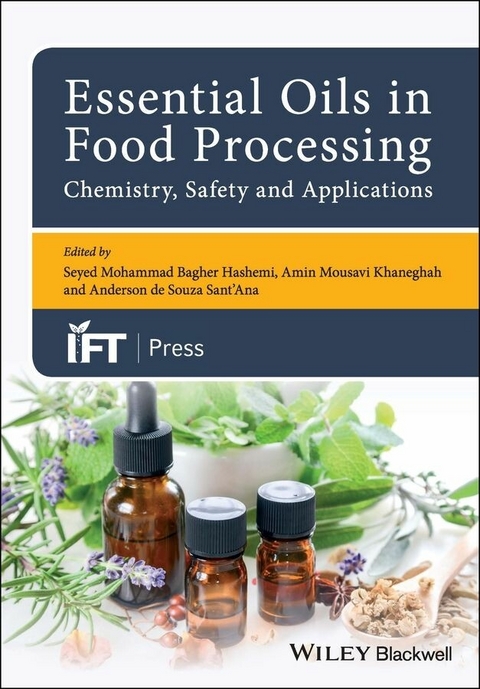
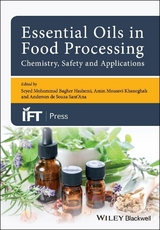
Essential Oils in Food Processing: Chemistry, Safety and Applications (eBook)
John Wiley & Sons (Verlag)
978-1-119-14935-4 (ISBN)
A guide to the use of essential oils in food, including information on their composition, extraction methods, and their antioxidant and antimicrobial applications
Consumers' food preferences are moving away from synthetic additives and preservatives and there is an increase demand for convenient packaged foods with long shelf lives. The use of essential oils fills the need for more natural preservativesto extend the shelf-life and maintaining the safety of foods. Essential Oils in Food Processing offers researchers in food science a guide to the chemistry, safety and applications of these easily accessible and eco-friendly substances.
The text offers a review of essential oils components, history, source and their application in foods and explores common and new extraction methods of essential oils from herbs and spices. The authors show how to determine the chemical composition of essential oils as well as an explanation of the antimicrobial and antioxidant activity of these oils in foods. This resource also delves into the effect of essential oils on food flavor and explores the interaction of essential oils and food components. Essential Oils in Food Processing offers a:
- Handbook of the use of essential oils in food, including their composition, extraction methods and their antioxidant and antimicrobial applications
- Guide that shows how essential oils can be used to extend the shelf life of food products whilst meeting consumer demand for 'natural' products
- Review of the use of essential oils as natural flavour ingredients
- Summary of relevant food regulations as pertaining to essential oils
Seyed Mohammad Bagher Hashemi, Department of Food Science and Technology, College of Agriculture, Fasa University, Fasa, Iran.
Amin Mousavi Khaneghah, Department of Food Science, Faculty of Food Engineering, University of Campinas (UNICAMP), Campinas, São Paulo, Brazil.
Anderson de Souza Sant'Ana, Department of Food science, Faculty of Food Engineering, University of Campinas (UNICAMP), São Paulo, Brazil.
A guide to the use of essential oils in food, including information on their composition, extraction methods, and their antioxidant and antimicrobial applications Consumers food preferences are moving away from synthetic additives and preservatives and there is an increase demand for convenient packaged foods with long shelf lives. The use of essential oils fills the need for more natural preservativesto extend the shelf-life and maintaining the safety of foods. Essential Oils in Food Processing offers researchers in food science a guide to the chemistry, safety and applications of these easily accessible and eco-friendly substances. The text offers a review of essential oils components, history, source and their application in foods and explores common and new extraction methods of essential oils from herbs and spices. The authors show how to determine the chemical composition of essential oils as well as an explanation of the antimicrobial and antioxidant activity of these oils in foods. This resource also delves into the effect of essential oils on food flavor and explores the interaction of essential oils and food components. Essential Oils in Food Processing offers a: Handbook of the use of essential oils in food, including their composition, extraction methods and their antioxidant and antimicrobial applications Guide that shows how essential oils can be used to extend the shelf life of food products whilst meeting consumer demand for natural products Review of the use of essential oils as natural flavour ingredients Summary of relevant food regulations as pertaining to essential oils Academic researchers in food science, R&D scientists, and educators and advanced students in food science and nutrition can tap into the most recent findings and basic understanding of the chemistry, application, and safe us of essential oils in food processing.
Seyed Mohammad Bagher Hashemi, Department of Food Science and Technology, College of Agriculture, Fasa University, Fasa, Iran. Amin Mousavi Khaneghah, Department of Food Science, Faculty of Food Engineering, University of Campinas (UNICAMP), Campinas, São Paulo, Brazil. Anderson de Souza Sant'Ana, Department of Food science, Faculty of Food Engineering, University of Campinas (UNICAMP), São Paulo, Brazil.
| Erscheint lt. Verlag | 6.10.2017 |
|---|---|
| Reihe/Serie | Institute of Food Technologists Series |
| Institute of Food Technologists Series | Institute of Food Technologists Series |
| Sprache | englisch |
| Themenwelt | Naturwissenschaften ► Biologie |
| Technik ► Lebensmitteltechnologie | |
| Wirtschaft | |
| Weitere Fachgebiete ► Land- / Forstwirtschaft / Fischerei | |
| Schlagworte | Ãle u. Fette • Amin Mousavi Khaneghah • Anderson de Souza Sant'Ana • antimicrobial applications of essential oils • antioxidant applications of essential oils • Applications of food processing with essential oils • Chemistry and essential oils in food processing: Safety and food processing of essential oils • components of essential oils • composition of essential oils • essential oils as a flavor agent • essential oils extending shelf life of products • Essential Oils in Food Processing • extraction methods of essential oils • Food Science & Technology • Functional Food, Nutraceuticals • Functional Foods & Nutraceuticals • interaction between essential oils and food components • Lebensmittelforschung u. -technologie • legal aspects of the use of essential oils in foods • Microbiology, Food Safety & Security • Mikrobiologie u. Nahrungsmittelsicherheit • Ohmic assisted extraction of essential oils for foods • Oils & Fats • Öle u. Fette • Seyed Mohammad Bagher Hashemi • Ultrasound assisted extraction of essential oils for foods |
| ISBN-10 | 1-119-14935-5 / 1119149355 |
| ISBN-13 | 978-1-119-14935-4 / 9781119149354 |
| Informationen gemäß Produktsicherheitsverordnung (GPSR) | |
| Haben Sie eine Frage zum Produkt? |
 PDF (Adobe DRM)
Kopierschutz: Adobe-DRM
Adobe-DRM ist ein Kopierschutz, der das eBook vor Mißbrauch schützen soll. Dabei wird das eBook bereits beim Download auf Ihre persönliche Adobe-ID autorisiert. Lesen können Sie das eBook dann nur auf den Geräten, welche ebenfalls auf Ihre Adobe-ID registriert sind.
Details zum Adobe-DRM
Dateiformat: PDF (Portable Document Format)
Mit einem festen Seitenlayout eignet sich die PDF besonders für Fachbücher mit Spalten, Tabellen und Abbildungen. Eine PDF kann auf fast allen Geräten angezeigt werden, ist aber für kleine Displays (Smartphone, eReader) nur eingeschränkt geeignet.
Systemvoraussetzungen:
PC/Mac: Mit einem PC oder Mac können Sie dieses eBook lesen. Sie benötigen eine
eReader: Dieses eBook kann mit (fast) allen eBook-Readern gelesen werden. Mit dem amazon-Kindle ist es aber nicht kompatibel.
Smartphone/Tablet: Egal ob Apple oder Android, dieses eBook können Sie lesen. Sie benötigen eine
Geräteliste und zusätzliche Hinweise
Buying eBooks from abroad
For tax law reasons we can sell eBooks just within Germany and Switzerland. Regrettably we cannot fulfill eBook-orders from other countries.
aus dem Bereich