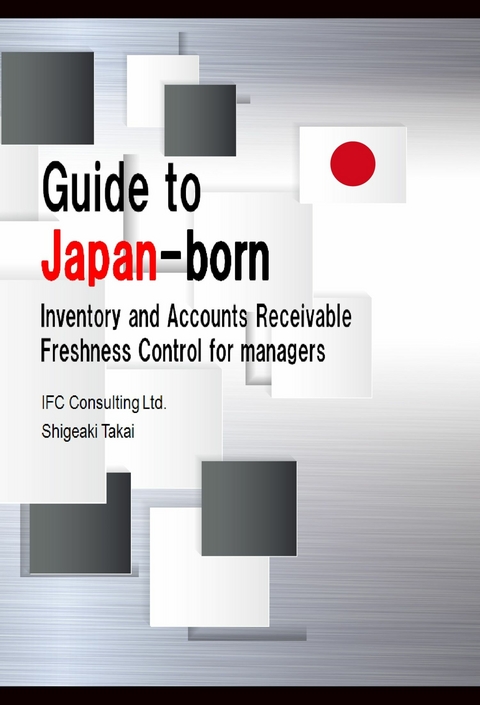
Guide to Japan-born Inventory and Accounts Receivable Freshness Control for Managers (eBook)
153 Seiten
Shigeaki Takai (Verlag)
978-0-00-003102-0 (ISBN)
The proper Inventory and Accounts Receivable control can solve all management issues!
Having engaged in production and distribution for many years at Sony and familiar with 'inventory management' of domestic and foreign companies, author explains as to what is Inventory-centric management consulting.
While inventory is the fountainhead of profits for business, it also brings about a loss and is only a result of operation.
Focusing on three issues related to inventory (① Increase in working capital ② Increase in disposal costs ③ Reduction of accounting fraud risks), the essence of inventory management is clearly explained, that is freshness (time-axis) management of goods and thorough weekly operation.
Case studies of domestic major companies acquired through interview, Cash Conversion Cycle between Japan and US is thoroughly compared. Also, referring to the latest world food problem, advocating to suppress overproduction and excess supply. Following the English translation version, the book will be published in multiple languages to promote inventory freshness control.
Manufacturing, logistics, food · · · Management executives, Corporate control staff, SCM person responsible person for all industries must read.
Table of Contents
Chapter 1: Why the tighter Inventory control and Inventory freshness control is required now?
Chapter 2: Cash management
Chapter 3: Inventory from the viewpoints of financial statements
Chapter 4: Inventory from the viewpoints of integrated demand and supply chain
Chapter 5: The effective KPIs for operational improvement
Chapter 6: Inventory Dollar control
Chapter 7: The future of Inventory management
Chapter 8: Strengthening operations towards the mitigation of accounting fraud risks
Chapter 9: The effective system and its usage for Freshness Control and mitigation of accounting fraud risks
Guide to Japan-born Inventory and Accounts Receivable Freshness Control for managers
Introduction
First of all, while inventory is the fountainhead of profits for business, it also brings about a loss and is only a result of operation.
A management method has also changed a lot according to a change in the business environment.
In the mid-1980s, the market changed from 'the era of mass production, mass consumption' to 'the era of quantity to quality, high-mix small-volume production'.
At that time, logistics that aimed at "optimizing in-house logistics" of its own company was mainstream.
Most companies have held buffer or excess inventory to avoid the opportunity loss by closely communicating with sales and the factory within the organization.
From the mid-1990s that has passed through the bubble economy and its collapse, the efficiency of logistics, in the demand for low cost becomes severe, not only to the internal company, eliminating waste by involving up to other companies aiming at "optimization of the entire business-to-business", the supply chain management (SCM) has been invented by the United States IT company, in reference to model the "Kanban system" of Toyota Motor and introduced to leading and medium-sized companies.
SCM covered a variety of systems for the purpose of inventory management, such as demand forecasting, automatic inventory allocation, reply to request, delivery date answer, warehouse management systems and visualization of inventory, etc.
Then, we encountered catastrophes, such as the financial crisis of the Lehman shock of September 15, 2008, the Great East Japan Earthquake of March 11, 2011, and the Thailand flood of the same year in autumn. It is said that it took more than six months to restore the imbalance of supply and demand, depending on the industry, and is said in preparation for the BCP (business continuity plan).
The importance of securing supply routes by the procurement section and minimizing inventory driven costs have been emphasized and later named the supply chain risk management.
There are three fundamental problems with the inventory:
1) Increase in working capital
Regardless of the business scale, the importance of the management of working capital and cash management is mentioned as a management subject. In the process of the corporate activity of purchasing products, selling and collecting payment, when paying the purchase price of goods before the receipt of money on products sold in order to compensate for the time lag, fixed cash is needed. This is called working capital.
The working capital is calculated as current assets (accounts receivable plus inventory) minus current liabilities (accounts payable) and usually, is positive; you will need that amount of money.
Cash Conversion Cycle (CCC) = DIO (Days Inventory Outstanding) + DSO (Days Sales Outstanding) - DPO (Days Payment Outstanding)
Although Japanese companies, which move a pivoting foot from P/L (profit and loss statement) initiative to the B/S (balance sheet) initiative and the C/F (cash flow) initiative, are increasing, I think that there is still room for improvement compared with a European and an American company.
2) Increase of inventory driven costs (disposal costs)
Food waste and food loss will be mentioned on a global scale. About 1/3 (approximately 1,300 million tons) of food produced throughout the world is discarded, and it is said to be it when the thing, which is soon discarded though it was originally eaten, as the so-called food waste is equal to food of a purely total amount of production (230 million tons) of Sub-Saharan Africa at 17% (222 million tons).
Moreover, the food abandonment (generally called a food loss) in our country is said to be 5-8 million tons per year, This quantity is equal to the annual crop yields (about 8.5 million tons in 2012) of rice and far exceeds the amount of food aid (about 3.9 million tons per year in 2011) in the world for people who are troubled by starvation all over the world.
Following the UN Summit, which was held in September 2015, it was agreed that food waste has to be reduced by half per capita of the entire world at the retail and consumption levels by 2030 and to reduce the loss of food in the production and supply chain, such as post-harvest loss, and new global warming countermeasures "Paris Agreement have been adopted by 196 countries and areas at United Nations Climate Change conference (COP21) held in Paris in December 2015.
The food loss and food waste occurring is wasting the resources of water, land, energy, and labor and capital, it has led to greenhouse gas emissions generating superfluously, and they are global warming and an important environmental issue that participates in climate change.
3) Reduction of accounting fraud risks (inventory, accounts receivable, and accounts payable)
Generally, most accounting fraud is performed to pretend that there are more sales and profits than the fact. By the accounting fraud of Toshiba, which occurred in fiscal year 2015, to improperly write down inventory, and wrong payment by fictional stocking was found out with Kozosushi. Also, not only the inventory and improper handling in the past but also in accounts receivable was connected to accounting fraud scandals are frequent. Measures to minimize accounting fraud risks generally include reinforcement of the further monitoring function by auditing firms, governance reinforcement of the company by certified public accountants, and compliance reinforcement. Unfortunately, it is no exaggeration to say that concrete proposals as to how to prevent accounting fraud by well-informed persons are not evident but left to the company.
With respect to these issues, as an inventory-centric management consultant making the best use of past experience and knowledge, I believe that I may find tips to avoid accounting risks to some extent by expediting the cash cycle, and I recommend freshness control of inventory and cash (accounts receivable as well as accounts payable), in other words, I will advocate time-axis management.
It especially became a buyer's market after the collapse of the bubble economy, and from a sellers' market in the FMCG (fast moving consumer goods) market, and 20 years or more have already passed.
When the imbalance of supply and demand happens in a market, the clue to the solution can be seen by perceiving the change quickly and doing thorough research of the company that can respond, in other words, the type of company corresponding to changes.
Companies that are noted as case studies in this book sensitively perceive the changes in demand in the market and respond to the operations of production (or purchase) and selling in a timely manner, and as a result, show performance where inventory is managed well and disposal costs are kept relatively low.
The fact is that the introduction of freshness management (or time-axis management) is to suppress excessive surplus production and surplus procurement. I think that it is no exaggeration to say that it will definitely contribute to the environmental issues as a result. How does it work? We will briefly describe that technique as follows.
The framework of working capital changes daily from the relationship between the customer or market. Therefore, control according to the level of a fixed point observation is inescapable.
When working capital increases, cash is newly needed, and when working capital decreases, conversely, it becomes unnecessary to prepare cash for the part.
As a financial indicator of the efficiency and speed at which the company is to recover funds, there is the cash conversion cycle (CCC). In this book, we use the term cash rate.
Major European and American companies have adopted CCC as a management index, and even if it is the same profits level, the worth of a company with excellent cash management is evaluated highly. For negative CCC companies, working capital becomes abundant in accordance with sales increases, and they enable the realization and aggressive strategic investment in a robust financial structure. On the other hand, positive CCC companies will face working capital pressure as debt and interest burdens will increase.
It requires cash management in order not to fall into a lack of funds during rapid changes in the business environment. Today, in accordance with the expected slowdown in profit growth, there is the background that methods of efficiently generating cash have been attracting attention. The concept of CCC is gradually perceived and introduced among Japanese companies. In recent years, Asahi Group Holdings, LIXIL Group, and Nidec have introduced CCC as a management index aiming at cash-flow improvement. CCC is measured in days, but by understanding the amount at the same time, with respect to the target, you have to figure out how much the inventory assets and accounts receivable can be compressed; in addition, by extending the accounts payable in order to reduce working capital, you will need to share the impact on operating cash flow at the company level.
Then what should we do to improve CCC cash rate?
① To shorten the days inventory outstanding (DIO) by reducing inventory
② To shorten the days sales outstanding (DSO) by reducing absolute amounts of accounts receivable and reviewing terms and conditions
③ To lengthen the days payable outstanding (DPO) by relaxing terms and conditions
To that end, I think that the five following steps are necessary.
1. To recognize the companys CCC...
| Erscheint lt. Verlag | 25.9.2017 |
|---|---|
| Sprache | englisch |
| Themenwelt | Wirtschaft ► Betriebswirtschaft / Management |
| ISBN-10 | 0-00-003102-X / 000003102X |
| ISBN-13 | 978-0-00-003102-0 / 9780000031020 |
| Informationen gemäß Produktsicherheitsverordnung (GPSR) | |
| Haben Sie eine Frage zum Produkt? |
 EPUB (Adobe DRM)
Größe: 15,8 MB
Kopierschutz: Adobe-DRM
Adobe-DRM ist ein Kopierschutz, der das eBook vor Mißbrauch schützen soll. Dabei wird das eBook bereits beim Download auf Ihre persönliche Adobe-ID autorisiert. Lesen können Sie das eBook dann nur auf den Geräten, welche ebenfalls auf Ihre Adobe-ID registriert sind.
Details zum Adobe-DRM
Dateiformat: EPUB (Electronic Publication)
EPUB ist ein offener Standard für eBooks und eignet sich besonders zur Darstellung von Belletristik und Sachbüchern. Der Fließtext wird dynamisch an die Display- und Schriftgröße angepasst. Auch für mobile Lesegeräte ist EPUB daher gut geeignet.
Systemvoraussetzungen:
PC/Mac: Mit einem PC oder Mac können Sie dieses eBook lesen. Sie benötigen eine
eReader: Dieses eBook kann mit (fast) allen eBook-Readern gelesen werden. Mit dem amazon-Kindle ist es aber nicht kompatibel.
Smartphone/Tablet: Egal ob Apple oder Android, dieses eBook können Sie lesen. Sie benötigen eine
Geräteliste und zusätzliche Hinweise
Buying eBooks from abroad
For tax law reasons we can sell eBooks just within Germany and Switzerland. Regrettably we cannot fulfill eBook-orders from other countries.
aus dem Bereich