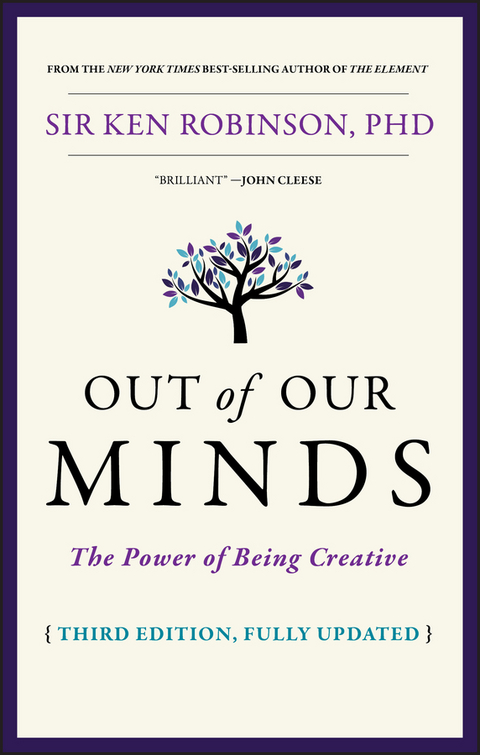
Out of Our Minds (eBook)
John Wiley & Sons (Verlag)
9780857087447 (ISBN)
Creativity is critical.
Out of Our Minds explores creativity: its value in business, its ubiquity in children, its perceived absence in many adults and the phenomenon through which it disappears - and offers a groundbreaking approach for getting it back. Author Sir Ken Robinson is an internationally recognised authority on creativity, and his TED talk on the subject is the most watched video in TED's history. In this book, Sir Ken argues that organisations everywhere are struggling to fix a problem that originates in schools and universities. Organisations everywhere are competing in a world that changes in the blink of an eye - they need people who are flexible enough to adapt, and creative enough to find novel solutions to problems old and new. Out of Our Minds describes how schools, businesses and communities can work together to bring creativity out of the closet and realise its inherent value at every stage of life. This new third edition has been updated to reflect changing technologies and demographics, with updated case studies and coverage of recent changes to education.
While education and training are the keys to the future, the key can also be turned the other way; locking people away from their own creativity. Only by actively fostering creativity can businesses unlock those doors and achieve their true potential. This book will help you to:
- Understand the importance of actively promoting creativity and innovation.
- Discover why creativity stagnates somewhere between childhood and adulthood.
- Learn how to re-awaken dormant creativity to help your business achieve more.
- Explore ways in which we can work together to keep creativity alive for everyone.
Modern business absolutely demands creativity of thought and action. We're all creative as children - so where does it go? When do we lose it? Out of Our Minds has the answers, and clear solutions for getting it back.
SIR KEN ROBINSON, PHD, is an internationally recognized leader in the development of creativity, innovation and human resources. He speaks to audiences throughout the world on the creative challenges facing business and education in the new global economies. Listed by Fast Company as one of the world's elite thinkers on creativity and innovation and ranked among the Thinkers50 of the world's top business thought leaders, he has worked with governments in the United States, Europe and Asia, with international agencies, Fortune 500 companies, national and state education systems and some of the world's leading cultural organizations.
For 12 years, he was professor of education at the University of Warwick in the UK and is now Professor Emeritus. He has received numerous honorary degrees and awards for his international work in education, creativity and cultural development. In 2003, he received a knighthood from H.M. Queen Elizabeth II for his services to the arts.
Sir Ken's famous 2006 talk at the prestigious TED Conference is the most watched in TED history and has been seen by millions of people in more than 160 countries. He is author of the New York Times bestsellers The Element: How Finding Your Passion Changes Everything and Finding Your Element: How to Discover Your Talents and Passions and Transform Your Life. Born in the UK, he lives in Los Angeles California.
Creativity is critical. Out of Our Minds explores creativity: its value in business, its ubiquity in children, its perceived absence in many adults and the phenomenon through which it disappears and offers a groundbreaking approach for getting it back. Author Sir Ken Robinson is an internationally recognised authority on creativity, and his TED talk on the subject is the most watched video in TED s history. In this book, Sir Ken argues that organisations everywhere are struggling to fix a problem that originates in schools and universities. Organisations everywhere are competing in a world that changes in the blink of an eye they need people who are flexible enough to adapt, and creative enough to find novel solutions to problems old and new. Out of Our Minds describes how schools, businesses and communities can work together to bring creativity out of the closet and realise its inherent value at every stage of life. This new third edition has been updated to reflect changing technologies and demographics, with updated case studies and coverage of recent changes to education. While education and training are the keys to the future, the key can also be turned the other way; locking people away from their own creativity. Only by actively fostering creativity can businesses unlock those doors and achieve their true potential. This book will help you to: Understand the importance of actively promoting creativity and innovation. Discover why creativity stagnates somewhere between childhood and adulthood. Learn how to re-awaken dormant creativity to help your business achieve more. Explore ways in which we can work together to keep creativity alive for everyone. Modern business absolutely demands creativity of thought and action. We're all creative as children so where does it go? When do we lose it? Out of Our Minds has the answers, and clear solutions for getting it back.
SIR KEN ROBINSON, PHD, is an internationally recognized leader in the development of creativity, innovation and human resources. He speaks to audiences throughout the world on the creative challenges facing business and education in the new global economies. Listed by Fast Company as one of the world's elite thinkers on creativity and innovation and ranked among the Thinkers50 of the world's top business thought leaders, he has worked with governments in the United States, Europe and Asia, with international agencies, Fortune 500 companies, national and state education systems and some of the world's leading cultural organizations. For 12 years, he was professor of education at the University of Warwick in the UK and is now Professor Emeritus. He has received numerous honorary degrees and awards for his international work in education, creativity and cultural development. In 2003, he received a knighthood from H.M. Queen Elizabeth II for his services to the arts. Sir Ken's famous 2006 talk at the prestigious TED Conference is the most watched in TED history and has been seen by millions of people in more than 160 countries. He is author of the New York Times bestsellers The Element: How Finding Your Passion Changes Everything and Finding Your Element: How to Discover Your Talents and Passions and Transform Your Life. Born in the UK, he lives in Los Angeles California.
Acknowledgments xi
About the Author xiii
Preface to the Third Edition xv
1 Out of Our Minds 1
2 Facing the Revolution 15
3 The Trouble with Education 41
4 The Academic Illusion 65
5 Knowing Your Mind 91
6 Being Creative 119
7 Feeling Better 143
8 You Are Not Alone 169
9 Being a Creative Leader 187
10 Learning to be Creative 209
Afterword 239
Endnotes 241
References 259
Index 267
"written in an interesting and conversational manner, which adds to the appeal of the subject." - Nursing Times, May 2018
"remains an inspiring read" - In Tuition, January 2018
"Out of Our Minds is thoughtful, well-written, and provides a solutions to a common problem." - Association of MBAs, Decemeber 2017
"a rallying cry for anyone serious about finding solutions to the fast-paced complexity of the modern world." - Ideas for Leaders, Novemeber 2017
1
OUT OF OUR MINDS
“When people say to me that they are not creative, I assume that they haven’t yet learnt what is involved.”
CREATING THE FUTURE
HOW CREATIVE ARE YOU? How creative are the people you work with? How about your friends? Next time you are at a social event, ask them. You may be surprised by what they say. I’ve worked with people and organizations all over the world. Everywhere I go, I find the same paradox. Most children think they’re creative; many adults think they are not. This is a bigger issue than it may seem.
We are living in a world that is changing faster than ever and face challenges that are unprecedented. How the complexities of the present will play out in future is all but unknowable. Cultural change is never linear and rarely predictable. If it were, the legions of pundits and forecasters would be out of a job. It was probably with this in mind that the economist J.K. Galbraith said, “The primary purpose of economic forecasting is to make astrology look respectable.” As the world spins faster, organizations everywhere need people who can think creatively, communicate and work in teams: people who are flexible and quick to adapt. Too often they can’t find them. Why not? My aim in this book is to answer three questions.
- Why is it essential to promote creativity? Business leaders, politicians and educators emphasize the vital importance of promoting creativity and innovation. Why does this matter so much?
- What is the problem? Why do people need help to be creative? Young children are buzzing with ideas. What happens as we grow up to make us think we are not creative?
- What is involved? What is creativity? Is everyone creative or just a select few? Can creativity be developed and, if so, how?
Everyone occasionally has new ideas, but how can creativity be encouraged as a regular part of everyday life? If you are running a company or an organization or a school, how do you make innovation systematic? How do you lead a culture of innovation?
RETHINKING CREATIVITY
To answer these questions, it’s important to be clear about what creativity is and how it works. There are three related ideas, which I’ll elaborate as we go on. They are imagination, which is the process of bringing to mind things that are not present to our senses; creativity, which is the process of developing original ideas that have value; and innovation, which is the process of putting new ideas into practice. There are various misconceptions about creativity in particular.
“My starting point is that everyone has huge creative capacities as a natural result of being a human being. The challenge is to develop them. A culture of creativity has to involve everybody, not just a select few.”
Special people?
One misconception is that only special people are creative. This idea is reinforced by histories of creative icons like Martha Graham, Pablo Picasso, Albert Einstein, Thomas Edison, Virginia Wolf, Maya Angelou and Steve Jobs. Companies seem to think this too. They often divide the workforce into two groups: the “creatives” and the “suits.” You can normally tell who the creatives are because they don’t wear suits. They wear jeans and they come in late because they’ve been struggling with an idea. I don’t mean that the creatives are not creative. They can be highly creative, but so can anybody if the conditions are right – including the suits. Everyone has creative capacities. The challenge is to develop them. A culture of innovation has to involve everybody, not just a select few.
Special activities?
A second misconception is that creativity is about special activities, like the arts, or advertising, design or marketing. All of these can be creative, but so can anything, including science, mathematics, teaching, medicine, running a sports team or a restaurant. Some schools have “creative arts” departments. I am an uncompromising advocate of better provision for the arts in schools but creativity is not confined to the arts. Other disciplines, including science and mathematics, can be just as creative. Creativity is possible in any activity that engages our intelligence.
Companies are creative in different areas. Apple is famously good at creating new products. Wal-Mart’s creative strength is in systems, such as supply chain management and pricing. Starbucks did not invent coffee; it created a particular service culture around coffee. Actually, it did invent the $8 cup of coffee, which was a breakthrough, I thought. A culture of innovation should embrace all areas of the organization.
Letting go?
Creativity is sometimes associated with free expression, which is why some people worry about encouraging too much creativity in schools. They think of children running wild and knocking the furniture over rather than getting on with serious work. Being creative often does involve playing with ideas and having fun and enjoyment. It is also about working hard on ideas and projects, crafting them into their best forms and making critical judgments along the way about which ones work best and why. In every discipline, creativity draws on skill, knowledge and control. It’s not only about letting go, it’s about holding on.
Learning to be creative
It is often thought that people are either born creative or not, just as they may have blue or brown eyes, and there’s not much anyone can do about it. The fact is, there is a lot you can do to help yourself, and other people, become more creative. If someone tells you they can’t read or write, you don’t assume they are not capable of it, just that they haven’t learnt how. It is the same with creativity. When people say they are not creative, I just assume they have not learnt how. I also assume that they can. Why are these issues important anyway?
THREE THEMES
There are three core themes in this book.
-
We are living in times of revolutionary change
No matter where you are or what you do, if you live on earth you are caught up in a global revolution. I mean this literally not metaphorically. There are forces at work now for which there are no precedents. Human affairs have always been turbulent. What is distinctive now is the rate and scale of change. Two of the driving forces are technological innovation and population growth. Together they’re transforming how we live and work, changing the nature of politics and culture and putting perilous strains on the earth’s natural resources. The outcomes are unpredictable. What is certain is that we and our children are confronting challenges that are unique in human history.1
-
We have to think differently about our talents and abilities
Given the challenges we face, the most profound shift has to be in how we think about our abilities and those of our children. In my experience, many people have little idea of their real talents. Too many think they have no special talents at all. My premise is that we are all born with immense talents but that too few people discover or develop them. Ironically, one of the reasons is education. The waste of talent is not deliberate. Most educators have a deep commitment to helping students do their best. Politicians make impassioned speeches about making the most of every student’s abilities. The waste of talent may not be deliberate but it is systemic. Dominant approaches to education and training are preoccupied with certain types of ability that systematically overlook the talents and stifle the creative confidence of untold numbers of people.
-
We have to run schools, companies and communities differently
Leading a culture of innovation has radical implications for how institutions are organized, whether they are schools or corporations, and for styles of leadership. Business and public sector leaders commonly share three perspectives. They know that one of the biggest challenges they face is the increasing complexity of the global environment, which they expect to accelerate in the coming years. They are concerned that their organizations are not equipped to cope with this complexity. They agree that the most important leadership skill for dealing with this growing complexity is creativity. Many organizations put on occasional training days to encourage their staff to think creatively; but, like the rituals of rain dancing, I believe they may misunderstand the problems they’re trying to solve. The problems they face are immediate and there are some immediate things they can do to tackle them, but the long-term solutions lie upstream in the education system.
I’ve worked with national education systems, with school districts, principals, teachers and students from kindergarten to university and beyond, including community colleges and adult education associations. I’ve directed national research projects, taught in universities and trained teachers. I also work now with every type of business, including Fortune 500 companies, major banks and insurance houses, design companies, media corporations, information technology organizations, and with retail, manufacturing, engineering and service companies. I’ve worked with cultural centers in the arts and the sciences; with museums, orchestras, and with dance and theater companies...
| Erscheint lt. Verlag | 20.9.2017 |
|---|---|
| Sprache | englisch |
| Themenwelt | Sachbuch/Ratgeber ► Beruf / Finanzen / Recht / Wirtschaft ► Bewerbung / Karriere |
| Wirtschaft ► Betriebswirtschaft / Management | |
| Schlagworte | Awakening Creativity • Business & Management • business culture • Business Innovation • Business Leadership • Business Self-Help • Community creativity • creativity case studies • creativity demographics • creativity in leadership • creativity in schools • Culture of Creativity • developing creativity • Educational change • Educational Culture • importance of creativity • losing creativity • <p>creativity in business • Management • mental flexibility • Organisational Culture • Out of Our Minds: Learning to Be Creative, 3rd Edition • promoting creativity • Ratgeber Wirtschaft • re-learning creativity • Sir Ken Robinson </p> • thinking differently • Wirtschaft u. Management |
| ISBN-13 | 9780857087447 / 9780857087447 |
| Informationen gemäß Produktsicherheitsverordnung (GPSR) | |
| Haben Sie eine Frage zum Produkt? |
 EPUB (Adobe DRM)
Kopierschutz: Adobe-DRM
Adobe-DRM ist ein Kopierschutz, der das eBook vor Mißbrauch schützen soll. Dabei wird das eBook bereits beim Download auf Ihre persönliche Adobe-ID autorisiert. Lesen können Sie das eBook dann nur auf den Geräten, welche ebenfalls auf Ihre Adobe-ID registriert sind.
Details zum Adobe-DRM
Dateiformat: EPUB (Electronic Publication)
EPUB ist ein offener Standard für eBooks und eignet sich besonders zur Darstellung von Belletristik und Sachbüchern. Der Fließtext wird dynamisch an die Display- und Schriftgröße angepasst. Auch für mobile Lesegeräte ist EPUB daher gut geeignet.
Systemvoraussetzungen:
PC/Mac: Mit einem PC oder Mac können Sie dieses eBook lesen. Sie benötigen eine
eReader: Dieses eBook kann mit (fast) allen eBook-Readern gelesen werden. Mit dem amazon-Kindle ist es aber nicht kompatibel.
Smartphone/Tablet: Egal ob Apple oder Android, dieses eBook können Sie lesen. Sie benötigen eine
Geräteliste und zusätzliche Hinweise
Buying eBooks from abroad
For tax law reasons we can sell eBooks just within Germany and Switzerland. Regrettably we cannot fulfill eBook-orders from other countries.
aus dem Bereich