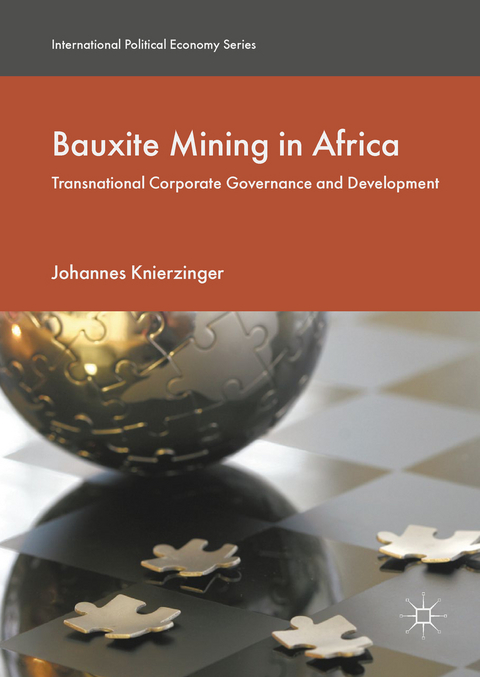
Bauxite Mining in Africa (eBook)
XVII, 268 Seiten
Springer International Publishing (Verlag)
978-3-319-52706-2 (ISBN)
This book deals with the consequences of the inclusion of African states and communities in the global aluminium chain. The so-called 'New Scramble for Africa' of the 2000s illustrated how seriously African living conditions are affected by continuous cycles of boom and bust, and how strongly the quality of life currently depends on the investment decisions and corporate social responsibility policies of transnational corporations. Taking the example of the global production network of bauxite and aluminium, the author focuses on the socio-political aspects of this dependency, which he achieves through the conducting of a series of interviews with various involved parties.
Johannes Knierzinger is Researcher at the Institut de recherche pour le développement (IRD) and works at the joint research unit Prodig (CNRS), France.
Johannes Knierzinger is Researcher at the Institut de recherche pour le développement (IRD) and works at the joint research unit Prodig (CNRS), France.
Acknowledgements 7
Contents 9
Acronyms 10
List of Figures 13
List of Tables 14
Chapter 1 Introduction 15
1.1 The Global Production Network of Aluminum 17
1.1.1 The Social and Ecological Consequences of Aluminum Production 21
1.2 Bauxite and Aluminum Production in Africa 25
1.2.1 Tanzania, Mozambique, and Sierra Leone 28
1.2.2 Mining and Smelting in Ghana 30
1.2.3 Mining and Refining in Guinea 33
1.2.4 Alucam in Cameroon 34
1.2.5 Nigeria’s “Alu City” Ikot Abasi 37
1.2.6 South Africa and Egypt 38
1.3 Concluding Remarks 39
Bibliography 43
Chapter 2 Concepts: Corporate Decision Spaces and Chains of Command 49
2.1 Commodity-Based Approaches 51
2.2 GCC, GVC, or GPN? 54
2.3 Possible Contributions of the ExtractiveSector to GPN Research 54
2.3.1 Corporate Decision Space and Infrastructural Power 56
2.4 Global Chains of Command 58
2.5 Crises of Chain Governance 61
2.6 The African State as a Victimof Globalization? 67
References 70
Chapter 3 Case Study: Guinea 77
3.1 The Decision Space of Rusal in Guinea 84
3.1.1 Fria 86
3.1.1.1 Fria Under Pechiney 87
3.1.1.2 Environmental Damage 93
3.1.1.3 Fria Turns into Friguia 95
Workers as Super-Citizens 98
Sysmin Programs in Fria 99
Pechiney Leaves 100
3.1.1.4 Fria Under Rusal (2003–2014) 102
The New Masters 104
Sub-Contracting 106
More Conflicts 108
Protests on the Countryside: The Example of Kondekhore 109
Dadis and the World Economic Crisis 112
Pensions 117
Wages 118
Condé Comes 120
Lights Out: Rusal Leaves Fria 121
From Fria to Dian-Dian 131
How to Jump Off a Lion 136
The Women Take Over 139
Current Situation and Outlook 141
3.1.2 Débélé 143
3.1.2.1 Tax Payments and the Electrification of Mambia 148
3.1.2.2 Infrastructure and Corporate Social Responsibility 152
3.1.2.3 Expropriations 153
3.1.2.4 Infrastructural Projects Under Control of Local Authorities 154
3.1.2.5 Salaries and Working Conditions 156
3.1.2.6 Meager Prospects 159
3.2 The Compagnie Des Bauxites de Guinée 160
3.2.1 History 165
3.2.1.1 OFAB and the Start of Construction 167
3.2.1.2 The Start of Production 169
3.2.2 Kamsar 173
3.2.2.1 Electricity, Security, and Relations with the Local Administration 178
3.2.2.2 Taxes Versus CSR 182
3.2.2.3 Comparison of “Public” and “Private” Investments in Infrastructure 183
3.2.2.4 Schools and Hospitals 187
3.2.2.5 Environment 190
3.2.2.6 New Projects 191
3.2.3 Sangaredi 192
3.2.3.1 Services 193
3.2.3.2 CSR, PDLs, and Taxes 196
Rich Workers and Poor Administrators 198
3.2.3.3 Local Neopatrimonialism 200
3.2.3.4 The Villages Around Sangaredi 201
Relocations and Compensations 202
Compensations for Destructions 203
Hamdalay 206
Ndanta Fonye 207
Wendou Diawle 209
Boundouwouande 209
The Construction Site of GAC 212
3.3 Summary of the Chapter 217
3.3.1 Post-Colonial Exploitation: Infrastructural Power Replaces Despotic Power 217
3.3.2 Status Quo in Guinea 223
References 235
Chapter 4 Conclusions 258
4.1 Global Chains of Command 258
4.2 Different Company Cultures 262
4.3 Two Crises of Chain Governance 264
4.4 Possible Ways Forward 266
Bibliography 268
Index 271
| Erscheint lt. Verlag | 7.9.2017 |
|---|---|
| Reihe/Serie | International Political Economy Series | International Political Economy Series |
| Zusatzinfo | XVII, 268 p. 16 illus., 6 illus. in color. |
| Verlagsort | Cham |
| Sprache | englisch |
| Themenwelt | Geschichte ► Allgemeine Geschichte ► Zeitgeschichte |
| Sozialwissenschaften ► Politik / Verwaltung ► Vergleichende Politikwissenschaften | |
| Sozialwissenschaften ► Soziologie | |
| Wirtschaft | |
| Schlagworte | Aluminium • Bauxite • Cameroon • Ghana • Guinea • Sierra Leone |
| ISBN-10 | 3-319-52706-1 / 3319527061 |
| ISBN-13 | 978-3-319-52706-2 / 9783319527062 |
| Informationen gemäß Produktsicherheitsverordnung (GPSR) | |
| Haben Sie eine Frage zum Produkt? |
 PDF (Wasserzeichen)
DRM: Digitales Wasserzeichen
Dieses eBook enthält ein digitales Wasserzeichen und ist damit für Sie personalisiert. Bei einer missbräuchlichen Weitergabe des eBooks an Dritte ist eine Rückverfolgung an die Quelle möglich.
Dateiformat: PDF (Portable Document Format)
Mit einem festen Seitenlayout eignet sich die PDF besonders für Fachbücher mit Spalten, Tabellen und Abbildungen. Eine PDF kann auf fast allen Geräten angezeigt werden, ist aber für kleine Displays (Smartphone, eReader) nur eingeschränkt geeignet.
Systemvoraussetzungen:
PC/Mac: Mit einem PC oder Mac können Sie dieses eBook lesen. Sie benötigen dafür einen PDF-Viewer - z.B. den Adobe Reader oder Adobe Digital Editions.
eReader: Dieses eBook kann mit (fast) allen eBook-Readern gelesen werden. Mit dem amazon-Kindle ist es aber nicht kompatibel.
Smartphone/Tablet: Egal ob Apple oder Android, dieses eBook können Sie lesen. Sie benötigen dafür einen PDF-Viewer - z.B. die kostenlose Adobe Digital Editions-App.
Buying eBooks from abroad
For tax law reasons we can sell eBooks just within Germany and Switzerland. Regrettably we cannot fulfill eBook-orders from other countries.
aus dem Bereich