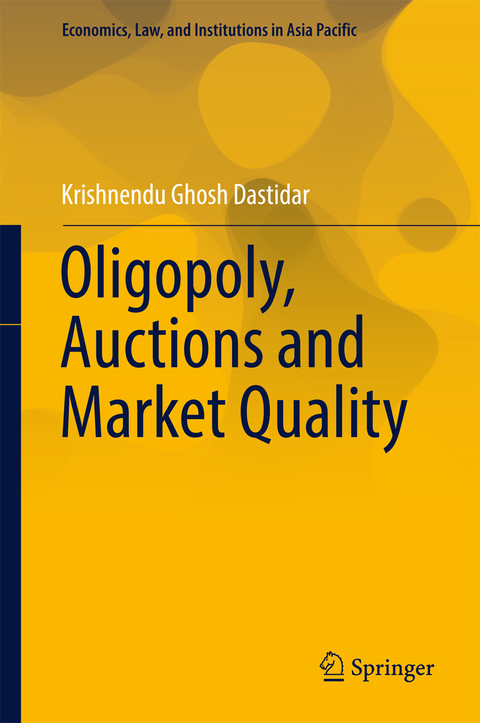
Oligopoly, Auctions and Market Quality (eBook)
XV, 189 Seiten
Springer Tokyo (Verlag)
978-4-431-55396-0 (ISBN)
This book provides an economic analysis of various aspects of 'market quality', a new concept which emerged in the 21st century, using the tools of 'oligopoly theory' and 'auction theory' that evolved over the 19th and 20th centuries. In the economics literature the link between the theories of oligopoly and auctions with market quality remains largely unexplored. This book attempts to forge such a link as it brings together relevant theoretical results in the literature on these topics under a unified framework. While the book is mainly theoretical in nature, it also discusses some specific issues related to the problems of market quality in emerging economies like India. Illustrated by carefully chosen examples, this book is highly recommended to readers who seek an in-depth and up-to-date integrated overview of the new field of market quality economics and are interested in some open research problems in this area.
How should auctions and other allocation mechanisms be designed for oligopolistic industries to achieve such goals as efficiency, high-quality output and fast production? Krishnendu Ghosh Dastidar's book offers novel analysis of this question and also some interesting answers. Highly recommended.
Eric S. Maskin, Nobel laureate in Economics
Krishnendu Ghosh Dastidar is a Professor of Economics at the Centre for Economic Studies and Planning, Jawaharlal Nehru University, New Delhi. His areas of specialization are oligopoly theory and auction theory. He was educated at Presidency College, Kolkata and Jawaharlal Nehru University, New Delhi. He pursued his Post-Doctoral research in 1997-98 as a visiting fellow, Department of Economics, Harvard University, USA (with a Ford Foundation Post-Doctoral Fellowship). He has been a visiting research scholar at the Institute of Social and Economic Research, Osaka University, Japan during April-July, 2010 and during the academic year 2013-14. He has published in leading economics journals such as the Journal of Economic Theory, Economic Theory, International Journal of Economic Theory, European Economic Review, and Games and Economic Behavior. He is on the editorial board of International Journal of Economic Theory, Journal of Quantitative Economics and Arthaniti (Economics).
This book provides an economic analysis of various aspects of 'market quality', a new concept which emerged in the 21st century, using the tools of 'oligopoly theory' and 'auction theory' that evolved over the 19th and 20th centuries. In the economics literature the link between the theories of oligopoly and auctions with market quality remains largely unexplored. This book attempts to forge such a link as it brings together relevant theoretical results in the literature on these topics under a unified framework. While the book is mainly theoretical in nature, it also discusses some specific issues related to the problems of market quality in emerging economies like India. Illustrated by carefully chosen examples, this book is highly recommended to readers who seek an in-depth and up-to-date integrated overview of the new field of market quality economics and are interested in some open research problems in this area.How should auctions and other allocation mechanisms be designed for oligopolistic industries to achieve such goals as efficiency, high-quality output and fast production? Krishnendu Ghosh Dastidar's book offers novel analysis of this question and also some interesting answers. Highly recommended. Eric S. Maskin, Nobel laureate in Economics
Krishnendu Ghosh Dastidar is a Professor of Economics at the Centre for Economic Studies and Planning, Jawaharlal Nehru University, New Delhi. His areas of specialization are oligopoly theory and auction theory. He was educated at Presidency College, Kolkata and Jawaharlal Nehru University, New Delhi. He pursued his Post-Doctoral research in 1997–98 as a visiting fellow, Department of Economics, Harvard University, USA (with a Ford Foundation Post-Doctoral Fellowship). He has been a visiting research scholar at the Institute of Social and Economic Research, Osaka University, Japan during April-July, 2010 and during the academic year 2013-14. He has published in leading economics journals such as the Journal of Economic Theory, Economic Theory, International Journal of Economic Theory, European Economic Review, and Games and Economic Behavior. He is on the editorial board of International Journal of Economic Theory, Journal of Quantitative Economics and Arthaniti (Economics).
1 Introduction.- 2 Allocation of scarce resources.- 3 E¤ects of corruption and incompetence in the quality monitoring process.- 4 On some aspects of scoring auctions.- 5 Some specifc market quality issues in emerging economies.- References.- Index.
| Erscheint lt. Verlag | 29.8.2017 |
|---|---|
| Reihe/Serie | Economics, Law, and Institutions in Asia Pacific | Economics, Law, and Institutions in Asia Pacific |
| Zusatzinfo | XV, 189 p. 11 illus. |
| Verlagsort | Tokyo |
| Sprache | englisch |
| Themenwelt | Wirtschaft ► Volkswirtschaftslehre |
| Schlagworte | auctions • Corruption • Emerging-economies • Market-quality • Oligopoly |
| ISBN-10 | 4-431-55396-7 / 4431553967 |
| ISBN-13 | 978-4-431-55396-0 / 9784431553960 |
| Informationen gemäß Produktsicherheitsverordnung (GPSR) | |
| Haben Sie eine Frage zum Produkt? |
 PDF (Wasserzeichen)
DRM: Digitales Wasserzeichen
Dieses eBook enthält ein digitales Wasserzeichen und ist damit für Sie personalisiert. Bei einer missbräuchlichen Weitergabe des eBooks an Dritte ist eine Rückverfolgung an die Quelle möglich.
Dateiformat: PDF (Portable Document Format)
Mit einem festen Seitenlayout eignet sich die PDF besonders für Fachbücher mit Spalten, Tabellen und Abbildungen. Eine PDF kann auf fast allen Geräten angezeigt werden, ist aber für kleine Displays (Smartphone, eReader) nur eingeschränkt geeignet.
Systemvoraussetzungen:
PC/Mac: Mit einem PC oder Mac können Sie dieses eBook lesen. Sie benötigen dafür einen PDF-Viewer - z.B. den Adobe Reader oder Adobe Digital Editions.
eReader: Dieses eBook kann mit (fast) allen eBook-Readern gelesen werden. Mit dem amazon-Kindle ist es aber nicht kompatibel.
Smartphone/Tablet: Egal ob Apple oder Android, dieses eBook können Sie lesen. Sie benötigen dafür einen PDF-Viewer - z.B. die kostenlose Adobe Digital Editions-App.
Buying eBooks from abroad
For tax law reasons we can sell eBooks just within Germany and Switzerland. Regrettably we cannot fulfill eBook-orders from other countries.
aus dem Bereich