Economics
South-Western College Publishing (Verlag)
978-1-337-61738-3 (ISBN)
- Titel erscheint in neuer Auflage
- Artikel merken
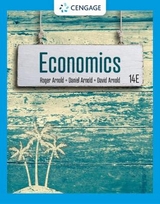
Short video lectures clarify key economic concepts, while longer Video Office Hours answer questions. In addition, "What’s Wrong With this Diagram?", "Working with Diagrams," and "Progression Graphs" videos help you work with diagrams. Digital resources Aplia and MindTap with new Adaptive Test Prep also help you to assess your personal economic understanding.
Dr. Roger Arnold is at California State University San Marcos, where his fields of specialization are general microeconomic theory and monetary theory. Dr. Arnold earned his B.S. in economics from the University of Birmingham in England. He received his Ph.D. in economics from Virginia Tech.
An Introduction to Economics.
Part I: ECONOMICS: THE SCIENCE OF SCARCITY.
1. What Economics Is About.
Appendix A: Working with Diagrams.
Appendix B: Should You Major in Economics?
2. Production Possibilities Frontier Framework.
3. Supply and Demand: Theory.
4. Prices: Free, Controlled, and Relative.
5. Supply, Demand, and Price: Applications.
Macroeconomics.
Part II: MACROECONOMIC FUNDAMENTALS.
6. Macroeconomic Measurements, Part I: Prices and Unemployment.
7. Macroeconomic Measurements, Part II: GDP and Real GDP.
Part III: MACROECONOMIC STABILITY, INSTABILITY, AND FISCAL POLICY.
8. Aggregate Demand and Aggregate Supply.
9. Classical Macroeconomics and the Self-Regulating Economy.
10. Keynesian Macroeconomics and Economic Instability: A Critique of the Self-Regulating Economy.
11. Fiscal Policy and the Federal Budget.
Part IV: MONEY, THE ECONOMY, AND MONETARY POLICY.
12. Money, Banking and the Financial System.
13. The Federal Reserve System.
Appendix C: The Market for Reserves (or the Federal Funds Market).
14. Money and the Economy.
15. Monetary Policy.
Appendix D: Bond Prices and Interest Rates.
Part V: EXPECTATIONS AND GROWTH.
16. Expectations Theory and the Economy.
17. Economic Growth: Resources, Technology, Ideas, and Institutions.
Part VI: GOVERNMENT AND THE ECONOMY.
18. Debates in Macroeconomics Over the Role and Effects of Government.
Microeconomics.
Part VII: MICROECONOMIC FUNDAMENTALS.
19. Elasticity.
20. Consumer Choice: Maximizing Utility and Behavioral Economics.
Appendix E: Budget Constraint and Indifference Curve Analysis.
21. Production and Costs.
Part VII: PRODUCT MARKETS AND POLICIES.
22. Perfect Competition.
23. Monopoly.
24. Monopolistic Competition, Oligopoly, and Game Theory.
25. Government and Product Markets: Antitrust and Regulation.
Part IX: FACTOR MARKETS AND RELATED ISSUES.
26. Factor Markets: With Emphasis on the Labor Market.
27. Wages, Unions, and Labor.
28. The Distribution of Income and Poverty.
29. Interest, Rent, and Profit.
Part X: MARKET FAILURE, PUBLIC CHOICE, AND SPECIAL-INTEREST-GROUP POLITICS.
30. Market Failure: Externalities, Public Goods, and Asymmetric Information.
31. Public Choice and Special-Interest-Group Politics.
Part XI: ECONOMICS THEORY-BUILDING AND EVERYDAY LIFE.
32. Building Theories to Explain Everyday Life: From Observations to Questions to Theories to Predictions.
The Global Economy.
Part XII: INTERNATIONAL ECONOMICS AND GLOBALIZATION.
33. International Trade.
34. International Finance.
Web Chapters.
35. The Economic Case For and Against Government: Five Topics Considered.
36. Stocks, Bonds, Futures, and Options.
| Erscheinungsdatum | 08.01.2018 |
|---|---|
| Verlagsort | Florence |
| Sprache | englisch |
| Maße | 88 x 18 mm |
| Gewicht | 1970 g |
| Themenwelt | Schulbuch / Wörterbuch ► Schulbuch / Allgemeinbildende Schulen |
| Sozialwissenschaften ► Pädagogik | |
| Wirtschaft ► Volkswirtschaftslehre | |
| ISBN-10 | 1-337-61738-5 / 1337617385 |
| ISBN-13 | 978-1-337-61738-3 / 9781337617383 |
| Zustand | Neuware |
| Informationen gemäß Produktsicherheitsverordnung (GPSR) | |
| Haben Sie eine Frage zum Produkt? |
aus dem Bereich