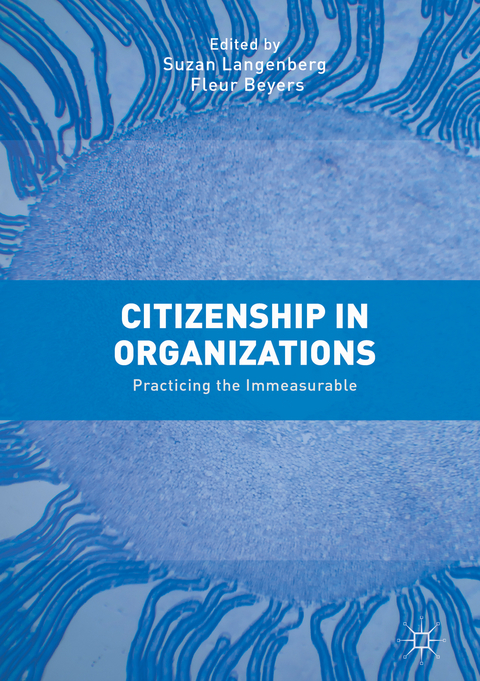
Citizenship in Organizations (eBook)
XV, 311 Seiten
Springer International Publishing (Verlag)
9783319602370 (ISBN)
This book explores the concept of citizenship, and the role that organizations can or do play in its creation, stimulation and control. Offering multiple organizational perspectives (private and public organisations) and their relation to several types of output (citizenship, poverty, profit, employability), this work presents a rich collection of philosophical thoughts and practices on the subject of citizenship within and without the organizational context. Particular attention is given to this human aspect, an element of unpredictability, a gut feeling, the unknown... something immeasurable that plays a part in human relations and how they organize themselves. Citizenship in Organizations casts new light on the impact of organizations to the notion of citizenship.
Fleur Beyers is an editor and researcher with a passion for language an
d philosophy. As a partner in a consulting firm, she has come across a wide variety of issues relating organizations and the position of the individual therein. She is also the co-owner of a Brasserie/Bar, which has provided her with a great amount of organizational practice. Fleur holds a research Master of Cultural Analysis from the University of Amsterdam, The NetherlandsSuzan Langenberg is a researcher, trainer and consultant and holds a PhD in Philosophy and Business Ethics from the Radboud University of Nijmegen, The Netherlands. Suzan is the author of multiple works on criticism and speaking up within an organizational context. Throughout her many years as coach and facilitator, she has built an extensive experience in leadership and organizational issues. Suzan is also active as a moderator of debates on social and philosophical issues.Fleur Beyers is an editor and researcher with a passion for language and philosophy. As a partner in a consulting firm, she has come across a wide variety of issues relating organizations and the position of the individual therein. She is also the co-owner of a Brasserie/Bar, which has provided her with a great amount of organizational practice. Fleur holds a research Master of Cultural Analysis from the University of Amsterdam, The Netherlands
Acknowledgements 5
Contents 6
Notes on Contributors 8
List of Figures 12
List of Tables 13
Introduction 14
An Example of Mixing the Incompatible 17
Organization Theory 18
Organizational Paradigms 19
Fourteen Contributions 22
References 28
In What Sense Does Economic Immeasurability Exist? 30
Introduction 30
Timeless Time and Future 35
Undecidability and Immeasurability 40
Notes 46
References 48
Meeting at the Boundaries: Marginality as a Source of Wealth 50
Background and Scope of the Chapter 50
Hermeneutics 53
2, 4, 8 … Doubling as the Basic Multiplier 53
Meeting at the Boundaries 56
Making Sense of the Two Themes: Growth and Development 58
Linking the Text to Professional Experience in Organizations and Social Systems 62
Concluding Remarks: About Hebron 64
Notes 65
References 65
Inequality of Power 67
Introduction 68
Inequality: Injustice or Submission? 68
Coercive Power and Social Inequality 70
Four Figures of Power 71
Slavery 72
Four Powers and Their Enslavement 74
Power Inequality After the Abolition of Slavery 77
Political Imbalance of Power 78
The Unequalizing Power of Possession 79
Self-Mastery and Equalization 80
Conclusion 81
Notes 82
References 83
Politics: Understanding a Volatile Realm 85
Introduction 86
Politics: An Immeasurable 86
Dislocation 87
An Examination of the Definition: A Practical Case 89
Multifocal: Only One View on a Given Situation 94
Contingent and Unpredictable 95
A Personal Dimension 96
Tension—Attention—Awaiting: Producing Politics 96
Personal Necessity Generating Politics 96
Going Public: Converging Public and Personal Interests 97
De-personalizing: The Political Realm 98
Opening an Immeasurable Realm 99
Abstraction Producing Governance 100
The Case Revisited 101
Revisiting My Definition of Politics 102
Conclusion 105
References 106
Is There Space for Rational Thinking in Altruism? From Charity to Philanthropy 107
Introduction 108
Exploring Some Mental Processes Which Suppress Rational Thinking 109
Religious Convictions and Ideologies of ‘Helping the Poor’ 110
Compassion and Ethical Drive Tend to Suppress Exploring the Feasibility of Altruistic Actions 111
‘Doing Well’ Should Be Unselfish! 112
Some Critical Voices About Charity and Aid Organizations 113
Appreciating Charitable Projects, Not Just Their Organizations 118
Guiding Thoughts on Responsible Altruism 125
Notes 126
References 127
Guiltless Guilt, Basis of a Critical Morality 128
Introduction 129
The Original Sin 130
The Guilty Context 132
Guilty Language 134
How Can We Escape the Guilty Context? 136
The Awareness of Guilt, the Basis for a Critical Ethic 138
Facilitation of Criticism in Organizations 139
Notes 142
References 142
Organizing Counter-Conduct 143
Introduction 144
Organizing Is Changing 146
Sensemaking and Interruption 150
The Relation with Criticism, the Foucauldian Version 151
Resistance/Counter-Conduct 153
The Role of Answering and Othering 155
Back to Organizing Again 158
Final Remarks 161
Notes 162
References 163
Emergent Times: Disruptive Logic as a Breeding Ground 166
Notes 182
References 182
Toward an Irony-Centered Organization 184
Introduction 185
The Relationship Between the Organizational Words and the Organizational Things 186
Language and Economy 188
Functionality Versus Factors of Expressiveness 189
Irony as Factor of Expressiveness 192
Language and Work 193
Language Theory of the Financial Markets 194
Kierkegaard’s Negative Freedom 197
The Concept of Irony 198
Contradictions and Organizations 200
Irony as a Critical Stance Within the Organization 203
Toward an Irony-Centered Organization 205
References 208
Immeasurability, Biology, Identity. Citizenship and the Meaning of a Diagnostic Label for Adults Diagnosed with Autism 209
Introduction 210
Methodology 213
Results 215
Autism’s Moral Career 216
Autism’s Explanatory Power and Practical Advantages 220
Autism’s Ambiguities 222
Conclusion: Beyond the Diagnosis 225
Notes 229
References 229
Recognition: A Business Case for Developing Through Relationships 232
Introduction 233
Modern Man and the Issue of Recognition 234
Understanding Human Development 236
Recognition in the Organization 241
The Case of Sheila 245
The Case of Anita 248
Conclusion 253
Notes 254
References 255
Facilitating the Unexpected 256
Introduction 257
Family Group Conferencing, Reveal the Unpredictable 257
The Origin of Eigen Kracht-Conferenties 260
There Is an Issue 261
The Referral 262
Patrick’s Story: ‘My Network Will Never Help Me’ 263
The Activation of the Network 264
A Story of Family Care: ‘We Did Not Know’ 265
The Actual Meeting: An Eigen Kracht-Conferentie 266
When the Organization Meets a Person: Julien, Rescued from Care5 267
The Outcome of an EK-c 271
Tom’s Story 271
Lucy’s Story 272
Conclusion 273
Notes 274
References 275
Boundaries of (Im)measurability in Palliative Care 276
Introduction 277
Palliative Support Team 277
Legal Regulation PST 277
Positioning of PST Within the Hospital Structure 278
PST in Practice 278
Role as Psychologist Within the PST 279
Palliative Care 280
Measurability and Immeasurability in Palliative Care 281
False Reassurance 286
Palliative Care Within the Hospital Organization: A Field of Tension 286
Case Analysis 288
Case 1 288
Measurable Versus Immeasurable in Case 1 289
Case 2 291
Measurable Versus Immeasurable in Case 2 292
Conclusion and Discussion 293
References 294
Measuring the Immeasurable 295
Introduction 296
Definition of Poverty 298
Inequality Poverty Versus Endemic Poverty 299
Traditional ‘Solutions’ to Poverty 299
Small-Scale Social Practice 299
Social Work 300
Is Poverty Inevitable? 303
The Importance of Measuring Well-Being 304
Choosing the Right Measuring Tools 306
Addressing the Poverty Web with System Dynamics 306
Money Matters 308
Fooled by Experience Based Learning 309
ATK: A Multi-Disciplinary Action Research Project 310
Conclusion 311
Notes 312
References 313
Index 315
| Erscheint lt. Verlag | 10.8.2017 |
|---|---|
| Zusatzinfo | XV, 311 p. 3 illus. |
| Verlagsort | Cham |
| Sprache | englisch |
| Themenwelt | Wirtschaft ► Betriebswirtschaft / Management ► Personalwesen |
| Schlagworte | interdependence • Organizing • Philosophy • Sense • Society • sociology of the workplace |
| ISBN-13 | 9783319602370 / 9783319602370 |
| Informationen gemäß Produktsicherheitsverordnung (GPSR) | |
| Haben Sie eine Frage zum Produkt? |
 PDF (Wasserzeichen)
DRM: Digitales Wasserzeichen
Dieses eBook enthält ein digitales Wasserzeichen und ist damit für Sie personalisiert. Bei einer missbräuchlichen Weitergabe des eBooks an Dritte ist eine Rückverfolgung an die Quelle möglich.
Dateiformat: PDF (Portable Document Format)
Mit einem festen Seitenlayout eignet sich die PDF besonders für Fachbücher mit Spalten, Tabellen und Abbildungen. Eine PDF kann auf fast allen Geräten angezeigt werden, ist aber für kleine Displays (Smartphone, eReader) nur eingeschränkt geeignet.
Systemvoraussetzungen:
PC/Mac: Mit einem PC oder Mac können Sie dieses eBook lesen. Sie benötigen dafür einen PDF-Viewer - z.B. den Adobe Reader oder Adobe Digital Editions.
eReader: Dieses eBook kann mit (fast) allen eBook-Readern gelesen werden. Mit dem amazon-Kindle ist es aber nicht kompatibel.
Smartphone/Tablet: Egal ob Apple oder Android, dieses eBook können Sie lesen. Sie benötigen dafür einen PDF-Viewer - z.B. die kostenlose Adobe Digital Editions-App.
Buying eBooks from abroad
For tax law reasons we can sell eBooks just within Germany and Switzerland. Regrettably we cannot fulfill eBook-orders from other countries.
aus dem Bereich