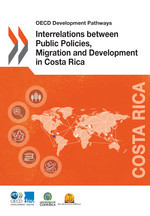
OECD Development Pathways Interrelations between Public Policies, Migration and Development in Costa Rica (eBook)
128 Seiten
OECD Publishing (Verlag)
978-92-64-27910-0 (ISBN)
Interrelations between Public Policies, Migration and Development in Costa Rica is the result of a project carried out by the Centro Centroamericano de Población (CCP) at the University of Costa Rica and the OECD Development Centre, in collaboration with the Dirección General de Migración y Extranjeria (DGME) and with support from the European Union. The project aimed to provide policy makers with evidence on the way migration influences specific sectors – the labour market, agriculture, education, investment and financial services and social protection and health – and, in turn, how sectoral policies affect migration. The report addresses four dimensions of the migration cycle: emigration, remittances, return and immigration.
The results of the empirical work confirm that migration contributes to the development of Costa Rica, but the potential of migration is not fully exploited. One explanation is that, despite the acknowledgement of the links between migration and development in recent legislation and policy, policy makers in Costa Rica do not sufficiently take migration into account in all respective policy areas. Costa Rica therefore needs to adopt a more coherent policy agenda to better integrate migration into development strategies, improve co-ordination mechanisms and strengthen international co-operation, to enhance the contribution of migration to development in the country.
Interrelations between Public Policies, Migration and Development in Costa Rica is the result of a project carried out by the Centro Centroamericano de Poblacin (CCP) at the University of Costa Rica and the OECD Development Centre, in collaboration with the Direccin General de Migracin y Extranjeria (DGME) and with support from the European Union. The project aimed to provide policy makers with evidence on the way migration influences specific sectors - the labour market, agriculture, education, investment and financial services and social protection and health - and, in turn, how sectoral policies affect migration. The report addresses four dimensions of the migration cycle: emigration, remittances, return and immigration. The results of the empirical work confirm that migration contributes to the development of Costa Rica, but the potential of migration is not fully exploited. One explanation is that, despite the acknowledgement of the links between migration and development in recent legislation and policy, policy makers in Costa Rica do not sufficiently take migration into account in all respective policy areas. Costa Rica therefore needs to adopt a more coherent policy agenda to better integrate migration into development strategies, improve co-ordination mechanisms and strengthen international co-operation, to enhance the contribution of migration to development in the country.
Chapter 1. Integrating migration and development in Costa Rica: Overview and policy recommendations
Costa Rica has recently started seeing the potential of migration for development. However, there are still opportunities being missed to harness the full development potential embodied in its significant rates of emigration and immigration. The Interrelations between Public Policies, Migration and Development (IPPMD) project was conducted in Costa Rica between 2013 and 2017 to explore, through both quantitative and qualitative analysis, the two-way relationship between migration and public policies in five key sectors: the labour market, agriculture, education, investment and financial services, and social protection and health. This chapter provides an overview of the project’s findings for Costa Rica, highlighting the potential for migration in many of its dimensions (emigration, immigration, remittances and return migration) to boost development, and analysing the sectoral policies that will allow this to happen.
Costa Rica has a unique position in Central America as both a destination for and origin of migrants. It attracts immigrants from neighbouring countries as well as from the United States, while a significant part of its own population lives abroad.
These migration flows, and the remittances sent home, bring both opportunities and challenges to the country. The key question now is how to create a favourable policy environment across all relevant sectors to enhance the positive, and minimise the negative, impacts of migration.
This report details the Costa Rican findings of a ten-country study on the interrelations between public policies, migration and development (IPPMD; Box 1.1). It aims to provide policy makers with empirical evidence on the role played by migration in policy areas that matter for development. It also explores the influence on migration of public policies not specifically targeted at migration. This chapter provides an overview of the findings and policy recommendations.
Box 1.1. What is the IPPMD project?
In January 2013, the OECD Development Centre launched a project, co-funded by the EU Thematic Programme on Migration and Asylum, on the Interrelations between public policies, migration and development: case studies and policy recommendations (IPPMD). This project – carried out in ten low and middle-income countries between 2013 and 2017 – sought to provide policy makers with evidence of the importance of integrating migration into development strategies and fostering coherence across sectoral policies. A balanced mix of developing countries was chosen to participate in the project: Armenia, Burkina Faso, Cambodia, Costa Rica, Côte d’Ivoire, the Dominican Republic, Georgia, Haiti, Morocco and the Philippines.
While evidence abounds of the impacts – both positive and negative – of migration on development, the reasons why policy makers should integrate migration into development planning still lack empirical foundations. The IPPMD project aimed to fill this knowledge gap by providing reliable evidence not only for the contribution of migration to development, but also for how this contribution can be reinforced through policies in a range of sectors. To do so, the OECD designed a conceptual framework that explores the links between four dimensions of migration (emigration, remittances, return migration and immigration) and five key policy sectors: the labour market, agriculture, education, investment and financial services and social protection and health (Figure 1.1). The conceptual framework also linked these five sectoral policies to a variety of migration outcomes (Table 1.1).
| Table 1.1. Migration dimensions and migration outcomes in the IPPMD study |
|---|
| Migration dimensions | Migration outcomes |
|---|
| Emigration | Emigration happens when people live outside of their countries of origin for at least three consecutive months.a | The decision to emigrate is an important outcome for the countries of origin, not only because it may lead to actual outflows of people in the short term, but also because it may increase the number of emigrants living abroad in the long term. |
| Remittances | Remittances are international transfers, mostly financial, that emigrants send to those left behind.b | The sending and receiving of remittances includes the amount of remittances received and channels used to transfer money, which in turn affect the ability to make long-term investments. The use of remittances is often considered as a priority for policy makers, who would like to orientate remittances towards productive investment. |
| Return migration | Return migration occurs when international migrants decide to go back to and settle in, temporarily or permanently, their countries of origin. | The decision to return is influenced by various factors including personal preferences towards home countries or circumstances in host countries. Return migration, either temporary or permanent, can be beneficial for countries of origin, especially when it involves highly skilled people. The sustainability of return measures the success of return migration, whether voluntary or forced, for the migrants and their families, but also for the home country. |
| Immigration | Immigration occurs when individuals born in another country – regardless of their citizenship – stay in a country for at least three months. | The integration of immigrants implies that they have better living conditions and contribute more to the development of their host and, by extension, home countries. |
The methodological framework developed by the OECD Development Centre and the data collected by its local research partners together offer an opportunity to fill significant knowledge gaps in the migration and development nexus. Several aspects in particular make the IPPMD approach unique and important for shedding light on how the two-way relationship between migration and public policies affects development:
-
The same survey tools were used in all countries over the same time period (2014-15), allowing for comparisons across countries.
-
The surveys covered a variety of migration dimensions and outcomes (Table 1.1), thus providing a comprehensive overview of the migration cycle.
-
The project examined a wide set of policy programmes across countries covering the five key sectors.
-
Quantitative and qualitative tools were combined to collect a large new body of primary data on the ten partner countries:
-
A household survey covered on average around 2 000 households in each country, both migrant and non-migrant households. Overall, more than 20 500 households, representing about 100 000 individuals, were interviewed for the project.
-
A community survey reached a total of 590 local authorities and community leaders in the communities where the household questionnaire was administered.
-
Qualitative in-depth stakeholder interviews were held with key stakeholders representing national and local authorities, academia, international organisations, civil society and the private sector. In total, 375 interviews were carried out across the ten countries.
-
-
The data were analysed using both descriptive and regression techniques. The former identifies broad patterns and correlations between key variables concerning migration and public policies, while the latter deepens the empirical understanding of these interrelations by also controlling for other factors.
In October 2016, the OECD Development Centre and European Commission hosted a dialogue in Paris on tapping the benefits of migration for development through more coherent policies. The event served as a platform for policy dialogue between policy makers from partner countries, academic experts, civil society and multilateral organisations. It discussed the findings and concrete policies that can help enhance the contribution of migration to the development of both countries of origin and destination. A cross-country comparative report (OECD, 2017) and the ten country reports will be published in 2017.
a. Due to the lack of data, the role of diasporas – which often make an active contribution to hometown associations or professional or interest networks – is not analysed in this report.
b. Besides financial transfers, remittances also include social remittances – i.e. the ideas, values and social capital transferred by migrants. Even though social remittances represent an important aspect of the migration-development nexus, they go beyond the scope of this project and are therefore not discussed in this report.
Why was Costa Rica included in the IPPMD project?
Costa Rica is a country of significant emigration and immigration flows. While overall it...
| Erscheint lt. Verlag | 31.7.2017 |
|---|---|
| Sprache | englisch |
| Themenwelt | Wirtschaft ► Volkswirtschaftslehre ► Makroökonomie |
| ISBN-10 | 92-64-27910-5 / 9264279105 |
| ISBN-13 | 978-92-64-27910-0 / 9789264279100 |
| Informationen gemäß Produktsicherheitsverordnung (GPSR) | |
| Haben Sie eine Frage zum Produkt? |
 EPUB (Adobe DRM)
Kopierschutz: Adobe-DRM
Adobe-DRM ist ein Kopierschutz, der das eBook vor Mißbrauch schützen soll. Dabei wird das eBook bereits beim Download auf Ihre persönliche Adobe-ID autorisiert. Lesen können Sie das eBook dann nur auf den Geräten, welche ebenfalls auf Ihre Adobe-ID registriert sind.
Details zum Adobe-DRM
Dateiformat: EPUB (Electronic Publication)
EPUB ist ein offener Standard für eBooks und eignet sich besonders zur Darstellung von Belletristik und Sachbüchern. Der Fließtext wird dynamisch an die Display- und Schriftgröße angepasst. Auch für mobile Lesegeräte ist EPUB daher gut geeignet.
Systemvoraussetzungen:
PC/Mac: Mit einem PC oder Mac können Sie dieses eBook lesen. Sie benötigen eine
eReader: Dieses eBook kann mit (fast) allen eBook-Readern gelesen werden. Mit dem amazon-Kindle ist es aber nicht kompatibel.
Smartphone/Tablet: Egal ob Apple oder Android, dieses eBook können Sie lesen. Sie benötigen eine
Geräteliste und zusätzliche Hinweise
Buying eBooks from abroad
For tax law reasons we can sell eBooks just within Germany and Switzerland. Regrettably we cannot fulfill eBook-orders from other countries.
aus dem Bereich