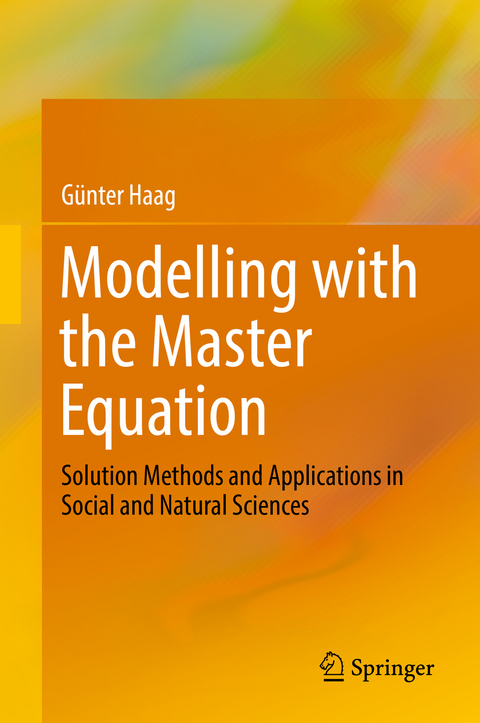
Modelling with the Master Equation (eBook)
XXV, 342 Seiten
Springer International Publishing (Verlag)
978-3-319-60300-1 (ISBN)
This book presents the theory and practical applications of the Master equation approach, which provides a powerful general framework for model building in a variety of disciplines. The aim of the book is to not only highlight different mathematical solution methods, but also reveal their potential by means of practical examples.
Part I of the book, which can be used as a toolbox, introduces selected statistical fundamentals and solution methods for the Master equation. In Part II and Part III, the Master equation approach is applied to important applications in the natural and social sciences.
The case studies presented mainly hail from the social sciences, including urban and regional dynamics, population dynamics, dynamic decision theory, opinion formation and traffic dynamics; however, some applications from physics and chemistry are treated as well, underlining the interdisciplinary modelling potential of the Master equation approach.
Drawing upon the author's extensive teaching and research experience and consulting work, the book offers a valuable guide for researchers, graduate students and professionals alike.
Guenter Haag studied engineering and physics at the University of Stuttgart and earned his Ph. D in Physics in 1978. He was visiting professor at the Case Western Reserve University, Cleveland in 1982 and the Institute for Advanced Studies (IHS), Vienna in 1990. At that time he was also member of the working groups Long waves in economy and Metropolitan studies at the International Institute for Applied Systems Analysis (IIASA), Laxenburg. The appointment to a university lectureship came in 1985 and in 1995 he was appointed APL professor for Theoretical Physics at the University of Stuttgart. In 1993 he became in addition managing director of the Institute for Applied Economic Research, Tuebingen. Two years later he founded the Steinbeis Transfer Center Applied Systems Analysis in Stuttgart, and in 2003 the STASA GmbH. He is member of different international working groups and member in the editorial board of international journals. He has initiated and led several national and international projects in the field of system analysis, statistics, urban and regional development and transport theory. Robert-Mayer-Award, do-it Software-Award 2004, Löhn-Award 2011.
Guenter Haag studied engineering and physics at the University of Stuttgart and earned his Ph. D in Physics in 1978. He was visiting professor at the Case Western Reserve University, Cleveland in 1982 and the Institute for Advanced Studies (IHS), Vienna in 1990. At that time he was also member of the working groups Long waves in economy and Metropolitan studies at the International Institute for Applied Systems Analysis (IIASA), Laxenburg. The appointment to a university lectureship came in 1985 and in 1995 he was appointed APL professor for Theoretical Physics at the University of Stuttgart. In 1993 he became in addition managing director of the Institute for Applied Economic Research, Tuebingen. Two years later he founded the Steinbeis Transfer Center Applied Systems Analysis in Stuttgart, and in 2003 the STASA GmbH. He is member of different international working groups and member in the editorial board of international journals. He has initiated and led several national and international projects in the field of system analysis, statistics, urban and regional development and transport theory. Robert-Mayer-Award, do-it Software-Award 2004, Löhn-Award 2011.
Preface.- 1 Introduction.- 2 Statistical Fundamentals.- 3 Derivation of the Chapman-Kolmogorov Equation and the Master Equation.- 4 Solution Methods of Master Equations.- 5 Some Applications in Physics and Chemistry.- 6 The Master Equation in Dynamic Decision Theory.- 7 Applications in Population Dynamics.- 8 Migration.- 9 Urban Dynamics and Transport.
| Erscheint lt. Verlag | 31.7.2017 |
|---|---|
| Zusatzinfo | XXV, 342 p. 109 illus., 19 illus. in color. |
| Verlagsort | Cham |
| Sprache | englisch |
| Themenwelt | Mathematik / Informatik ► Mathematik |
| Naturwissenschaften ► Chemie | |
| Naturwissenschaften ► Physik / Astronomie | |
| Sozialwissenschaften ► Politik / Verwaltung | |
| Sozialwissenschaften ► Soziologie ► Empirische Sozialforschung | |
| Wirtschaft | |
| Schlagworte | Dynamic Decision Theory • Dynamics • Econophysics-Migration-Urban • Fokker-Planck Equation • Master Equation • Model Building • Modelling • population dynamics • Social Sciences • Transport |
| ISBN-10 | 3-319-60300-0 / 3319603000 |
| ISBN-13 | 978-3-319-60300-1 / 9783319603001 |
| Informationen gemäß Produktsicherheitsverordnung (GPSR) | |
| Haben Sie eine Frage zum Produkt? |
 PDF (Wasserzeichen)
DRM: Digitales Wasserzeichen
Dieses eBook enthält ein digitales Wasserzeichen und ist damit für Sie personalisiert. Bei einer missbräuchlichen Weitergabe des eBooks an Dritte ist eine Rückverfolgung an die Quelle möglich.
Dateiformat: PDF (Portable Document Format)
Mit einem festen Seitenlayout eignet sich die PDF besonders für Fachbücher mit Spalten, Tabellen und Abbildungen. Eine PDF kann auf fast allen Geräten angezeigt werden, ist aber für kleine Displays (Smartphone, eReader) nur eingeschränkt geeignet.
Systemvoraussetzungen:
PC/Mac: Mit einem PC oder Mac können Sie dieses eBook lesen. Sie benötigen dafür einen PDF-Viewer - z.B. den Adobe Reader oder Adobe Digital Editions.
eReader: Dieses eBook kann mit (fast) allen eBook-Readern gelesen werden. Mit dem amazon-Kindle ist es aber nicht kompatibel.
Smartphone/Tablet: Egal ob Apple oder Android, dieses eBook können Sie lesen. Sie benötigen dafür einen PDF-Viewer - z.B. die kostenlose Adobe Digital Editions-App.
Buying eBooks from abroad
For tax law reasons we can sell eBooks just within Germany and Switzerland. Regrettably we cannot fulfill eBook-orders from other countries.
aus dem Bereich