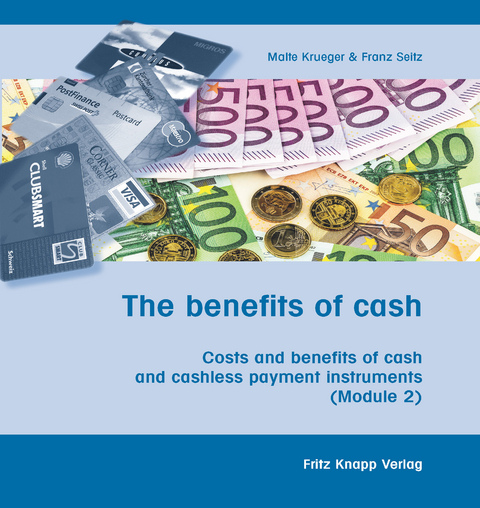
The benefits of cash (eBook)
104 Seiten
Fritz Knapp Verlag
9783831408832 (ISBN)
An analysis in which the costs and benefits of cash are considered on an equal footing is an essential foundation for a factual discussion about cash. While much attention is paid to the cost aspects, the benefits of cash are usually given less consideration in the relevant literature. This state of affairs led the Bundesbank to commission an external study analysing payment instruments in Germany – with a particular focus on cash payments – and evaluating their associated costs and benefits. The first part of the study, “Overview and initial estimates”, published in 2014, provides a critical overview of the literature on cost calculations and the significance of payment transactions in various countries. This module also provides an independent account of the importance and cost of cash and cashless payment instruments for the national economy. This second module of the study focuses especially on the benefits of cash. The authors describe the microeconomic, macroeconomic and societal benefits of cash. Against this backdrop, this study attempts to systematically capture the benefits, without providing a quantitative assessment. In addition, it goes into explicit detail about the aforementioned arguments put forward by critics of cash as well as the drawbacks and consequences of abolishing cash. To achieve an overall picture of the costs and benefits of cash, the costs generated by the use of cash are to be quantified in the study's planned third module.
Malte Krueger is Professor of Economics at the University of Applied Sciences in Aschaffenburg (Germany). He has worked as a research fellow for a number of institutions, inter alia, the Bank of Spain, the University of Western Ontario, and the European Commission. For many years he has also been a consultant for PaySys Consultancy (Frankfurt) with a focus on card payments. Academic research has mainly addressed cash and cash-less payments, two-sided markets, monetary economics and exchange rates. Currently, he works on a Bundesbank project on the costs and benefits of cash. Professor Franz Seitz teaches Economics with a special focus on Monetary Policy and Financial Markets at Weiden Technical University of Applied Sciences. He is also one of the leading members of the "Aktionskreis: Stabiles Geld". Before his professorship, he worked at the Deutsche Bundesbank in the division Money, Credit and Capital Markets. Professor Seitz is author of numerous articles in national and international journals. His textbook "European Monetary Policy: Theory, empirical applications and practice" ("Europäische Geldpolitik: Theorie, Empirie und Praxis") has become a standard book in German speaking countries. Additionally, one research focus is the payment system and cash in circulation. For many years now, Professor Seitz is acting as a consultant in different projects together with the Deutsche Bundesbank and the European Central Bank.
Preface
1 Introduction and overview
2 Benefits of cash: an overview of the literature
3 Some general remarks
4 Macroeconomic benefits
4.1 Implications for monetary policy
4.2 Role of cash in financial crises
4.3 Consequences for a two-stage banking system (A bank is where the money is)
4.4 Special role of foreign holdings
4.5 Seigniorage
5 Microeconomic benefits
5.1 Payment behaviour, risk and technology
5.1.1 The problem
5.1.2 Data and definition of variables
5.1.3 Results
5.1.4 Interpretation and classification of the results
5.2 Overview and control of spending
5.3 Lower income groups and cash (payments inclusion)
5.4 Data protection and privacy
5.5 A potential electronic substitute for cash
6 Societal benefit
6.1 Fall-back solution for cashless payments
6.2 Independence of foreign card providers
6.3 Benchmark for card fees
6.4 Alternative to a narrow oligopoly
6.5 Welfare aspects of cash
7 Criticism of cash
7.1 The shadow economy argument
7.2 The monetary policy argument
7.3 The speed argument and security aspects
7.4 Search for efficient prices
7.5 Possible disruptions to the cash supply
8 Summary, conclusions
References
Annex
| Erscheint lt. Verlag | 4.8.2017 |
|---|---|
| Verlagsort | Frankfurt |
| Sprache | englisch |
| Themenwelt | Sachbuch/Ratgeber ► Beruf / Finanzen / Recht / Wirtschaft ► Geld / Bank / Börse |
| Wirtschaft ► Betriebswirtschaft / Management | |
| Schlagworte | A potential electronic substitute for cash • Bargeld • Bargeldversorgung • Benefits of cash • Criticism of cash • Der Nutzen von Bargeld • Elektronischer Bargeldeinsatz • Implications for monetary policy • Implikationen der Geldpolitik • Kritik am Bargeld • Macroeconomic benefits • Makroökonomischer Nutzen • Payment behaviour • Role of cash in financial crises • Rolle des Bargeldes • Schattenwirtschaft • The shadow economy • Zahlungsverhalten |
| ISBN-13 | 9783831408832 / 9783831408832 |
| Informationen gemäß Produktsicherheitsverordnung (GPSR) | |
| Haben Sie eine Frage zum Produkt? |
 EPUB (Wasserzeichen)
DRM: Digitales Wasserzeichen
Dieses eBook enthält ein digitales Wasserzeichen und ist damit für Sie personalisiert. Bei einer missbräuchlichen Weitergabe des eBooks an Dritte ist eine Rückverfolgung an die Quelle möglich.
Dateiformat: EPUB (Electronic Publication)
EPUB ist ein offener Standard für eBooks und eignet sich besonders zur Darstellung von Belletristik und Sachbüchern. Der Fließtext wird dynamisch an die Display- und Schriftgröße angepasst. Auch für mobile Lesegeräte ist EPUB daher gut geeignet.
Systemvoraussetzungen:
PC/Mac: Mit einem PC oder Mac können Sie dieses eBook lesen. Sie benötigen dafür die kostenlose Software Adobe Digital Editions.
eReader: Dieses eBook kann mit (fast) allen eBook-Readern gelesen werden. Mit dem amazon-Kindle ist es aber nicht kompatibel.
Smartphone/Tablet: Egal ob Apple oder Android, dieses eBook können Sie lesen. Sie benötigen dafür eine kostenlose App.
Geräteliste und zusätzliche Hinweise
Buying eBooks from abroad
For tax law reasons we can sell eBooks just within Germany and Switzerland. Regrettably we cannot fulfill eBook-orders from other countries.
aus dem Bereich