John Broome is White's Professor of Moral Philosophy at Oxford University.
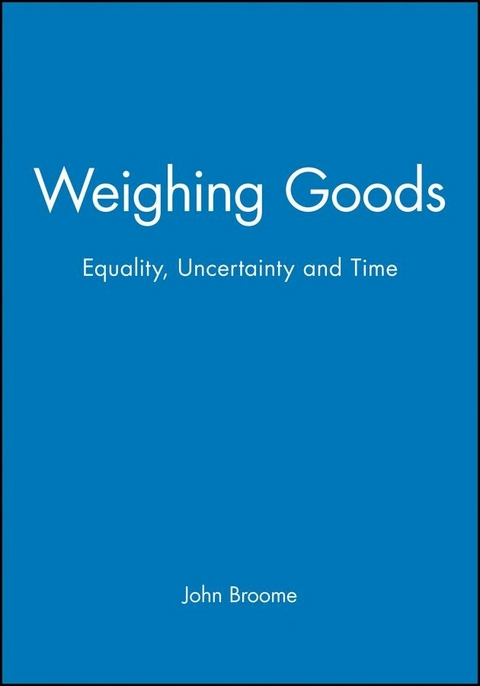
This study uses techniques from economics to illuminate fundamental questions in ethics, particularly in the foundations of utilitarianism. Topics considered include the nature of teleological ethics, the foundations of decision theory, the value of equality and the moral significance of a person's continuing identity through time.
John Broome is White's Professor of Moral Philosophy at Oxford University.
Cover 1
Half-Title Page 3
Title Page 5
Copyright Page 6
Contents 7
Preface 11
Chapter 1. Introduction I: The Structure of Good 13
1.1 Acts versus consequences, and agent relativity 15
1.2 The working of ethical considerations 18
1.3 Teleological structure 22
1.4 Does good exist? 29
Notes 32
Chapter 2. Introduction II: Weighing Goods 34
2.1 Locations of good, and separability 34
2.2 Three dimensions of locations 37
2.3 Dimensions with varying lengths 41
2.4 What things are good? 44
2.5 An outline of the argument 44
Notes 50
Chapter 3. Similarity Arguments 51
3.1 Parfit, Section 1 52
3.2 Parfit, Section 2 60
3.3 Harsanyi 63
Notes 70
Chapter 4. The Separability Theorems 72
4.1 Two examples 72
4.2 Definitions and theorems 77
4.3 The significance of additive separability 82
4.4 The rectangular field assumption 92
Notes 93
Appendix to Chapter 4: Proofs 94
Chapter 5. Expected Utility and Rationality 102
5.1 Axiomatic expected utility theory 102
5.2 The sure-thing principle 106
5.3 Individuation of outcomes 107
5.4 Transitivity of preferences 112
5.5 Rational requirements of indifference 116
5.6 Individuation and the sure-thing principle 119
5.7 The dispersion of value amongst states of nature 122
5.8 The rectangular field assumption 127
Notes 129
Chapter 6. The Coherence of Good 133
6.1 The goodness of uncertain prospects 134
6.2 Betterness and rational preferences 143
6.3 The argument for coherence 148
6.4 Representing betterness by utility 151
6.5 Bernoulli's hypothesis 154
Notes 160
Chapter 7. Coherence Against the Pareto Principle 163
7.1 The conflict 164
7.2 Two better principles 166
7.3 Welfare economics 171
Notes 176
Chapter 8. The Principle of Personal Good 177
8.1 Qualifications 177
8.2 The beginning of a defence 179
Notes 185
Chapter 9. Equality 186
9.1 A utilitarian case for equality 187
9.2 Types of egalitarianism 189
9.3 Equality under uncertainty 197
9.4 Fairness and equality 204
Notes 212
Chapter 10. The Interpersonal Addition Theorem 214
10.1 Proof 215
10.2 Connecting dimensions 221
10.3 The utilitarian principle of distribution 225
Notes 234
Chapter 11. Utilitarian Metaphysics? 236
11.1 The intertemporal addition theorem 236
11.2 The principle of temporal good 240
11.3 The metaphysical argument 242
11.4 Conclusion 249
Notes 252
Bibliography 253
Index 263
EULA 269
| Erscheint lt. Verlag | 7.7.2017 |
|---|---|
| Sprache | englisch |
| Themenwelt | Geisteswissenschaften ► Philosophie ► Allgemeines / Lexika |
| Geisteswissenschaften ► Philosophie ► Ethik | |
| Wirtschaft ► Allgemeines / Lexika | |
| Wirtschaft ► Volkswirtschaftslehre | |
| Schlagworte | Decision • Economics • Economic Theory • ethics • Foundations • Identity • illuminate fundamental • moral significance • Nature • particularly • persons continuing • Philosophie • Philosophy • Political & Economic Philosophy • Politische u. Ãkonomische Philosophie • Politische u. Ökonomische Philosophie • questions • Study • teleological • theory • Time • Topics • uses techniques • Utilitarianism • Volkswirtschaftslehre • Wirtschaftstheorie |
| ISBN-13 | 9781119451297 / 9781119451297 |
| Informationen gemäß Produktsicherheitsverordnung (GPSR) | |
| Haben Sie eine Frage zum Produkt? |
 PDF (Adobe DRM)
Kopierschutz: Adobe-DRM
Adobe-DRM ist ein Kopierschutz, der das eBook vor Mißbrauch schützen soll. Dabei wird das eBook bereits beim Download auf Ihre persönliche Adobe-ID autorisiert. Lesen können Sie das eBook dann nur auf den Geräten, welche ebenfalls auf Ihre Adobe-ID registriert sind.
Details zum Adobe-DRM
Dateiformat: PDF (Portable Document Format)
Mit einem festen Seitenlayout eignet sich die PDF besonders für Fachbücher mit Spalten, Tabellen und Abbildungen. Eine PDF kann auf fast allen Geräten angezeigt werden, ist aber für kleine Displays (Smartphone, eReader) nur eingeschränkt geeignet.
Systemvoraussetzungen:
PC/Mac: Mit einem PC oder Mac können Sie dieses eBook lesen. Sie benötigen eine
eReader: Dieses eBook kann mit (fast) allen eBook-Readern gelesen werden. Mit dem amazon-Kindle ist es aber nicht kompatibel.
Smartphone/Tablet: Egal ob Apple oder Android, dieses eBook können Sie lesen. Sie benötigen eine
Geräteliste und zusätzliche Hinweise
Buying eBooks from abroad
For tax law reasons we can sell eBooks just within Germany and Switzerland. Regrettably we cannot fulfill eBook-orders from other countries.
aus dem Bereich