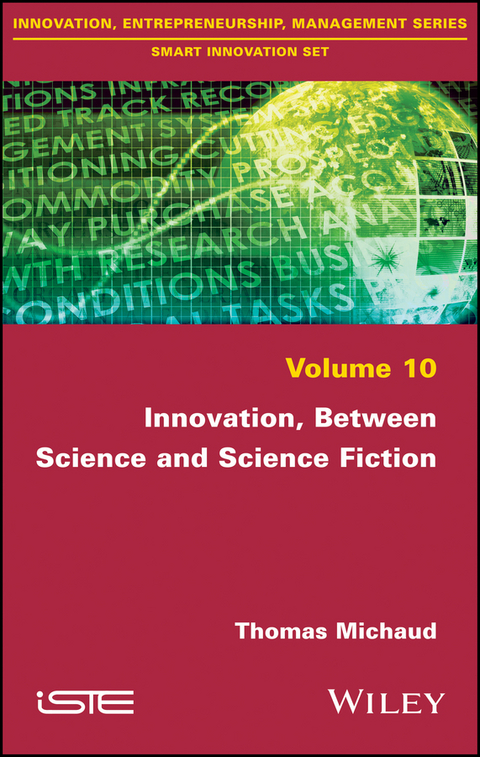
Innovation, Between Science and Science Fiction (eBook)
John Wiley & Sons (Verlag)
978-1-119-42754-4 (ISBN)
Thomas Michaud is the author of Innovation, Between Science and Science Fiction, published by Wiley.
Foreword ix
Introduction xvii
Chapter 1 The Growth of the Imagination in Industrial Societies 1
1.1 A short history of science fiction 1
1.1.1 From Frankenstein to The Island of Doctor Moreau 1
1.1.2 Jules Verne, the founding father of science fiction 3
1.1.3 Albert Robida, a visionary in the shadow of Jules Verne 6
1.1.4 Hugo Gernsback, from fictional invention to innovation 8
1.1.5 Hard science fiction 10
1.1.6 The cyberpunk movement 12
1.1.7 The biopunk movement 16
1.1.8 A map of utopic technologies 18
1.2 The imagination, a cognitive barrier useful for innovation 20
1.3 The organizations' use of science fiction 21
1.3.1 Design fiction and the popularization of technological imagination 21
1.3.2 Science fiction prototyping, a method to innovate 24
1.3.3 Science fiction and the identity of engineering students 27
1.3.4 The filter-philter theory 28
1.3.5 Institutional science fiction 29
1.3.6 Future Visions: Microsoft's science fiction 33
1.3.7 China's interest in science fiction and innovation 44
1.3.8 Forecasting and institutional science fiction 47
1.4 The psychology of organizations and science fiction 51
1.4.1 Normal, subversive or pathological imagination 51
1.4.2 Stimulating creativity with the imagination 54
1.4.3 Psychiatry and science fiction 56
1.4.4 Freudo-Lacanianism and science fiction 57
1.5 Should we organize a patenting system for utopic technologies? 59
Chapter 2 Technological Ideologies and Utopias 67
2.1 The space industry and technological utopias 68
2.1.1 Imagining the human colonization of Mars 68
2.1.2 Terraforming Mars, a great project that remains fiction 77
2.1.3 The colonization of the universe, the future of humankind? 79
2.1.4 Space imagination in Lucien Boia and the ESA's ITSF report 81
2.2 Transhumanism and science fiction 84
2.3 Science fiction and nanotechnologies 90
2.4 Accelerationism for a critical use of science fiction 95
2.5 From technological fiction to innovation 96
2.6 Imagining futures, at risk of the Cassandra syndrome 104
Chapter 3 Science, the Imagination and Innovation 109
3.1 The serious global dangers tackled by science fiction 109
3.2 The great steps in the history of technologies since the end of the 19th Century 116
3.3 Economic cycles and science fiction 121
3.4 Theories on innovation and theories on the imagination 124
3.4.1 Performative imagination and the creation of cyberspace 133
3.4.2 From science fiction to techno-scientific innovations: virtual reality headsets 134
3.4.3 The imagination before, together with and after science 135
3.4.4 The hypothesis of a basic imagination at the root of science 136
3.4.5 From the prophetic unconscious to the technological imagination 137
3.4.6 Historical dynamics and technological utopianism 138
Conclusion 141
Bibliography 149
Index 169
| Erscheint lt. Verlag | 6.7.2017 |
|---|---|
| Sprache | englisch |
| Themenwelt | Wirtschaft ► Betriebswirtschaft / Management ► Unternehmensführung / Management |
| Schlagworte | Business & Management • Creativity & Innovation Management • Doctor • Father • Fiction • fictional • founding • Frankenstein • growth • History • Imagination • Industrial • Innovations- u. Kreativitätsmanagement • introduction contents • Invention • Island • Ix • Jules • map • Moreau • Science • shadow • Short • Societies • Verne • visionary • Wirtschaft u. Management |
| ISBN-10 | 1-119-42754-1 / 1119427541 |
| ISBN-13 | 978-1-119-42754-4 / 9781119427544 |
| Informationen gemäß Produktsicherheitsverordnung (GPSR) | |
| Haben Sie eine Frage zum Produkt? |
 PDF (Adobe DRM)
Kopierschutz: Adobe-DRM
Adobe-DRM ist ein Kopierschutz, der das eBook vor Mißbrauch schützen soll. Dabei wird das eBook bereits beim Download auf Ihre persönliche Adobe-ID autorisiert. Lesen können Sie das eBook dann nur auf den Geräten, welche ebenfalls auf Ihre Adobe-ID registriert sind.
Details zum Adobe-DRM
Dateiformat: PDF (Portable Document Format)
Mit einem festen Seitenlayout eignet sich die PDF besonders für Fachbücher mit Spalten, Tabellen und Abbildungen. Eine PDF kann auf fast allen Geräten angezeigt werden, ist aber für kleine Displays (Smartphone, eReader) nur eingeschränkt geeignet.
Systemvoraussetzungen:
PC/Mac: Mit einem PC oder Mac können Sie dieses eBook lesen. Sie benötigen eine
eReader: Dieses eBook kann mit (fast) allen eBook-Readern gelesen werden. Mit dem amazon-Kindle ist es aber nicht kompatibel.
Smartphone/Tablet: Egal ob Apple oder Android, dieses eBook können Sie lesen. Sie benötigen eine
Geräteliste und zusätzliche Hinweise
Buying eBooks from abroad
For tax law reasons we can sell eBooks just within Germany and Switzerland. Regrettably we cannot fulfill eBook-orders from other countries.
aus dem Bereich