


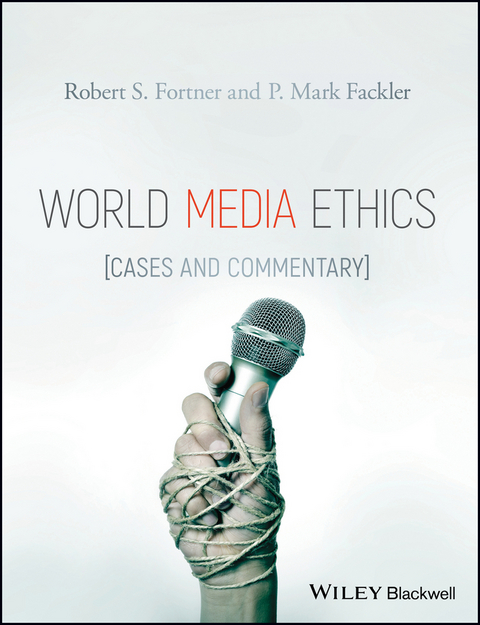
World Media Ethics (eBook)
John Wiley & Sons (Verlag)
978-1-118-99001-8 (ISBN)
Robert S. Fortner is Professor of Communication and Media at Palm Beach Atlantic University. He has published widely on international communication, global public diplomacy, the history of international media, media ethics, and media theory. Most recently, he is the co-editor of The Handbook of Media and Mass Communication Theory (2 volume set, Wiley-Blackwell, 2014) and The Handbook of Global Communication and Media Ethics (2 volume set, Wiley-Blackwell, 2011). He has extensive experience teaching, lecturing, and interacting with media practitioners in various countries around the world, from Moscow to Nairobi, and Abidjan to Ulan Bator.
P. Mark Fackler is Professor of Communication at Calvin College in the, USA, and has written extensively on communication and journalism ethics. He is the co-author of Media Ethics: Cases and Moral Reasoning (10th edition, 2016), Ethics for Public Communication (2011), and Ethics and Evil in the Public Sphere (2010). He is the co-editor of The Handbook of Media and Mass Communication Theory (2 volume set, Wiley-Blackwell, 2014) and The Handbook of Global Communication and Media Ethics (2 volume set, Wiley-Blackwell, 2011). He teaches communications ethics regularly in Kenya, Uganda, and Ethiopia, and publishes with African scholars on media ethics in that region.
Emphasizing the intertwined concepts of freedom of the press and social responsibility, this is the first book to cover media ethics from a truly global perspective. Case studies on hot topics and issues of enduring importance in media studies are introduced and thoroughly analyzed, with particular focus on ones involving social media and public protest Written by two global media ethics experts with extensive teaching experience, this work covers the whole spectrum of media, from news, film, and television, to advertising, PR, and digital media End-of-chapter exercises, discussion questions, and commentary boxes from a global group of scholars reinforce student learning, engage readers, and offer diverse perspectives
Robert S. Fortner is Professor of Communication and Media at Palm Beach Atlantic University. He has published widely on international communication, global public diplomacy, the history of international media, media ethics, and media theory. Most recently, he is the co-editor of The Handbook of Media and Mass Communication Theory (2 volume set, Wiley-Blackwell, 2014) and The Handbook of Global Communication and Media Ethics (2 volume set, Wiley-Blackwell, 2011). He has extensive experience teaching, lecturing, and interacting with media practitioners in various countries around the world, from Moscow to Nairobi, and Abidjan to Ulan Bator. P. Mark Fackler is Professor of Communication at Calvin College in the, USA, and has written extensively on communication and journalism ethics. He is the co-author of Media Ethics: Cases and Moral Reasoning (10th edition, 2016), Ethics for Public Communication (2011), and Ethics and Evil in the Public Sphere (2010). He is the co-editor of The Handbook of Media and Mass Communication Theory (2 volume set, Wiley-Blackwell, 2014) and The Handbook of Global Communication and Media Ethics (2 volume set, Wiley-Blackwell, 2011). He teaches communications ethics regularly in Kenya, Uganda, and Ethiopia, and publishes with African scholars on media ethics in that region.
World Media Ethics: Cases and Commentary 1
Contents 7
Preface 9
1: Introduction: Contexts for Ethical Decision-Making 11
Does the ``Global Village´´ Imply a Global Media Ethics? 11
The Political-Economic Context of Global Media Ethics 13
The Cultural-Religious Context of Global Media Ethics 14
The Professional Context of Global Media Ethics 15
The Moral Context of Global Media Ethics 16
The Legal Context of Global Media Ethics 17
Economics, Acquisition, and Materialism in Global Media Ethics 18
Politics and Face-Saving in Global Media Ethics 19
Section Summary 21
Freedom of the Press 21
Social Responsibility 24
Social Responsibility in a Global Context 25
Social Responsibility and Technological Change 26
Discussion Questions 28
Notes 28
2: Philosophical Perspectives on Ethical Decision-Making: The Individualist Traditions 29
Introduction 29
Sources of Moral Action 29
Individualist Ethical Traditions 33
Deontological Ethics 33
Utilitarian Ethics 34
Case 2.1: Humanizing “Terrorists?” 34
Commentary on Case 2.1 35
Virtue Ethics 35
Contractual Ethics 36
Humanist Ethics 37
Liberation Ethics 38
Postmodern Ethics 39
Nihilist Ethics 40
Case 2.2: Aliaa Maghda El-Mahdy 40
Commentary on Case 2.2 41
Conclusion: Reconciling Different Perspectives? 42
Discussion Questions 43
Notes 44
3: Philosophical Perspectives on Ethical Decision-Making: The Collectivist Traditions 45
Introduction 45
Communitarian Ethics 45
Buddhist/Shinto Ethics 46
Confucian Ethics 48
Feminist Ethics 49
Hindu Ethics 50
Ma'at 51
Ubuntu 52
Iwa 52
Cieng 53
Palaver 54
Case 3.1: Western Reportage of African Conflict 55
Commentary on Case 3.1 55
Differences in Religious Ethical Perspectives 56
Judeo-Christian Perspectives 56
Islamic Perspectives 58
Case 3.2: Hate Speech in Kenya 59
Commentary on Case 3.2 60
Case 3.3: The Media in the Chilcot Report 61
Commentary on Case 3.3 61
Conclusion 62
Discussion Questions 62
Notes 63
4: Ethics and Political Economy 64
Introduction 64
Defining Political Economy 64
Colonialism, Political Economy, and Ethics 65
International Political Economy of Media 66
The Right to Communicate 68
Case 4.1a: Licensing Journalists 70
Commentary on Case 4.1a 70
Case 4.1b: Secrecy Agreements in China 71
Commentary on Case 4.1b 72
Case 4.1c: Supporting Government Activities 72
Commentary on Case 4.1c 73
International Media Domination 74
Implications of Global Media Consolidation 75
Case 4.2a: Video Games and History 76
Commentary on Case 4.2a 77
Case 4.2b: Photoshop and Benetton 77
Commentary on Case 4.2b 78
Case 4.2c: Misrepresenting People for a Good Cause 80
Commentary on Case 4.2c 82
Conclusion 83
Discussion Questions 83
Notes 83
5: Boundaries on Civil Discourse 85
Introduction 85
Disinformation 86
Case 5.1: Thrive and Coverage of Extra-Terrestrial Intelligence 87
Commentary on Case 5.1 88
Case 5.2: The Interview 88
Commentary on Case 5.2 89
Language and Presentation 89
Case 5.3: Graphic Content in the News 93
Commentary on Case 5.3 93
Case 5.4: Tourism Dispute in Hong Kong 95
Commentary on Case 5.4 96
Case 5.5: Racism in Bollywood 96
Commentary on Case 5.5 97
Conclusion 98
Discussion Questions 98
6: Advertising, Public Relations, and Materialism 100
Introduction 100
Advertising as a Post-Enlightenment Enterprise 100
The Growth of Global Advertising 103
Tobacco Advertising 105
Case 6.1: Skin Whitening Products in Asia 106
Commentary on Case 6.1 107
Case 6.2: Pharmaceuticals and Natural Remedies in Africa 110
Commentary on Case 6.2 112
Case 6.3: Is it Public Relations or is it Advertising? 113
Commentary on Case 6.3 115
Discussion Questions 116
Notes 116
7: Global Entertainment 118
Introduction 118
Case 7.1: The Nollywood Film 119
Commentary on Case 7.1 120
Case 7.2: Korean Comics and Films 122
Commentary on Case 7.2 123
Moral Reasoning and Play 124
Case 7.3: Video Games 126
Commentary on Case 7.3 126
Forbidden Knowledge? 128
Concluding Remarks 128
Discussion Questions 129
8: Media and the Political Process 131
Introduction 131
Media and Public Discourse 132
Public Discourse Using the Internet 136
Case 8.1: Charlie Hebdo 140
Commentary on Case 8.1 141
Case 8.2: In the First Circle 143
Commentary on Case 8.2 143
Case 8.3: Death of a Social Media Celebrity in Pakistan 144
Commentary on Case 8.3 145
Conclusion 145
Discussion Questions 146
Notes 147
9: The Rule of Law 148
Introduction 148
Case 9:1: Aiding Terrorism 151
Commentary on Case 9.1 152
Case 9.2: Israeli Anti-Arab Politics 154
Commentary on Case 9.2 155
Case 9.3: Opposition Journalism in Uzbekistan 156
Commentary on Case 9.3 157
Discussion Questions 158
10: Treasuring Persons, Protecting Institutions: The Protection of Minority Voices 159
Introduction 159
Media and Society 159
Double-Standards in Social Responsibility - Not All Are Equal in Media Reports 163
Leakers, Hackers, and Whistle-Blowers 164
The Tactic of Trolling 166
Case 10.1: Vulnerable People, Suicide, and the Internet 169
Commentary on Case 10.1 171
Case 10.2: The Characterization of Women 172
Commentary on Case 10.2 174
Conclusion 177
Discussion Questions 177
Notes 178
11: Religion and Social Responsibility 179
Introduction 179
Case 11.1: Al-Qaeda in France 181
Commentary on Case 11.1 182
Case 11.2: Sharia in Sudan 185
Commentary on Case 11.2 186
Case 11.3: The Syrian Civil War 186
Commentary on Case 11.3 187
Discussion Questions 188
Notes 188
12: War, Violence, and Media 189
Introduction 189
Why Cover Violence? 189
Case 12.1: Elections in Kenya 190
Commentary on Case 12.1 191
Case 12.2: Casual Talk and Public Discourse 197
Commentary on Case 12.2 197
Conclusion 199
Discussion Questions 199
13: Truth, Conflict, Chronic Problems, and Media Attention 200
The Problem of the Truth 200
Case 13.1: Sexual Trafficking 201
Commentary on Case 13.1 202
Case 13.2: Truth and Reconciliation 202
Commentary on Case 13.2 203
Chronic Truths 204
Case 13.3: Chronic Poverty 206
Commentary on Case 13.3 207
Case 13.4: Achieving a Peaceful Planet 209
Commentary on Case 13.4 210
Conclusion: What Is To Be Done? 211
Discussion Questions 213
Notes 213
14: Conclusion 215
Introduction 215
Case 14.1: Freedom vs. Responsibility 216
Commentary on Case 14.1 217
Case 14.2: Defamation by Corporation 219
Commentary on Case 14.2 219
Concluding Remarks 220
Discussion Questions 220
Notes 221
Glossary 223
References 225
Index 253
End User License Agreement 261
| Erscheint lt. Verlag | 30.5.2017 |
|---|---|
| Sprache | englisch |
| Themenwelt | Sozialwissenschaften ► Kommunikation / Medien ► Journalistik |
| Sozialwissenschaften ► Kommunikation / Medien ► Medienwissenschaft | |
| Sozialwissenschaften ► Politik / Verwaltung | |
| Sozialwissenschaften ► Soziologie | |
| Wirtschaft ► Betriebswirtschaft / Management ► Marketing / Vertrieb | |
| Schlagworte | Advertising • Communication & Media Studies • Digital Media • ethical decision making • ethical philosophy • Freedom of the Press • International communication • Kommunikation u. Medienforschung • <p>Global media • Mass Communication & The Media • Massenkommunikation • Massenkommunikation, Massenmedien • Massenmedien u. Gesellschaft • Massenmedium • Mass Media & Society • Media Law & Ethics • Medienrecht • Medienrecht, Medienethik • PR • Public Relations • Social Responsibility • truth in media • world media</p> |
| ISBN-10 | 1-118-99001-3 / 1118990013 |
| ISBN-13 | 978-1-118-99001-8 / 9781118990018 |
| Informationen gemäß Produktsicherheitsverordnung (GPSR) | |
| Haben Sie eine Frage zum Produkt? |
 PDF (Adobe DRM)
Kopierschutz: Adobe-DRM
Adobe-DRM ist ein Kopierschutz, der das eBook vor Mißbrauch schützen soll. Dabei wird das eBook bereits beim Download auf Ihre persönliche Adobe-ID autorisiert. Lesen können Sie das eBook dann nur auf den Geräten, welche ebenfalls auf Ihre Adobe-ID registriert sind.
Details zum Adobe-DRM
Dateiformat: PDF (Portable Document Format)
Mit einem festen Seitenlayout eignet sich die PDF besonders für Fachbücher mit Spalten, Tabellen und Abbildungen. Eine PDF kann auf fast allen Geräten angezeigt werden, ist aber für kleine Displays (Smartphone, eReader) nur eingeschränkt geeignet.
Systemvoraussetzungen:
PC/Mac: Mit einem PC oder Mac können Sie dieses eBook lesen. Sie benötigen eine
eReader: Dieses eBook kann mit (fast) allen eBook-Readern gelesen werden. Mit dem amazon-Kindle ist es aber nicht kompatibel.
Smartphone/Tablet: Egal ob Apple oder Android, dieses eBook können Sie lesen. Sie benötigen eine
Geräteliste und zusätzliche Hinweise
Buying eBooks from abroad
For tax law reasons we can sell eBooks just within Germany and Switzerland. Regrettably we cannot fulfill eBook-orders from other countries.
aus dem Bereich


