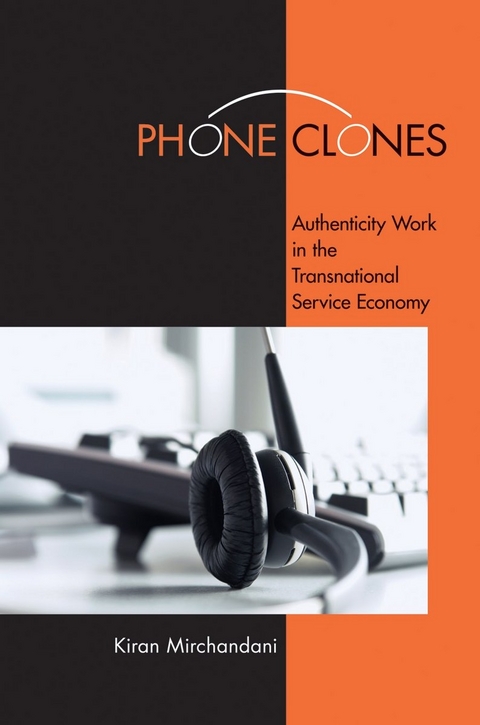
Phone Clones (eBook)
192 Seiten
Ilr Press (Verlag)
978-0-8014-6461-4 (ISBN)
Kiran Mirchandani explores the experiences of the men and women who work in Indian call centers through one hundred interviews with workers in Bangalore, Delhi, and Pune.
Transnational customer service workers are an emerging touchstone of globalization given their location at the intersecting borders of identity, class, nation, and production. Unlike outsourced manufacturing jobs, call center work requires voice-to-voice conversation with distant customers; part of the product being exchanged in these interactions is a responsive, caring, connected self. In Phone Clones, Kiran Mirchandani explores the experiences of the men and women who work in Indian call centers through one hundred interviews with workers in Bangalore, Delhi, and Pune.
As capital crosses national borders, colonial histories and racial hierarchies become inextricably intertwined. As a result, call center workers in India need to imagine themselves in the eyes of their Western clients—to represent themselves both as foreign workers who do not threaten Western jobs and as being "just like" their customers in the West. In order to become these imagined ideal workers, they must be believable and authentic in their emulation of this ideal. In conversation with Western clients, Indian customer service agents proclaim their legitimacy, an effort Mirchandani calls "authenticity work," which involves establishing familiarity in light of expectations of difference. In their daily interactions with customers, managers and trainers, Indian call center workers reflect and reenact a complex interplay of colonial histories, gender practices, class relations, and national interests.
Transnational customer service workers are an emerging touchstone of globalization given their location at the intersecting borders of identity, class, nation, and production. Unlike outsourced manufacturing jobs, call center work requires voice-to-voice conversation with distant customers; part of the product being exchanged in these interactions is a responsive, caring, connected self. In Phone Clones, Kiran Mirchandani explores the experiences of the men and women who work in Indian call centers through one hundred interviews with workers in Bangalore, Delhi, and Pune.
As capital crosses national borders, colonial histories and racial hierarchies become inextricably intertwined. As a result, call center workers in India need to imagine themselves in the eyes of their Western clients—to represent themselves both as foreign workers who do not threaten Western jobs and as being "just like" their customers in the West. In order to become these imagined ideal workers, they must be believable and authentic in their emulation of this ideal. In conversation with Western clients, Indian customer service agents proclaim their legitimacy, an effort Mirchandani calls "authenticity work," which involves establishing familiarity in light of expectations of difference. In their daily interactions with customers, managers and trainers, Indian call center workers reflect and reenact a complex interplay of colonial histories, gender practices, class relations, and national interests.
Kiran Mirchandani is Associate Professor in the Ontario Institute for Studies in Education at the University of Toronto. She is the coauthor of Criminalizing Race, Criminalizing Poverty and coeditor of The Future of Lifelong Learning and Work.
Introduction: The Authentic Clone
1. Transnational Customer Service: A New Touchstone of Globalization
2. Language Training: The Making of the Deficient Worker
3. Hate Nationalism and the Outsourcing Backlash
4. Surveillance Schooling for Professional Clones
5. "Don't Take Calls, Make Contact!": Legitimizing Racist Abuse
6. Being Nowhere in the World: Synchronous Work and Gendered Time
Conclusion: Authenticity Work in the Transnational Service Economy
| Erscheint lt. Verlag | 15.4.2012 |
|---|---|
| Zusatzinfo | 5 halftones, 5 charts/graphs |
| Verlagsort | Ithaca |
| Sprache | englisch |
| Maße | 150 x 150 mm |
| Themenwelt | Sozialwissenschaften ► Pädagogik |
| Sozialwissenschaften ► Soziologie ► Mikrosoziologie | |
| Wirtschaft ► Volkswirtschaftslehre ► Makroökonomie | |
| Wirtschaft ► Volkswirtschaftslehre ► Mikroökonomie | |
| Schlagworte | call center work, indian call centers, outsourcing, routinized work, customer service, colonial history, racism, international work, globalized service work |
| ISBN-10 | 0-8014-6461-7 / 0801464617 |
| ISBN-13 | 978-0-8014-6461-4 / 9780801464614 |
| Informationen gemäß Produktsicherheitsverordnung (GPSR) | |
| Haben Sie eine Frage zum Produkt? |
 EPUB (Adobe DRM)
Kopierschutz: Adobe-DRM
Adobe-DRM ist ein Kopierschutz, der das eBook vor Mißbrauch schützen soll. Dabei wird das eBook bereits beim Download auf Ihre persönliche Adobe-ID autorisiert. Lesen können Sie das eBook dann nur auf den Geräten, welche ebenfalls auf Ihre Adobe-ID registriert sind.
Details zum Adobe-DRM
Dateiformat: EPUB (Electronic Publication)
EPUB ist ein offener Standard für eBooks und eignet sich besonders zur Darstellung von Belletristik und Sachbüchern. Der Fließtext wird dynamisch an die Display- und Schriftgröße angepasst. Auch für mobile Lesegeräte ist EPUB daher gut geeignet.
Systemvoraussetzungen:
PC/Mac: Mit einem PC oder Mac können Sie dieses eBook lesen. Sie benötigen eine
eReader: Dieses eBook kann mit (fast) allen eBook-Readern gelesen werden. Mit dem amazon-Kindle ist es aber nicht kompatibel.
Smartphone/Tablet: Egal ob Apple oder Android, dieses eBook können Sie lesen. Sie benötigen eine
Geräteliste und zusätzliche Hinweise
Buying eBooks from abroad
For tax law reasons we can sell eBooks just within Germany and Switzerland. Regrettably we cannot fulfill eBook-orders from other countries.
aus dem Bereich