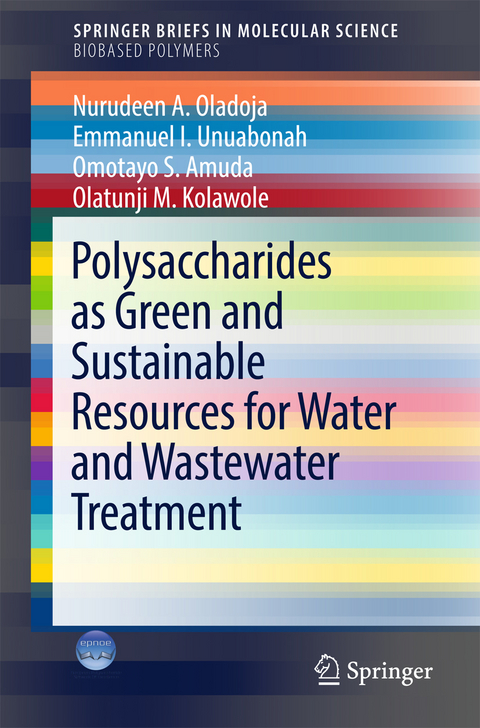
Polysaccharides as a Green and Sustainable Resources for Water and Wastewater Treatment (eBook)
110 Seiten
Springer International Publishing (Verlag)
978-3-319-56599-6 (ISBN)
Dr. Nurudeen A. Oladoja is based in the Department of Chemistry, Adekunle Ajasin, University, Nigeria.Dr. Oladoja has over 65 publications in peer reviewed journals and is the receipient of several awards and fellowships including the Alexander von Humboldt Return Fellowship Grant (2015).Dr. O M Kolawole ia the Group Leader, Infectious Diseases and Environmental Health Research Group, Department of Microbiology, University of Ilorin, Ilorin, Kwara State, Nigeria. Dr. Kolawole has authored over 88 Publications and published 75 papers in peer reviewed journals.Dr. Omotayo S Amuda is based in the Environmental/Analytical Chemistry Unit, Department Pure and Applied Chemistry, Ladoke Akintola, University of Technology, ogbomoso, Nigeria. Dr. Amuda has almost 60 publications in the form of various books, books chapters and monographs inclusing two wastewater articles which became the top 25 Hottest Articles in Science Direct.Dr. Emmanuel I Unuabona is based in the Department of Chemical Sciences, Redeemer’s University, PMB 230, Ede, Osun State, Nigeria. Dr. Unuabona has circa 50 publications and a Scopus h-index of 15 and Google scholar h-index of 18.
Foreword 6
Contents 8
About the Authors 11
1 Operational Principles and Material Requirements for Coagulation/Flocculation and Adsorption-based Water Treatment Operations 15
1.1 Introduction 15
1.2 Operational Principles of Adsorption and Coagulation/Flocculation 16
1.2.1 Adsorption Based Water Treatment Operations 16
1.2.2 Coagulation/Flocculation Treatment Operations 18
1.3 Material Requirements for Adsorption and Coagulation/Flocculation 19
1.3.1 Adsorption Based Treatment Operation 19
1.3.2 Coagulation/Flocculation Operations 20
1.4 Polysaccharides—A Brief Overview 21
1.5 Justification and the Theoretical Basis for the Use of Polysaccharides 21
1.5.1 Adsorption-based Water Treatment Operations 21
1.5.2 Coagulation/Flocculation Treatment Operations 22
1.6 Conclusion 23
References 24
2 Mechanistic Insight into the Coagulation Efficiency of Polysaccharide-based Coagulants 26
2.1 Polysaccharides-A Brief Overview 26
2.2 Polysaccharide-based Coagulants 27
2.3 Overview of Active Coagulating Species in Polysaccharide-based Coagulants 28
2.3.1 Chitosan 31
2.3.2 Seed Gums 31
2.3.3 Fruit Wastes 33
2.3.4 Mucilage 34
2.3.5 Plant Seed Extracts 34
2.3.6 Polyphenolics 35
2.3.7 Starch 36
2.3.8 Actinobacteria 37
2.3.9 Alginate 38
2.4 Underlying Mechanisms of Coagulation-Flocculation Process 39
2.4.1 Double-Layer Compression 39
2.4.2 Charge Neutralization 39
2.4.3 Adsorption and Bridging 39
2.4.4 Sweep Coagulation 40
2.4.5 Insight into the Coagulation Mechanism of PBC 40
2.5 Conclusion 42
References 42
3 Tuning Polysaccharide Framework for Optimal Coagulation Efficiency 49
3.1 Introduction 49
3.2 The Skeletal Framework of Polysaccharides 50
3.3 Justification and Theoretical Basis for Modifying Polysaccharide Framework 51
3.4 Advances and Mechanistic Insight into the Modification of Polysaccharide Framework 56
3.4.1 Modified Chitosan Flocculants 56
3.4.1.1 Etherification/Amination 57
3.4.1.2 Graft Copolymerization 60
3.4.2 Plant-based Bioflocculants 60
3.4.2.1 Plant Materials and Bioflocculant Preparation 60
3.4.3 Flocculation Mechanism of Bioflocculants 63
3.4.4 Plant-based Grafted Bioflocculants 63
3.4.4.1 Grafting Methods 64
3.5 Performance Evaluation of Modified and Unmodified Polysaccharides 68
3.5.1 Performance Evaluation of Chitosan-based Flocculants 68
3.5.2 Performance Evaluation of Modified Chitosan-based Flocculants 70
3.5.3 Performance Evaluation of Combined Flocculation with Chitosan-based Flocculants as Coagulant Aids 70
3.5.4 Performance Evaluation of Unmodified Bioflocculants In Industrial Wastewater Treatment 70
3.5.4.1 Performance Evaluation of Unmodified Bioflocculants 71
3.5.4.2 Performance Evaluation of Modified Bioflocculants 72
3.6 Conclusions 72
References 73
4 Progress and Prospects of Polysaccharide Composites as Adsorbents for Water and Wastewater Treatment 77
4.1 Progress in Preparation of Polysaccharide-based Adsorbents 77
4.1.1 Crosslinked Polysaccharides 77
4.1.2 Polysaccharide Composites 79
4.1.3 Nanoporous Polysaccharide Composites 82
4.2 Treatment of Water and Wastewater 83
4.2.1 Pollutant Removal 83
4.2.1.1 Inorganic Pollutants 84
4.2.1.2 Organic Pollutants 85
4.2.2 Adsorption Mechanism 86
4.2.3 Regeneration Techniques 89
4.2.4 Polysaccharide-based Adsorbents Versus Other Adsorbents 91
4.3 Prospects and Challenges 93
4.4 Conclusion 95
References 95
5 Tapping into Microbial Polysaccharides for Water and Wastewater Purifications 103
5.1 Introduction 103
5.2 General Applications of Microbial Polysaccharides 104
5.3 Microbial Polysaccharide in Water and Wastewater Purification 106
5.4 Characterization of Microbial Polysaccharides for Water and Wastewater Purification 107
5.5 Morphologic and Functional Properties of Microbial Polysaccharides 108
5.5.1 Lipopolysaccharides (LPS) 109
5.5.2 Capsular Polysaccharides (CPS) 109
5.5.3 Exopolysaccharides (EPS) 109
5.6 Roles of Exopolysaccharides in Biofilm Formation 111
5.7 Microbial Biofilms in Water and Wastewater Treatment: The Dual Action 112
5.7.1 Antibiofilms in Water and Wastewater Treatment 113
5.8 Analytical Methods for Assessment of Microbial Polysaccharides in Water and Wastewater 114
5.8.1 Biological Oxygen Demand (BOD) 115
5.8.2 Chemical Oxygen Demand (COD) 116
5.8.3 Total Suspended Solids (TSS) 116
5.8.4 Nitrification and Denitrification (Ammonium Test) 117
5.9 Trends and Prospects of Microbial Polysaccharides in Water and Wastewater Purification 118
5.10 Conclusion 119
Acknowledgements 119
References 119
| Erscheint lt. Verlag | 16.5.2017 |
|---|---|
| Reihe/Serie | Biobased Polymers |
| Biobased Polymers | |
| Biobased Polymers | |
| SpringerBriefs in Molecular Science | SpringerBriefs in Molecular Science |
| Zusatzinfo | XIV, 110 p. 16 illus. |
| Verlagsort | Cham |
| Sprache | englisch |
| Themenwelt | Naturwissenschaften ► Physik / Astronomie |
| Technik | |
| Wirtschaft | |
| Schlagworte | Biocoagulant Materials • Bioflocculant Materials • Biosorbent Polymers • composite materials • Polysaccharide Based Coagulants • Water Quality and Water Pollution |
| ISBN-10 | 3-319-56599-0 / 3319565990 |
| ISBN-13 | 978-3-319-56599-6 / 9783319565996 |
| Informationen gemäß Produktsicherheitsverordnung (GPSR) | |
| Haben Sie eine Frage zum Produkt? |
 PDF (Wasserzeichen)
DRM: Digitales Wasserzeichen
Dieses eBook enthält ein digitales Wasserzeichen und ist damit für Sie personalisiert. Bei einer missbräuchlichen Weitergabe des eBooks an Dritte ist eine Rückverfolgung an die Quelle möglich.
Dateiformat: PDF (Portable Document Format)
Mit einem festen Seitenlayout eignet sich die PDF besonders für Fachbücher mit Spalten, Tabellen und Abbildungen. Eine PDF kann auf fast allen Geräten angezeigt werden, ist aber für kleine Displays (Smartphone, eReader) nur eingeschränkt geeignet.
Systemvoraussetzungen:
PC/Mac: Mit einem PC oder Mac können Sie dieses eBook lesen. Sie benötigen dafür einen PDF-Viewer - z.B. den Adobe Reader oder Adobe Digital Editions.
eReader: Dieses eBook kann mit (fast) allen eBook-Readern gelesen werden. Mit dem amazon-Kindle ist es aber nicht kompatibel.
Smartphone/Tablet: Egal ob Apple oder Android, dieses eBook können Sie lesen. Sie benötigen dafür einen PDF-Viewer - z.B. die kostenlose Adobe Digital Editions-App.
Buying eBooks from abroad
For tax law reasons we can sell eBooks just within Germany and Switzerland. Regrettably we cannot fulfill eBook-orders from other countries.
aus dem Bereich