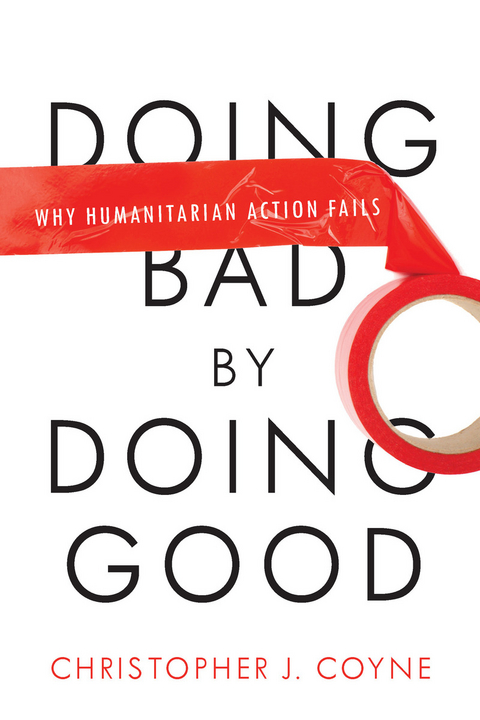
Doing Bad by Doing Good (eBook)
272 Seiten
Stanford University Press (Verlag)
978-0-8047-8611-9 (ISBN)
An economics-focused analysis of why humanitarian relief efforts fail and how they can be remedied. In 2010, Haiti was ravaged by a brutal earthquake that affected the lives of millions. The call to assist those in need was heard around the globe. Yet two years later humanitarian efforts led by governments and NGOs have largely failed. Resources are not reaching the needy due to bureaucratic red tape, and many assets have been squandered. How can efforts intended to help the suffering fail so badly? In this timely and provocative book, Christopher J. Coyne uses the economic way of thinking to explain why this and other humanitarian efforts that intend to do good end up doing nothing or causing harm. In addition to Haiti, Coyne considers a wide range of interventions. He explains why the US government was ineffective following Hurricane Katrina, why the international humanitarian push to remove Muammar Gaddafi in Libya may very well end up causing more problems than prosperity, and why decades of efforts to respond to crises and foster development around the world have resulted in repeated failures. In place of the dominant approach to state-led humanitarian action, this book offers a bold alternative, focused on establishing an environment of economic freedom. If we are willing to experiment with aid asking questions about how to foster development as a process of societal discovery, or how else we might engage the private sector, for instance we increase the range of alternatives to help people and empower them to improve their communities. Anyone concerned with and dedicated to alleviating human suffering in the short term or for the long haul, from policymakers and activists to scholars, will find this book to be an insightful and provocative reframing of humanitarian action. Praise for Doing Bad by Doing Good"e;Coyne is to be congratulated for a book that strongly calls into question the conventional wisdom that we must look first to government to accomplish humanitarian ends."e; George Leef, Regulation Magazine"e;Coyne attempts to explain why conventional approaches to humanitarian aid and longer-term economic development have failed miserably . . . . Recommended."e; M. Q. Dao, Choice"e;Coyne offers a classic neo-liberal economic analysis to explain why the humanitarian project in its current state is doomed."e; Zoe Cormack, Times Literary Supplement
Christopher J. Coyne is the F.A. Harper Professor of Economics at George Mason University and the Associate Director of the F. A. Hayek Program for Advanced Study in Philosophy, Politics, and Economics at the Mercatus Center. He is the author of After War: The Political Economy of Exporting Democracy , coauthor of Media, Development, and Institutional Change, and coeditor of The Handbook on the Political Economy of War.
| Erscheint lt. Verlag | 25.5.2023 |
|---|---|
| Zusatzinfo | 2 tables, 5 figures |
| Sprache | englisch |
| Themenwelt | Sozialwissenschaften ► Pädagogik ► Sozialpädagogik |
| Sozialwissenschaften ► Politik / Verwaltung ► Staat / Verwaltung | |
| Sozialwissenschaften ► Soziologie | |
| Wirtschaft ► Betriebswirtschaft / Management ► Planung / Organisation | |
| Wirtschaft ► Volkswirtschaftslehre ► Makroökonomie | |
| Wirtschaft ► Volkswirtschaftslehre ► Wirtschaftspolitik | |
| ISBN-10 | 0-8047-8611-9 / 0804786119 |
| ISBN-13 | 978-0-8047-8611-9 / 9780804786119 |
| Informationen gemäß Produktsicherheitsverordnung (GPSR) | |
| Haben Sie eine Frage zum Produkt? |
 EPUB (Adobe DRM)
Kopierschutz: Adobe-DRM
Adobe-DRM ist ein Kopierschutz, der das eBook vor Mißbrauch schützen soll. Dabei wird das eBook bereits beim Download auf Ihre persönliche Adobe-ID autorisiert. Lesen können Sie das eBook dann nur auf den Geräten, welche ebenfalls auf Ihre Adobe-ID registriert sind.
Details zum Adobe-DRM
Dateiformat: EPUB (Electronic Publication)
EPUB ist ein offener Standard für eBooks und eignet sich besonders zur Darstellung von Belletristik und Sachbüchern. Der Fließtext wird dynamisch an die Display- und Schriftgröße angepasst. Auch für mobile Lesegeräte ist EPUB daher gut geeignet.
Systemvoraussetzungen:
PC/Mac: Mit einem PC oder Mac können Sie dieses eBook lesen. Sie benötigen eine
eReader: Dieses eBook kann mit (fast) allen eBook-Readern gelesen werden. Mit dem amazon-Kindle ist es aber nicht kompatibel.
Smartphone/Tablet: Egal ob Apple oder Android, dieses eBook können Sie lesen. Sie benötigen eine
Geräteliste und zusätzliche Hinweise
Buying eBooks from abroad
For tax law reasons we can sell eBooks just within Germany and Switzerland. Regrettably we cannot fulfill eBook-orders from other countries.
aus dem Bereich