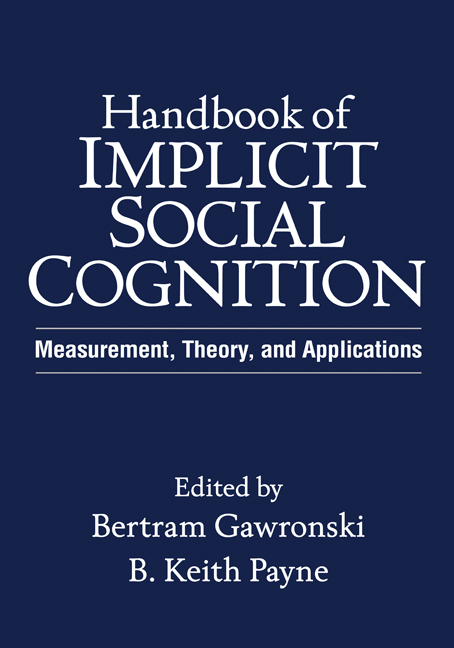
Handbook of Implicit Social Cognition (eBook)
594 Seiten
Guilford Publications (Verlag)
9781606236741 (ISBN)
Bertram Gawronski, PhD, is Professor of Psychology at the University of Texas at Austin. His research investigates the mental underpinnings and behavioral consequences of spontaneous and deliberate evaluations of objects, individuals, groups, and social issues. Dr. Gawronski's work has been recognized with honors including the Theoretical Innovation Prize from SPSP, the Career Trajectory Award from SESP, the Early Career Award from the International Social Cognition Network, the Early Researcher Award from the Ministry of Research and Innovation of Ontario, and the Charlotte-and-Karl-Bühler Award from the German Psychological Society. He is a fellow of APS, SESP, and SPSP.B. Keith Payne, PhD, is Associate Professor in the Department of Psychology at the University of North Carolina at Chapel Hill. His research is concerned with the development of innovative approaches for studying automatic and controlled processes underpinning social behavior. Dr. Payne is a recipient of the Early Career Award from the International Social Cognition Network and the SAGE Young Scholars Award from the Foundation for Social and Personality Psychology and Sage Publications. He was profiled as a “Rising Star” in psychology in the Association for Psychological Science Observerand was cited by the Observer as one of the Top Ten most highly cited Social/Personality Psychologists at the Assistant Professor rank in the United States.
1. A History of Implicit Social Cognition: Where Is It Coming From? Where Is It Now? Where Is It Going?, B. Keith Payne and Bertram GawronskiI. Basics2. In Search of a Measure That Qualifies as Implicit: Recommendations Based on a Decompositional View of Automaticity, Agnes Moors, Adriaan Spruyt, and Jan De Houwer3. Models of Implicit and Explicit Mental Representation, Don Carlston4. Building Blocks of Social Behavior: Reflective and Impulsive Processes, Roland Deutsch and Fritz Strack5. Implicit Social Cognition: Insights from Social Neuroscience, Tiffany A. ItoII. Methods and Procedures6. A Practical Guide to Sequential Priming and Related Tasks, Dirk Wentura and Juliane Degner7. A Practical Guide to Implicit Association Tests and Related Tasks, Sara Teige-Mocigemba, Karl Christoph Klauer, and Jeffrey W. Sherman8. A Practical Guide to Paper-and-Pencil Implicit Measures of Attitudes, Denise Sekaquaptewa, Patrick Vargas, and William von Hippel9. Mathematical Modeling of Implicit Social Cognition: The Machine in the Ghost, Jeffrey W. Sherman, Karl Christoph Klauer, and Thomas J. Allen10. Implicit Measures: Similarities and Differences, Jan De Houwer and Agnes MoorsIII. Cross-Cutting Perspectives11. Consciousness, Introspection, and the Adaptive Unconscious, Wilhelm Hofmann and Timothy D. Wilson12. Formation, Change, and Contextualization of Mental Associations: Determinants and Principles of Variations in Implicit Measures, Bertram Gawronski and Rajees Sritharan13. The Development of Implicit Social Cognition, Kristina R. Olson and Yarrow Dunham14. Prediction of Behavior, Marco Perugini, Juliette Richetin, and Cristina Zogmaister15. Automatic Aspects of Judgment and Decision Making, Galen V. Bodenhausen and Andrew R. Todd16. Consistency and Inconsistency in Implicit Social Cognition: The Case of Implicit and Explicit Measures of Attitudes, Robert J. Rydell and Allen R. McConnell17. What is Implicit about Goal Pursuit?, Melissa J. Ferguson and Shanette C. PorterIV. Domain-Specific Perspectives 18. Attitude Structure and Change: Implications for Implicit Measures, Richard E. Petty and Pablo Briñol19. Implicit Intergroup Bias: Cognitive, Affective, and Motivational Underpinnings, David M. Amodio and Saaid A. Mendoza20. Racial Bias and Stereotyping: Interpersonal Processes, Sophie Trawalter and Jenessa R. Shapiro 21. Two Faces of Self-Esteem: Implicit and Explicit Forms of Self-Esteem, Virgil Zeigler-Hill and Christian H. Jordan 22. The Self-Concept: New Insights from Implicit Measurement Procedures, Konrad Schnabel and Jens B. Asendorpf23. Measuring Implicit Processes in Close Relationships, Mark W. Baldwin, John E. Lydon, M. Joy McClure, and Sara Etchison24. Divided Minds, Divided Morals: How Implicit Social Cognition Underpins and Undermines our Sense of Social Justice, B. Keith Payne and C. Daryl CameronV. Applied Perspectives25. Implicit Cognition in Health Psychology: Why Common Sense Goes Out the Window, Reinout W. Wiers, Katrijn Houben, Anne Roefs, Peter de Jong, Wilhelm Hofmann, and Alan W. Stacy26. Clinical Applications of Implicit Social Cognition Theories and Methods, Bethany A. Teachman, Meghan W. Cody, and Elise M. Clerkin27. Implicit Social Cognition in Forensic Settings, Robert J. Snowden and Nicola S. Gray28. Implicit Social Cognition and Indirect Measures in Consumer Behavior, Andrew Perkins and Mark Forehand29. Implicit Political Cognition, Brian A. Nosek, Jesse Graham, and Carlee Beth Hawkins
| Erscheint lt. Verlag | 6.7.2011 |
|---|---|
| Verlagsort | New York |
| Sprache | englisch |
| Maße | 180 x 180 mm |
| Themenwelt | Geisteswissenschaften ► Psychologie ► Klinische Psychologie |
| Geisteswissenschaften ► Psychologie ► Sozialpsychologie | |
| Wirtschaft ► Betriebswirtschaft / Management ► Marketing / Vertrieb | |
| ISBN-13 | 9781606236741 / 9781606236741 |
| Informationen gemäß Produktsicherheitsverordnung (GPSR) | |
| Haben Sie eine Frage zum Produkt? |
 PDF (Adobe DRM)
Kopierschutz: Adobe-DRM
Adobe-DRM ist ein Kopierschutz, der das eBook vor Mißbrauch schützen soll. Dabei wird das eBook bereits beim Download auf Ihre persönliche Adobe-ID autorisiert. Lesen können Sie das eBook dann nur auf den Geräten, welche ebenfalls auf Ihre Adobe-ID registriert sind.
Details zum Adobe-DRM
Dateiformat: PDF (Portable Document Format)
Mit einem festen Seitenlayout eignet sich die PDF besonders für Fachbücher mit Spalten, Tabellen und Abbildungen. Eine PDF kann auf fast allen Geräten angezeigt werden, ist aber für kleine Displays (Smartphone, eReader) nur eingeschränkt geeignet.
Systemvoraussetzungen:
PC/Mac: Mit einem PC oder Mac können Sie dieses eBook lesen. Sie benötigen eine
eReader: Dieses eBook kann mit (fast) allen eBook-Readern gelesen werden. Mit dem amazon-Kindle ist es aber nicht kompatibel.
Smartphone/Tablet: Egal ob Apple oder Android, dieses eBook können Sie lesen. Sie benötigen eine
Geräteliste und zusätzliche Hinweise
Buying eBooks from abroad
For tax law reasons we can sell eBooks just within Germany and Switzerland. Regrettably we cannot fulfill eBook-orders from other countries.
aus dem Bereich