


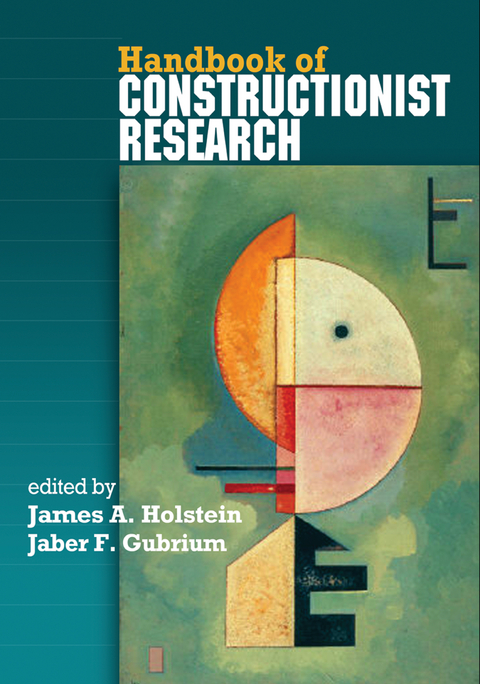
Handbook of Constructionist Research (eBook)
832 Seiten
Guilford Publications (Verlag)
9781593858537 (ISBN)
James A. Holstein (PhD, University of Michigan) is Professor of Sociology in the Department of Social and Cultural Sciences at Marquette University. His research and publications have addressed social problems, deviance and social control, family, and the self--all approached from an ethnomethodologically informed, constructionist perspective. Jaber F. Gubrium (PhD, Wayne State University) is Professor and Chair of Sociology at the University of Missouri-Columbia. He has had a long-standing program of research on the social organization of care in human services institutions and pioneered in the reconceptualization of qualitative methods and the development of narrative analysis. Dr. Gubrium has published widely on aging, the life course, medicalization, and representational practice in therapeutic context. As collaborators for 20 years, Drs. Holstein and Gubrium have developed a distinctive constructionist approach to everyday life in a variety of coauthored and coedited projects.
Introduction 1. The Constructionist Mosaic, Jaber F. Gubrium and James A. Holstein I. Foundations and Historical Context2. The Philosophical Foundations of Constructionist Research, Darin Weinberg3. Historical Development and Defining Issues of Constructionist Inquiry, Joel BestII. Constructionism across the Disciplines 4. Constructionism in Anthropology, James D. Faubion and George E. Marcus5. Social Constructionist Perspectives in Communication Research, Elissa Foster and Arthur P. Bochner6. Educational Constructionisms, Stanton Wortham and Kara Jackson7. Social Constructionism in Management and Organization Studies, Dalvir Samra-Fredericks8. Critical Constructionism in Nursing Research, Joanna Latimer9. Social Construction and Psychological Inquiry, Kenneth J. Gergen and Mary M. Gergen10. Social Constructions in the Study of Public Policy, Anne L. Schneider and Helen Ingram11. Social Constructionism in Science and Technology Studies, Sal Restivo and Jennifer Croissant12. Constructionism in Sociology, Scott R. HarrisIII. The Scope of Constructionist Inquiry13. Foucauldian Constructionism, Leslie Miller14. Discursive Constructionism, Jonathan Potter and Alexa Hepburn15. Narrative Constructionist Inquiry, Andrew C. Sparkes and Brett Smith16. Interactional Constructionism, Amir Marvasti17. Claimsmaking, Culture, and the Media in the Social Construction Process, Kathleen S. Lowney18. Strict and Contextual Constructionism in the Sociology of Deviance and Social Problems, Peter R. IbarraIV. Strategies and Techniques19. Constructionist Impulses in Ethnographic Fieldwork, James A. Holstein and Jaber F. Gubrium 20. Constructionism and the Grounded Theory Method, Kathy Charmaz21. Constructionism and Discourse Analysis, Pirjo Nikander22. A Social Constructionist Framing of the Research Interview, Mirka Koro-Ljungberg23. Autoethnography as Constructionist Project, Laura L. Ellingson and Carolyn Ellis24. Documents, Texts, and Archives in Constructionist Research, Annulla LindersV. The Social Construction of What? 25. The Constructed Body, Bryan S. Turner26. The Social Construction of Emotion, Donileen R. Loseke and Margarethe Kusenbach27. Constructing Gender: The Dancer and the Dance, Judith Lorber28. The Construction of Sex and Sexualities, Sara L. Crawley and K. L. Broad29. The Diverse Construction of Race and Ethnicity, Mitch Berbrier30. Constructions of Medical Knowledge, Paul Atkinson and Maggie Gregory31. Constructing Therapy and Its Outcomes, Gale Miller and Tom Strong32. Constructionist Themes in the Historiography of the Nation, Bo StråthVI. Continuing Challenges 33. The Reality of Social Constructions, Stephen Pfohl34. Can Constructionism Be Critical?, Dian Marie Hosking35. Feminism and Constructionism, Barbara L. Marshall36. Institutional Ethnography and Constructionism, Liza McCoy37. Ethnomethodology as a Provocation to Constructionism, Michael Lynch38. Saving Social Construction: Contributions from Cultural Studies, Joseph Schneider39. Writing Culture, Holism, and the Partialities of Ethnographic Inquiry, Vered Amit40. Constructionist Research and Globalization, Pertti Alasuutari
| Erscheint lt. Verlag | 21.10.2013 |
|---|---|
| Verlagsort | New York |
| Sprache | englisch |
| Maße | 180 x 180 mm |
| Themenwelt | Geisteswissenschaften ► Psychologie |
| Pflege ► Fachpflege ► Neurologie / Psychiatrie | |
| Naturwissenschaften | |
| Sozialwissenschaften ► Ethnologie | |
| Sozialwissenschaften ► Kommunikation / Medien ► Kommunikationswissenschaft | |
| Sozialwissenschaften ► Pädagogik | |
| Sozialwissenschaften ► Soziologie ► Empirische Sozialforschung | |
| Wirtschaft ► Betriebswirtschaft / Management ► Unternehmensführung / Management | |
| Schlagworte | Anthropology • behavioral • communications • Constructionism • constructionist • Constructivist • Cultural Studies • Discourse analysis • Education • Epistemology • Ethnicity • ethnography • feminist • Foucault • Gender • Gerontology • Knowledge • Management • Methodology • Methods • nursing • Psychology • qualitative • Race • Reality • Research • Sciences • Social • Social Work • Sociology • "substance abuse, behavior change, psychotherapy, interventions, addictions, ambivalence, resistance, therapy, counseling field, counseling students, interviewing skills, meth addiction, life coaching, helping professionals, therapeutic relationship, helping professions, professional counselor, core concepts, social workers, transpersonal, rationales, person-centered, exam, cognitive-behavioral, court-ordered, modality, clinicians, evidence-based, revisions, trainers, therapists, counselors, seminar, exerci • Symbolic Interactionism • techniques • theory • women's studies |
| ISBN-13 | 9781593858537 / 9781593858537 |
| Informationen gemäß Produktsicherheitsverordnung (GPSR) | |
| Haben Sie eine Frage zum Produkt? |
 PDF (Adobe DRM)
Kopierschutz: Adobe-DRM
Adobe-DRM ist ein Kopierschutz, der das eBook vor Mißbrauch schützen soll. Dabei wird das eBook bereits beim Download auf Ihre persönliche Adobe-ID autorisiert. Lesen können Sie das eBook dann nur auf den Geräten, welche ebenfalls auf Ihre Adobe-ID registriert sind.
Details zum Adobe-DRM
Dateiformat: PDF (Portable Document Format)
Mit einem festen Seitenlayout eignet sich die PDF besonders für Fachbücher mit Spalten, Tabellen und Abbildungen. Eine PDF kann auf fast allen Geräten angezeigt werden, ist aber für kleine Displays (Smartphone, eReader) nur eingeschränkt geeignet.
Systemvoraussetzungen:
PC/Mac: Mit einem PC oder Mac können Sie dieses eBook lesen. Sie benötigen eine
eReader: Dieses eBook kann mit (fast) allen eBook-Readern gelesen werden. Mit dem amazon-Kindle ist es aber nicht kompatibel.
Smartphone/Tablet: Egal ob Apple oder Android, dieses eBook können Sie lesen. Sie benötigen eine
Geräteliste und zusätzliche Hinweise
Buying eBooks from abroad
For tax law reasons we can sell eBooks just within Germany and Switzerland. Regrettably we cannot fulfill eBook-orders from other countries.
aus dem Bereich


