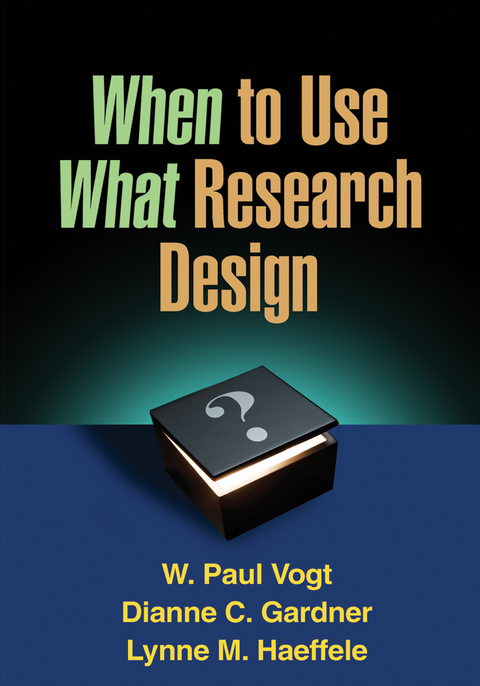
When to Use What Research Design (eBook)
378 Seiten
The Guilford Press (Verlag)
978-1-4625-0362-9 (ISBN)
W. Paul Vogt, PhD, until his death in 2016, was Emeritus Professor of Research Methods and Evaluation at Illinois State University, where he received both teaching and research awards. Dr. Vogt’s areas of specialization included research design and data analysis, with particular emphasis on combining qualitative, quantitative, and graphic approaches. His books include Selecting the Right Analyses for Your Data and When to Use What Research Design. Dianne C. Gardner, PhD, is Associate Professor of Educational Administration at Illinois State University. Dr. Gardner’s research interests include assessment, organizational development, program evaluation, P20 systems, and qualitative research methodology. Lynne M. Haeffele, PhD, is Senior Research Associate in the Center for the Study of Education Policy at Illinois State University. Dr. Haeffele’s research interests include combining research designs, applying research findings to policy and practice, program evaluation, and the topical areas of college readiness, organizational performance, and school–university partnerships.
General Introduction: Design, Sampling, and Ethics I. Research Questions and Designs What Is the Role of Theory in Research Questions and Designs? 1. When to Use Survey Designs When Are Surveys Likely to Be a Wise Design Choice? When Should You Use Which Mode of Administering Your Survey? What Design Should You Use to Study Change over Time? What Question Formats Can You Use in a Survey Design? Conclusion on Survey Designs: So Many Questions, So Little Time 2. When to Use Interview Designs Comparing Interviews with Surveys Conclusion on Interview Designs in General Specific Interview Types, Approaches, and Procedures Conclusion 3. When to Use Experimental Designs What’s Wrong with Gold-Standard Thinking? When Is an RCT a Good Option? When Is an Experimental Design a Good Option for Your Research? When Should You Use the Basic Types of Experimental Design? General Conclusion on When to Use Experimental Designs 4. When to Use Naturalistic and Participant Observational Designs Overview of Observational Designs When Is Observation a Good Design Choice? Further Distinguishing between Naturalistic and Participant Observational Designs When Should You Use a Naturalistic Observational Design? When Should You Use Participant Observational Designs? Conclusion: Characteristics of All Observational Designs 5. When to Use Archival Designs: Literature Reviews and Secondary Analyses What Kinds of Archival Data Are Available for Researchers? When Should You Collect and Use Preexisting Data Rather Than Produce Your Own? Types of Archival Research Database Archives Organizational Records Textual Studies of Documents New Media, Including Internet Sources Conclusion 6. When to Use Combined Research Designs Simple versus Multipart Research Questions When to Combine Research Designs Types and Qualities of Combined Designs Logistical Considerations in Combined Research Designs Conclusion and Summary II. Sampling, Selection, and Recruitment 7. Sampling for Surveys Probability Samples Nonprobability Samples When Should You Try to Improve Response Rates? How Big Should Your Sample Be? Conclusion 8. Identifying and Recruiting People for Interviews How Interview Strategies Are Shaped by Research Questions Making Basic Decisions about Interview Sampling Conclusions on Selecting People to Interview 9. Sampling, Recruiting, and Assigning Participants in Experiments Randomized Controlled Trials Alternatives to RCTs Controlling for Covariates Conclusion: Sampling, Recruiting, and Assigning Cases in Experiments 10. Searching and Sampling for Observations Overview of Searching and Sampling Concerns in Observational Research Appropriateness and Relevance of the Sample Accessing Observation Sites Decisions Influenced by Resources and Other Practical Considerations Four Basic Sampling Decisions Sampling and the Five Types of Research Questions Conclusion and Summary 11. Sampling from Archival Sources When Do You Search and When Do You Sample? Sampling Research Literature to Build Upon and Synthesize It Database Archives Organizational Records Textual Studies of Documents New Media, Including Various Internet Sources Conclusion 12. Sampling and Recruiting for Combined Research Designs When Should You Use Probability Samples in Your Combined Design Study? When Should You Use Purposive Samples in Your Combined Design Study? When Should You Use Both Probability and Purposive Samples in Your Study? Conclusion and Summary III. Research Ethics: The Responsible Conduct of Research Responsibilities toward the Persons Being Studied Responsibilities toward Other Researchers Responsibilities toward the Broader Society/Community 13. Ethics in Survey Research Consent: Informed Participants Willingly Joining the Research Project Harm: Preventing Injury to Respondents Privacy: Ensuring Respondents’ Anonymity and/or Confidentiality Conclusion 14. Ethics in Interview Research Consent: Informed Participants Willingly Agreeing to Be Interviewed Harm: Preventing Injury to Interviewees during the Interview Privacy: Ensuring Interviewees’ Confidentiality Conclusion 15. Ethics in Experimental Research Consent: Informed Participants Willingly Joining the Research Project Harm: Preventing Injury to Experimental Participants Privacy: Ensuring Participants’ Anonymity and/or Confidentiality Conclusion 16. Ethics in Observational Research Seeking and Acquiring Informed Consent to Observe Avoiding and Minimizing Harm to Participants While Conducting the Study Ensuring Participant Privacy Conclusion 17. Ethical Issues in Archival Research Ethical Practice in Reviews of the Research Literature Ethical Practices in Employing Database Archives Ethical Obligations When Using Institutional Records Ethical Issues When Using Documents, Including Public Documents Ethical Issues When Using Blogs and Other Sources Published On-line When Might the Honest, Correct Reporting of Archival Research Cause Harm? Conclusion 18. Ethical Considerations in Combined Research Designs Consent Harm Privacy Conclusion: Culmination of Design, Sampling, and Ethics in Valid Data Coding When to Use Qualities or Quantities, Names or Numbers, Categories or Continua? What Methods to Use to Code Concepts with Reliability and Validity What Methods to Use to Improve Reliability What Methods to Use to Enhance Validity What to Use to Code Concepts Validly Coding Decisions Shape Analytic Options Glossary
| Erscheint lt. Verlag | 4.4.2012 |
|---|---|
| Sprache | englisch |
| Maße | 180 x 180 mm |
| Themenwelt | Geisteswissenschaften ► Psychologie |
| Medizin / Pharmazie ► Pflege | |
| Naturwissenschaften | |
| Sozialwissenschaften ► Pädagogik | |
| Sozialwissenschaften ► Soziologie ► Empirische Sozialforschung | |
| Wirtschaft ► Betriebswirtschaft / Management ► Marketing / Vertrieb | |
| Schlagworte | data collection • Dissertation • Mixed Methods • participants • qualitative • Quantitative • Recruiting • research designs • research ethics • Research methods • Sampling • Social Sciences • Thesis |
| ISBN-10 | 1-4625-0362-4 / 1462503624 |
| ISBN-13 | 978-1-4625-0362-9 / 9781462503629 |
| Informationen gemäß Produktsicherheitsverordnung (GPSR) | |
| Haben Sie eine Frage zum Produkt? |
 EPUB (Adobe DRM)
Kopierschutz: Adobe-DRM
Adobe-DRM ist ein Kopierschutz, der das eBook vor Mißbrauch schützen soll. Dabei wird das eBook bereits beim Download auf Ihre persönliche Adobe-ID autorisiert. Lesen können Sie das eBook dann nur auf den Geräten, welche ebenfalls auf Ihre Adobe-ID registriert sind.
Details zum Adobe-DRM
Dateiformat: EPUB (Electronic Publication)
EPUB ist ein offener Standard für eBooks und eignet sich besonders zur Darstellung von Belletristik und Sachbüchern. Der Fließtext wird dynamisch an die Display- und Schriftgröße angepasst. Auch für mobile Lesegeräte ist EPUB daher gut geeignet.
Systemvoraussetzungen:
PC/Mac: Mit einem PC oder Mac können Sie dieses eBook lesen. Sie benötigen eine
eReader: Dieses eBook kann mit (fast) allen eBook-Readern gelesen werden. Mit dem amazon-Kindle ist es aber nicht kompatibel.
Smartphone/Tablet: Egal ob Apple oder Android, dieses eBook können Sie lesen. Sie benötigen eine
Geräteliste und zusätzliche Hinweise
Buying eBooks from abroad
For tax law reasons we can sell eBooks just within Germany and Switzerland. Regrettably we cannot fulfill eBook-orders from other countries.
aus dem Bereich