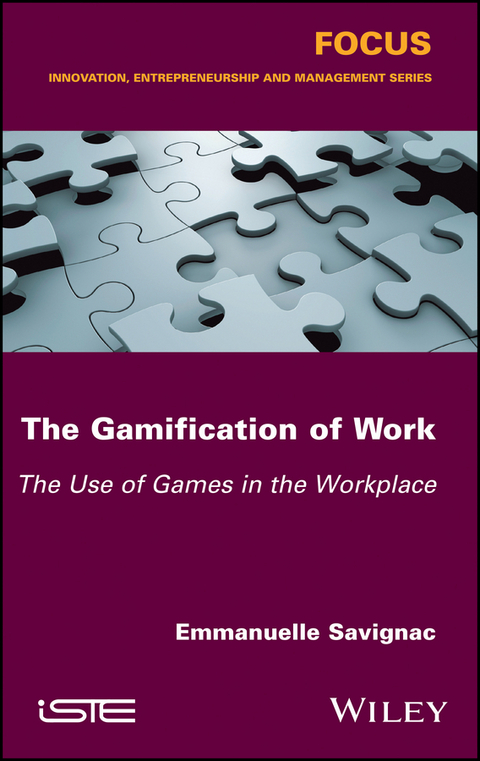
The Gamification of Work (eBook)
208 Seiten
John Wiley & Sons (Verlag)
978-1-119-38454-0 (ISBN)

Emmanuelle Savignac is an anthropologist and senior lecturer at the University La Sorbonne, and at the CERLIS (CNRS, Paris 3, Paris 5).
Introduction ix
Chapter 1 Prelude: Fun, Play, Game, Ludus A Survey of Game Theories 1
1.1 Animal play, human play 2
1.2 Theories of human play 6
1.2.1 Precursors 6
1.2.2 Differentiation between game structure and ludic attitude 14
1.3 Play as potential and intermediate space 16
1.3.1 Winnicott and play as "potential space" 16
1.3.2 Bateson and the question of "frame" 19
1.3.3 Goffman's analysis of frame 21
1.4 The concept of play today 27
1.4.1 The current syntheses of a definition of play 27
1.4.2 Brougère's characteristics of play 28
1.4.3 The link with learning 33
Chapter 2 Games in Business 35
2.1 Relations between games and work: an apparent incongruity 35
2.1.1 A variety of ways to address the relations between games and work in the social and human sciences 39
2.2 The game in business: returning to a typology 43
2.2.1 Challenges 45
2.2.2 Simulation games 49
2.2.3 "Real-life scenarios" or "role-playing games" during training 50
2.2.4 "Reversal days" or "Try my job" 53
2.2.5 Business theater 55
2.2.6 Serious games 56
2.2.7 Traditional games (board games, cards, Kapla and Lego blocks, murder party, etc.) introduced in work contexts 62
2.3 On the field of games in business: simulation and role-playing games 65
2.3.1 The games analyzed 66
2.4 ...Is it a game? 88
Chapter 3 Performativity of the Game: Games and the Structuring of Experience 97
3.1 From the reality of work to the fictionality of games 97
3.1.1 The ambiguity of games: from the "not for real" to the untruth 100
3.1.2 From double assertion to mediation 103
3.1.3 The liminality of the game 105
3.1.4 "Belief forged within immersion" 106
3.2 A role to play 109
3.2.1 Role understood as status 110
3.2.2 Deframing/reframing: role as technique 112
3.3 Asymmetrical reversals: what happens to social relations in the game? 118
3.3.1 Terms of reversal 119
3.3.2 Limits of reversal 120
3.3.3 Taking another's place up to what point? 122
3.3.4 Changing place, changing view? 124
3.3.5 Carnival and order 126
3.4 The game as an operating structure and the performativity of the game 129
3.4.1 An experience without consequences? 133
3.4.2 Training for reflexivity, flexibility and exploration 135
3.4.3 Performance linked to self-realization 137
3.4.4 The power to speak granted by the fictional frame 140
3.4.5 Promoting learning 142
3.4.6 The naturalization of rules and norms 145
Conclusion 151
Bibliography 155
Index 171
| Erscheint lt. Verlag | 19.1.2017 |
|---|---|
| Sprache | englisch |
| Themenwelt | Wirtschaft ► Betriebswirtschaft / Management ► Unternehmensführung / Management |
| Schlagworte | Business & Management • Creativity & Innovation Management • Innovations- u. Kreativitätsmanagement • Innovations- u. Kreativitätsmanagement • Wirtschaft u. Management |
| ISBN-10 | 1-119-38454-0 / 1119384540 |
| ISBN-13 | 978-1-119-38454-0 / 9781119384540 |
| Informationen gemäß Produktsicherheitsverordnung (GPSR) | |
| Haben Sie eine Frage zum Produkt? |
 PDF (Adobe DRM)
Kopierschutz: Adobe-DRM
Adobe-DRM ist ein Kopierschutz, der das eBook vor Mißbrauch schützen soll. Dabei wird das eBook bereits beim Download auf Ihre persönliche Adobe-ID autorisiert. Lesen können Sie das eBook dann nur auf den Geräten, welche ebenfalls auf Ihre Adobe-ID registriert sind.
Details zum Adobe-DRM
Dateiformat: PDF (Portable Document Format)
Mit einem festen Seitenlayout eignet sich die PDF besonders für Fachbücher mit Spalten, Tabellen und Abbildungen. Eine PDF kann auf fast allen Geräten angezeigt werden, ist aber für kleine Displays (Smartphone, eReader) nur eingeschränkt geeignet.
Systemvoraussetzungen:
PC/Mac: Mit einem PC oder Mac können Sie dieses eBook lesen. Sie benötigen eine
eReader: Dieses eBook kann mit (fast) allen eBook-Readern gelesen werden. Mit dem amazon-Kindle ist es aber nicht kompatibel.
Smartphone/Tablet: Egal ob Apple oder Android, dieses eBook können Sie lesen. Sie benötigen eine
Geräteliste und zusätzliche Hinweise
Buying eBooks from abroad
For tax law reasons we can sell eBooks just within Germany and Switzerland. Regrettably we cannot fulfill eBook-orders from other countries.
aus dem Bereich