


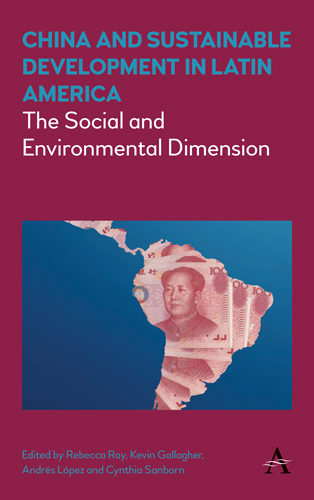
China and Sustainable Development in Latin America (eBook)
382 Seiten
NBN International - Anthem Press (Verlag)
978-1-78308-616-0 (ISBN)
China and Sustainable Development in Latin America documents the social and environmental impacts of the China-led commodity boom in Latin America. It also highlights important areas of innovation where governments, communities and investors have worked together to harness the commodity boom for the benefit of the people and the planet.
During Latin America’s China-led commodity boom, governments turned a blind eye to the inherent flaws in the region’s economic policy. Now that the commodity boom is coming to an end, those flaws cannot be ignored. High on the list of shortcomings is the fact that Latin American governments—and Chinese investors—largely fell short of mitigating the social and environmental impact of commodity-led growth.
China and Sustainable Development in Latin America documents the social and environmental impact of the China-led commodity boom in the region. Primary commodity exploitation—of petroleum, copper, iron ore, tin, soybeans and the like—are endemic to environmental degradation. The recent commodity boom exacerbated pressure on the region’s waterways and forests and accentuated threats to human health, biodiversity, global climate change and local livelihoods. China and Sustainable Development in Latin America also highlights important areas of innovation, like Chile’s solar energy sector, in which governments, communities and investors have worked together to harness the commodity boom for the benefit of the people and the planet.
It is imperative that Latin American governments put in place the necessary policies to ensure that economic activity in natural resource sectors is managed in an environmentally responsible and socially inclusive manner. China and Sustainable Development in Latin America aims to highlight the efforts that have borne fruit as well as the areas that still need attention. Without proper policies in place to make sustainable development part and parcel of economic decision-making, Latin America will continue to be plagued by commodity boom and bust cycles that accentuate social and environmental conflicts and are ultimately detrimental to long-term prosperity.
lt;p>Rebecca Ray is a research fellow at Boston University’s Global Economic Governance Initiative and a PhD student in economics at the University of Massachusetts Amherst.
Kevin Gallagher is Professor of Global Development Studies at Boston University’s Frederick S. Pardee School of Global Studies, and Co-director of BU's Global Economic Governance Initiative.
Andrés López is a full professor of development economics and head of the economics department at the University of Buenos Aires as well as the executive director of the Red Sudamericana de Economía Aplicada.
Cynthia Sanborn is Professor of Political Science and Vice President for Research at the Universidad del Pacifico.
Part I. Introduction and Regional Overview ; 1.China in Latin America: Lessons for South-South Cooperation and Sustainable Development — Rebecca Ray, Kevin P. Gallagher, Andres Lopez, and Cynthia Sanborn; Part II. China and Latin America’s Hydrocarbons Sector; 2. FDI and Trade: is China Relevant for the Future of our Environment? The Case of Argentina — Julian Donaubauer, Andrés López, and Daniela Ramos; 3. Colombia and China: Social and Environmental Impact of Trade and Foreign Direct Investment — Guillermo Rudas Lleras and Mauricio Cabrera Leal; 4. A Line in the Equatorial Forests: Chinese Investment and the Environmental and Social Impacts of Extractive Industries in Ecuador — Rebecca Ray and Adam Chimienti; Part III. China and Latin America’s Mining Sector; 5. An Assessment of the Environmental and Social Impacts of Chinese Trade and FDI in Bolivia — Alejandra Saravia López and Adam Rua Quiroga; 6. Chinese Investment in Peru’s Mining Industry: Blessing or Curse? — Cynthia Sanborn and Victoria Chonn; Part IV. China and Latin America’s Agricultural Sector; 7. China’s Influence on Deforestation in Brazilian Amazonia: A Growing Force in the State of Mato Grosso — Philip M. Fearnside and Adriano M.R. Figueiredo; Part V. China and Latin America’s Manufacturing Sector; 8. Chinese Incidence on the Chilean Solar Power Sector — Nicola Borregaard, Annie Dufey, Maria Teresa Ruiz-Tagle, and Santiago Sinclair; 9. China in Mexico: Some Environmental and Employment Dimensions — Claudia Schatan and Diana Piloyan
| Erscheint lt. Verlag | 2.1.2017 |
|---|---|
| Reihe/Serie | Anthem Frontiers of Global Political Economy |
| Anthem Frontiers of Global Political Economy and Development | Anthem Frontiers of Global Political Economy and Development |
| Zusatzinfo | 23 figures and 37 tables |
| Verlagsort | London |
| Sprache | englisch |
| Themenwelt | Naturwissenschaften |
| Sozialwissenschaften ► Politik / Verwaltung ► Staat / Verwaltung | |
| Sozialwissenschaften ► Soziologie | |
| Wirtschaft ► Volkswirtschaftslehre ► Makroökonomie | |
| Wirtschaft ► Volkswirtschaftslehre ► Wirtschaftspolitik | |
| ISBN-10 | 1-78308-616-5 / 1783086165 |
| ISBN-13 | 978-1-78308-616-0 / 9781783086160 |
| Informationen gemäß Produktsicherheitsverordnung (GPSR) | |
| Haben Sie eine Frage zum Produkt? |
 EPUB (Adobe DRM)
Kopierschutz: Adobe-DRM
Adobe-DRM ist ein Kopierschutz, der das eBook vor Mißbrauch schützen soll. Dabei wird das eBook bereits beim Download auf Ihre persönliche Adobe-ID autorisiert. Lesen können Sie das eBook dann nur auf den Geräten, welche ebenfalls auf Ihre Adobe-ID registriert sind.
Details zum Adobe-DRM
Dateiformat: EPUB (Electronic Publication)
EPUB ist ein offener Standard für eBooks und eignet sich besonders zur Darstellung von Belletristik und Sachbüchern. Der Fließtext wird dynamisch an die Display- und Schriftgröße angepasst. Auch für mobile Lesegeräte ist EPUB daher gut geeignet.
Systemvoraussetzungen:
PC/Mac: Mit einem PC oder Mac können Sie dieses eBook lesen. Sie benötigen eine
eReader: Dieses eBook kann mit (fast) allen eBook-Readern gelesen werden. Mit dem amazon-Kindle ist es aber nicht kompatibel.
Smartphone/Tablet: Egal ob Apple oder Android, dieses eBook können Sie lesen. Sie benötigen eine
Geräteliste und zusätzliche Hinweise
Buying eBooks from abroad
For tax law reasons we can sell eBooks just within Germany and Switzerland. Regrettably we cannot fulfill eBook-orders from other countries.
aus dem Bereich


