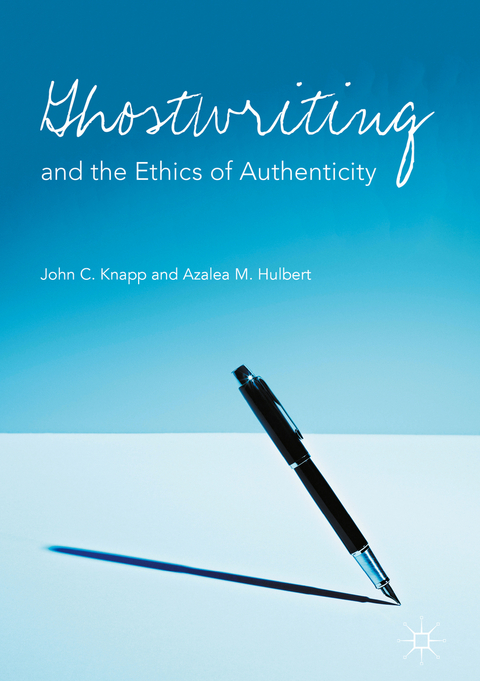
Ghostwriting and the Ethics of Authenticity (eBook)
181 Seiten
Palgrave Macmillan US (Verlag)
978-1-137-31313-3 (ISBN)
?This book presents an ethical framework which evaluates the legitimacy of the practice of ghostwriting. It explores the connection between personal authenticity and the use of ghostwriters in corporate, political, legal, higher education, and scientific contexts. It then examines the history of ghostwriting as a professional practice and introduces a model for ethical analysis.In this book, the authors shrewdly address crucial ethical questions such as: When is it acceptable for a leader to claim the words of a ghostwriter as their own? When may this be inappropriate or even dangerously misleading? What are the consequences when public awareness of this practice leads to cynicism about the authenticity of leaders and their communications? And when, if ever, is the use of a ghostwriter ethical? This book will be welcomed by scholars and practitioners alike as an original and timely contribution tothe literature of business, politics, and communications.
John C. Knapp is President and Professor of Hope College, USA. He is an internationally recognized speaker and the author and editor of several books. Earlier in his career, Dr. Knapp led a corporate communications firm and founded and directed two university ethics centers.Azalea M. Hulbert is a Ph.D. candidate in higher education administration at The Pennsylvania State University, USA where she focuses on organizational, student, and faculty issues. She previously served as Program Manager of a university ethics center, and is an internationally recognized speaker on academic integrity.
Prologue 5
What Ghostwriting Is and Isn’t 6
Modern Profession, Ancient Art 8
Why This Book? 9
Notes 10
Acknowledgments 12
Contents 13
Chapter 1: Authenticity and Ethics in Ghostwriting 15
Communication, Self-Deception, and the Limits of Authenticity 16
The Problem of Agency 18
The Challenge of Ascribing Authorship 20
A Model for Ethical Analysis 22
Is It Ghostwriting? 22
Why Was a Ghostwriter Involved? What Alternatives Were Available? 22
Whose Interests Are at Stake in the Project? 23
What Consequences May Result from a Decision to Use a Ghostwriter? 23
What Principles or Duties Are at Stake? 24
How Might the Ghostwritten Work Affect the Personal Authenticity of the Client? 24
Notes 25
Chapter 2: Emergence of a Professional Practice 27
Professionalization of Public Relations in the American Context 29
Ghostwriting and Professional Ethics 32
The Need for a Professionalized Practice 34
In Brief: Applying the Ethical Framework 36
Notes 38
Chapter 3: Political Communications 40
Defining the Parameters of Political Communication 41
Secretaries, Cabinet Officials, Literary Clerks, and Speechwriters 43
The Question of Anonymity 46
The Sorensen Legacy 48
The Hidden Costs of Political Ghosts 51
New Media, New Issues 54
In Brief: Applying the Ethical Framework 55
Notes 56
Chapter 4: Corporate and Institutional Communications 61
Ghostwriting as a Managerial Function 64
New Media, New Issues 66
In Brief: Applying the Ethical Framework 69
Notes 71
Chapter 5: Judicial Opinions and the Legal Profession 74
The Law Clerk as Ghost: Behind the Curtain of the Supreme Court 75
The Lawyer as Ghost, Part I: Ethics, Precedent, and the Law 80
Legal Precedent 82
Professional and Legal Ethics 84
The Lawyer as Ghost, Part II: Judicial Independence 87
In Brief: Applying the Ethical Framework 88
Notes 90
Chapter 6: Academic Dishonesty 96
Ghostwriting Versus Plagiarism 97
Ghostwriting in the Admissions Game 99
Ghostwriting in the College Classroom 102
Ghostwriting in the Locker Room 105
Ghostwriting by Faculty 108
In Brief: Applying the Ethical Framework 108
Notes 110
Chapter 7: Scientific Publications 117
Medical Ghostwriting: A Few Definitions 118
Academic Dishonesty, Sound Business Strategy, or Both? 119
Defining Scientific Authorship 120
Building Trust and Transparency 125
Fraud, or Good Business? 127
In Brief: Applying the Ethical Framework 128
Notes 131
Chapter 8: Book Publishing 137
Authorship as Branding: The Unique World of Ghostwritten Books 139
Identity and the Authentic Self of the Named Author 140
“GhostwritingGate” 142
The Authentic Self of the Ghost 144
If I Did It: Confessions of the Killer 144
Touched: The Jerry Sandusky Story 145
Julian Assange: The Unauthorized Autobiography 145
In Brief: Applying the Ethical Framework 148
Is it ghostwriting? 148
Why was a ghostwriter involved? What alternatives were available? 149
Whose interests are at stake in the project? What consequences may result from a decision to use a ghostwriter? 149
What principles or duties are at stake? 150
How might the ghostwritten work affect the personal authenticity of the client? 150
Notes 151
Chapter 9: Personal Contexts 156
Holy Ghost or Ghostwriter? 157
The Cyrano Effect 160
Outsourced Entertainment: Art, Music, and Media 163
The Ghosts of Twitter 163
“Keeping It Real” 164
Ghostcomposing 165
Ghostsculpting and Ghostpainting 166
In Brief: Applying the Ethical Framework 168
Notes 170
Epilogue 176
Notes 183
Personal Connection Versus Effect 178
Requirement Versus Interests 179
Willingness to Acknowledge Versus Sense of Betrayal 180
Other Ethical Frameworks 182
Concluding Thoughts 182
Index 184
| Erscheint lt. Verlag | 18.11.2016 |
|---|---|
| Zusatzinfo | XVI, 181 p. 7 illus. in color. |
| Verlagsort | New York |
| Sprache | englisch |
| Themenwelt | Wirtschaft ► Allgemeines / Lexika |
| Wirtschaft ► Betriebswirtschaft / Management ► Marketing / Vertrieb | |
| Wirtschaft ► Betriebswirtschaft / Management ► Unternehmensführung / Management | |
| Schlagworte | business • Business Ethics • Business Strategy • Communication • Corporate Communication • ethics • Management • New Media • Operation Research • Philosophy • Public Relations • Trust |
| ISBN-10 | 1-137-31313-7 / 1137313137 |
| ISBN-13 | 978-1-137-31313-3 / 9781137313133 |
| Informationen gemäß Produktsicherheitsverordnung (GPSR) | |
| Haben Sie eine Frage zum Produkt? |
 PDF (Wasserzeichen)
DRM: Digitales Wasserzeichen
Dieses eBook enthält ein digitales Wasserzeichen und ist damit für Sie personalisiert. Bei einer missbräuchlichen Weitergabe des eBooks an Dritte ist eine Rückverfolgung an die Quelle möglich.
Dateiformat: PDF (Portable Document Format)
Mit einem festen Seitenlayout eignet sich die PDF besonders für Fachbücher mit Spalten, Tabellen und Abbildungen. Eine PDF kann auf fast allen Geräten angezeigt werden, ist aber für kleine Displays (Smartphone, eReader) nur eingeschränkt geeignet.
Systemvoraussetzungen:
PC/Mac: Mit einem PC oder Mac können Sie dieses eBook lesen. Sie benötigen dafür einen PDF-Viewer - z.B. den Adobe Reader oder Adobe Digital Editions.
eReader: Dieses eBook kann mit (fast) allen eBook-Readern gelesen werden. Mit dem amazon-Kindle ist es aber nicht kompatibel.
Smartphone/Tablet: Egal ob Apple oder Android, dieses eBook können Sie lesen. Sie benötigen dafür einen PDF-Viewer - z.B. die kostenlose Adobe Digital Editions-App.
Buying eBooks from abroad
For tax law reasons we can sell eBooks just within Germany and Switzerland. Regrettably we cannot fulfill eBook-orders from other countries.
aus dem Bereich