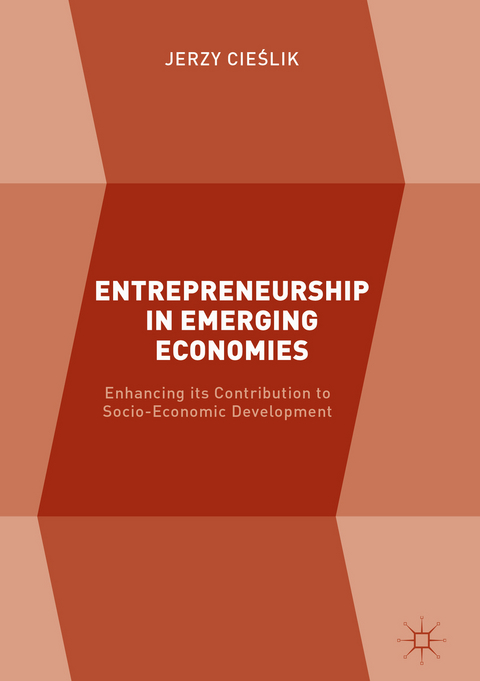
Entrepreneurship in Emerging Economies (eBook)
XVII, 266 Seiten
Springer International Publishing (Verlag)
978-3-319-41721-9 (ISBN)
In this book the author investigates the role of entrepreneurship in the socio-economic development of emerging economies, highlighting its vital part in implementing development programs and policy initiatives. In search of efficient ways to stimulate entrepreneurial activities, Entrepreneurship in Emerging Economies reviews recent academic research and accumulated policy implementation experiences to identify measures and instruments which can be adopted within emerging countries' institutional context. Particular attention is given to three issues which have dominated the debate on the macroeconomic impact of entrepreneurship at the turn of the twenty-first century: job creation, innovation, and international trade and economic cooperation. In the final chapter the author offers a holistic model of entrepreneurship policy to address the particular needs of emerging economies, encompassing entrepreneurship policy, favourable institutional environments and pragmatic principles for implementing selective policy measures.
Jerzy Cieślik is Director of the Center for Entrepreneurship at Kozminski University, Warsaw, Poland. He specializes in ambitious forms of entrepreneurship (growth-oriented, international, and technology-based) as well as entrepreneurship and innovation policy. Previously he held the position of Partner and CEO of Ernst & Young Poland.
Jerzy Cieślik is Director of the Center for Entrepreneurship at Kozminski University, Warsaw, Poland. He specializes in ambitious forms of entrepreneurship (growth-oriented, international, and technology-based) as well as entrepreneurship and innovation policy. Previously he held the position of Partner and CEO of Ernst & Young Poland.
Acknowledgements 6
Contents 8
List of Figures 11
List of Tables 14
1: Introduction 15
References 24
2: Essence of Entrepreneurship 26
2.1 Evolution of Views on the Nature and Role of Entrepreneurship 26
2.2 Entrepreneurship Research—Major Issues, Open Questions 32
2.3 Ambitious Entrepreneurship 44
2.4 Key Policy Lessons 49
References 51
3: Dimensions of Entrepreneurship 53
3.1 Introduction 53
3.2 Diversity of Small Businesses 55
3.2.1 Between Employment and Running an Employer Firm 56
Self-employed Entrepreneurs 56
Hybrid Entrepreneurship 57
Dependent Entrepreneurship 58
3.2.2 Entrepreneurship of Marginalized Groups of Population 60
Female Entrepreneurship 60
Second Chance Entrepreneurship 62
Elderly Entrepreneurship 63
Immigrant Entrepreneurs 65
Entrepreneurship of the Unemployed 67
Entrepreneurship of People with Disabilities 68
3.2.3 Entrepreneurship Underpinned by Supreme Values 69
Family Entrepreneurship 69
Lifestyle Entrepreneurship 70
3.2.4 Darker Side of Entrepreneurship 72
Shadow Economy 73
Criminal Entrepreneurship 75
3.3 Symptoms of Renaissance of Entrepreneurship 77
3.3.1 Innovative Entrepreneurship 77
High-tech Entrepreneurship 78
Knowledge-based Entrepreneurship 80
Intellectual Entrepreneurship 82
3.3.2 Dynamic Entrepreneurship 83
High-growth Entrepreneurship 84
Franchising 85
International Entrepreneurship 87
3.3.3 Corporate Entrepreneurship 88
3.4 Entrepreneurship Outside the Business Sector 90
3.4.1 Academic Entrepreneurship 90
3.4.2 Entrepreneurship in Culture and the Arts 92
3.4.3 Social Entrepreneurship 94
3.4.4 Entrepreneurship in the Public Sector 96
3.5 Key Policy Lessons 98
References 99
4: Measuring Entrepreneurship: International Comparisons 103
4.1 How is Entrepreneurship Measured? 104
4.2 Measuring the Level of Total Business Activity 106
4.3 Measurement of Early-stage Entrepreneurial Activity 109
4.3.1 Global Entrepreneurship Monitor (GEM) 109
4.3.2 OECD–Eurostat Enterprise Birth Rate 110
4.3.3 The World Bank Group Entrepreneurship Survey (WBGES) 112
4.4 Entrepreneurship and the Stage of Socioeconomic Development 113
4.5 Entrepreneurship in European Transition Economies—A Comparative Perspective 117
4.6 Identifying the Segment of “True” Entrepreneurship 123
4.6.1 OECD–Eurostat—High-growth Firms and Gazelles 125
4.6.2 Measurement of Entrepreneurial Aspirations in the GEM Project 126
4.7 Multi-criteria Measurement of Entrepreneurial Activity 127
4.8 Key Policy Lessons 131
References 132
5: Entrepreneurship and Employment 134
5.1 Firms that Generate New Jobs—Main Directions of Research and Key Findings 135
5.2 Entrepreneurship and Employment—Measures and International Comparisons 141
5.2.1 Diversity of Measurement Methods 141
5.2.2 Employment Growth—Measuring the Impact of Different Size Classes of Enterprises 143
5.2.3 Contribution of High-growth Firms 145
5.2.4 Employment Growth Aspirations Among Early-stage Entrepreneurs 149
5.3 Intermediary Forms between Employment and Employer Firm 152
5.4 Segmentation of the Microenterprise Sector 156
5.5 Quality of Jobs in the SME sector 159
5.6 Key Policy Lessons 162
References 165
6: Entrepreneurship and Innovation 167
6.1 Innovation as a Development Factor—Macroeconomic Perspective 168
6.2 Innovation—the Company and Industry Perspective 172
6.3 Diversity of Innovative Entrepreneurship 178
6.3.1 Young High-tech Companies Bringing Novel Technologies to the Market 179
6.3.2 Academic Spin-offs 181
6.3.3 “Spillover Hunters” 184
6.3.4 Proactive Imitators 188
6.4 Innovation and Economic Development—An Emerging Economy Perspective 192
6.5 Key Policy Lessons 196
References 201
7: International Dimension of Entrepreneurship 204
7.1 International Entrepreneurship or International Small Business? 205
7.2 Who Generates Manufacturing Exports? 209
7.3 Role of Foreign Direct Investment (FDI) 212
7.4 Export-driven High-growth Firms 215
7.5 International Dimension of Innovative Entrepreneurship 216
7.5.1 Internationalization of High-tech Start-ups 216
7.5.2 Intermediated Internationalization 217
7.5.3 Spillover Effects of Foreign Direct Investment (FDI) 219
7.6 Global Players from Emerging Economies 220
7.7 Key Policy Lessons 224
References 226
8: Entrepreneurship Policy: Towards an Integrated Framework 228
8.1 Rationale for Public Intervention in the Enterprise Sector—Market and System Failure 229
8.2 Objectives of Entrepreneurship Policy 232
8.2.1 Acceleration of Economic Growth 233
Creation of New Jobs 233
Entrepreneurship as a Catalyst of Innovation 234
Stimulating Growth through International Trade, Economic and Technological Co-operation 235
8.2.2 Entrepreneurship as a Lever for Regional and Local Development 236
8.2.3 Entrepreneurship as a Vehicle for Addressing Urgent Social Problems 239
8.2.4 Objectives of Entrepreneurship Policy—A Synthesis 241
8.3 Entrepreneurship Policy—A Systems Approach 244
8.3.1 Beneficiaries of Entrepreneurship Support and their Segmentation 247
8.3.2 Institutional Framework for Entrepreneurship Policy 252
Entrepreneurship as Part of a Nationwide Development Strategy 252
Sustainable Nature of Economic Growth and Predictable Environment for Running a Business 253
Favourable Regulations and Efficient Administration 254
Reasonable Tax Burden and an Efficient Tax Collection System 256
Publicly Funded Business Support Services 256
8.3.3 Social Climate around Entrepreneurship and Entrepreneurs 258
8.3.4 Criteria and Rules for the Implementation of Selective Support Instruments 261
8.4 Summary and Conclusion 264
References 265
Index 267
| Erscheint lt. Verlag | 10.12.2016 |
|---|---|
| Zusatzinfo | XVII, 266 p. 47 illus. |
| Verlagsort | Cham |
| Sprache | englisch |
| Themenwelt | Wirtschaft ► Betriebswirtschaft / Management ► Unternehmensführung / Management |
| Schlagworte | Institutions • International Trade • Job Creation • macroeconomic • Policy |
| ISBN-10 | 3-319-41721-5 / 3319417215 |
| ISBN-13 | 978-3-319-41721-9 / 9783319417219 |
| Informationen gemäß Produktsicherheitsverordnung (GPSR) | |
| Haben Sie eine Frage zum Produkt? |
 PDF (Wasserzeichen)
DRM: Digitales Wasserzeichen
Dieses eBook enthält ein digitales Wasserzeichen und ist damit für Sie personalisiert. Bei einer missbräuchlichen Weitergabe des eBooks an Dritte ist eine Rückverfolgung an die Quelle möglich.
Dateiformat: PDF (Portable Document Format)
Mit einem festen Seitenlayout eignet sich die PDF besonders für Fachbücher mit Spalten, Tabellen und Abbildungen. Eine PDF kann auf fast allen Geräten angezeigt werden, ist aber für kleine Displays (Smartphone, eReader) nur eingeschränkt geeignet.
Systemvoraussetzungen:
PC/Mac: Mit einem PC oder Mac können Sie dieses eBook lesen. Sie benötigen dafür einen PDF-Viewer - z.B. den Adobe Reader oder Adobe Digital Editions.
eReader: Dieses eBook kann mit (fast) allen eBook-Readern gelesen werden. Mit dem amazon-Kindle ist es aber nicht kompatibel.
Smartphone/Tablet: Egal ob Apple oder Android, dieses eBook können Sie lesen. Sie benötigen dafür einen PDF-Viewer - z.B. die kostenlose Adobe Digital Editions-App.
Buying eBooks from abroad
For tax law reasons we can sell eBooks just within Germany and Switzerland. Regrettably we cannot fulfill eBook-orders from other countries.
aus dem Bereich