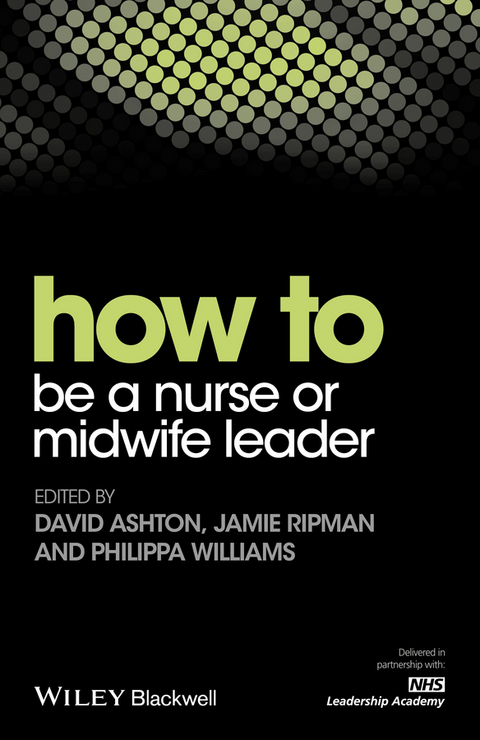
How to be a Nurse or Midwife Leader (eBook)
John Wiley & Sons (Verlag)
978-1-119-18702-8 (ISBN)
How to be a Nurse or Midwife Leader is an indispensable guide for all nurses and midwives who wish to develop and improve their practice as leaders. Written in collaboration with the NHS Leadership Academy, this practical book draws on the real experience of over 10,000 nurses and midwives to bring leadership dilemmas to life in specific situations.
Key learning features include:
- How to develop your self-awareness
- How to develop your personal impact and presence
- How to survive and thrive
- How to get your message across
- How to get the best out of others
- How to work with and lead other professionals and patients
- How to have courageous conversations
- How to balance conflicting demands and needs
Containing exercises and reflective questions to help apply theory to leadership practice, How to be a Nurse or Midwife Leader is an ideal companion for all nurses and midwives, whether you are newly qualified, or stepping into a team leader role.
David Ashton, Director, David Ashton Development Ltd.
Jamie Ripman, Director, Practive Ltd.
Philippa Williams,Director, Practive Ltd.
How to be a Nurse or Midwife Leader is an indispensable guide for all nurses and midwives who wish to develop and improve their practice as leaders. Written in collaboration with the NHS Leadership Academy, this practical book draws on the real experience of over 10,000 nurses and midwives to bring leadership dilemmas to life in specific situations. Key learning features include: How to develop your self-awareness How to develop your personal impact and presence How to survive and thrive How to get your message across How to get the best out of others How to work with and lead other professionals and patients How to have courageous conversations How to balance conflicting demands and needs Containing exercises and reflective questions to help apply theory to leadership practice, How to be a Nurse or Midwife Leader is an ideal companion for all nurses and midwives, whether you are newly qualified, or stepping into a team leader role.
David Ashton, Director, David Ashton Development Ltd. Jamie Ripman, Director, Practive Ltd. Philippa Williams,Director, Practive Ltd.
Authors vii
Contributors viii
Foreword by Karen Lynas ix
Foreword by Jane Cummings xi
Introduction xiii
Part 1: Leading myself well 1
Chapter 1: To begin at the beginning ... 3
David Ashton
Chapter 2: Presence and personal impact 20
Philippa Williams and Jamie Ripman
Chapter 3: Surviving and thriving - maintaining resilience 45
James Butcher with additional contributions from Nichola Jacob
Part 2: Leading others with skill 67
Chapter 4: Getting my message across 69
John Deffenbaugh
Chapter 5: Getting the best out of others 92
Alex Pett
Chapter 6: Influencing with integrity 117
Louisa Hardman
Chapter 7: Courageous conversations 137
Jamie Ripman and Philippa Williams
Part 3: Leading collectively and collaboratively 169
Chapter 8: Moving between the dance floor and the balcony (Heifetz and Linsky 2002) 171
Nicholas Bradbury with additional contributions from Nichola Jacob
Chapter 9: Helping to lead the NHS into the future 188
Caroline Alexander Catherine Eden Nichole McIntosh Natilla Henry with David Ashton Michelle Mello
Afterword 201
David Ashton Jamie Ripman and Philippa Williams
Index 204
Leadership is a well researched and described topic that is relevant to professions throughout health and social care.
This book, which was written in collaboration with the NHS Leadership Academy, focuses on real-life experiences of nurses and midwifes who have faced leadership dilemmas.
Its strength is its practical approach, based and grounded in academic theory.
It starts by looking at identity and self, a vital subject for any leader. Understanding ourselves and how we want to be seen are the foundations of being a good leader and allows for personal development.
As a leader, I found the book particularly useful as a reference when encountering difficult or challenging situations.
The section on chairing meetings prompted me to reflect on my practice and adapt how my meetings are conducted.
The topic of leadership is not a new one but how the book has been set out to address the topic is purely practical in its approach.
It allows the reader freedom to reflect on practice and consider how they use their leadership skills in their day-to-day practice so it can be based on academic theory.
Overall, this is a thoroughly enjoyable book relevant to health and social care professionals at all levels. - Helen Reeves, operational lead for Walsall and inpatient services, St Giles Hospice, Whittington, Staffordshire October 2018
Introduction
‘There are almost as many different definitions of leadership as there are persons who have attempted to define the concept.’ (Bass, 1981)
At the time of writing, if you google the word ‘leadership’, you get 629 000 000 responses. Similarly, if you search for books on leadership, you will find 369 000 000 suggestions. Over the past 50 or so years, there has been an explosion of research, discussion, debate and analysis of what constitutes leadership.
If you’ve picked up this book, we assume you’ve got an interest at least! And that, depending on where you are in your career as a nurse or midwife, you also might be thinking to yourself, ‘Am I a leader?’ or ‘In what way am I a leader?’.
So we thought it would be helpful to start by outlining what we mean by leadership, why we think it’s important and how we hope this book can help you. We could spend a long time word‐smithing another addition to the many definitions of leadership. However, we find Ronald Heifetz’s description of what he calls ‘adaptive leadership’ a helpful one.
‘Adaptive leadership is the practice of mobilizing people to tackle tough challenges and thrive.’ (Heifetz et al., 2009)
The word ‘adaptive’ here acknowledges the importance of how context determines the leadership challenges that we face. Simply put, the world keeps changing and we need to be able to respond to those changes. Very importantly, this definition is not about leadership role or position but about the activity, or practice, and the impact – notice the word ‘thrive’ here. So implicit in this, we believe, is the notion that we can lead from wherever we are in any organisation or system, whatever our responsibilities or job title. Benjamin Zander and Rosamund Stone Zander, in their book The Art of Possibility’(2000), define this as ‘leading from any chair’. Throughout this book, we offer examples of when nurses and midwives have demonstrated leadership at all levels and in many different contexts. This includes the newly qualified nurse who challenges a senior consultant on his behaviour to a patient, the staff nurse who introduced a change to mental health practice, the group of nurses who sought to change practice around care given to orthopaedic patients and many more besides.
If we can agree that this is a good enough definition of the task of leadership, our aim in this book is to explore what it takes to lead well – the ‘how’ of the title. Before we do that, let’s get back to the notion that the context in which we live, work and lead provides the challenges we face – as human beings and as leaders. This connects to the ‘why’ of leadership; Victor Frankl (2004) famously said ‘Those who have a “why” to live can bear with almost any “how”’. As we’ll discuss later in the book, for example in Chapters 1 and 3, we believe a fundamental part of the ‘how’ of leadership is being in touch with the ‘why’: why are you doing this, for what purpose, in whose interests are you acting?
So why do we think that leadership for nurses and midwives is so important? As we write this book, we are living in difficult times. At a global level, there are humanitarian disasters on an unimaginable scale as thousands of people seek refuge from their own war‐torn or poverty‐stricken countries. This runs alongside global financial crises; whether we have just come out of or are about to go back into a recession is a moot point, and not within the scope of this book. But we can certainly say that many people are suffering from times of austerity and that there is a huge challenge for healthcare as the NHS and other providers struggle with less money, not enough qualified people and increasing demand. And yet at the centre of the NHS lies a great purpose, articulated in the NHS Constitution.
‘The NHS belongs to the people. It is there to improve our health and well‐being, supporting us to keep mentally and physically well, to get better when we are ill and, when we cannot fully recover, to stay as well as we can until the end of our lives … The NHS is founded on a common set of principles and values that bind together the communities and people it serves, patients and public and the staff who work for it. It touches our lives at times of basic human need when care and compassion are what matter most.’
(Department of Health, 2015)
We appreciate that some of you reading this may not be working directly for the NHS. But we should nail our colours to the mast here and say that we hope this aspiration also reflects the aspirations of all healthcare professionals whether they work for the NHS, a commercial provider or a social enterprise, not least because the future may look very different indeed in terms of the organisation of healthcare provision. We acknowledge this is not an easy ‘ask’ and we think that all nurses and midwives (as indeed all healthcare professionals) have a personal responsibility and accountability to be the best leader they can be in the service of delivering outstanding patient care.
This book is sponsored by the NHS Leadership Academy and came about after a series of leadership development programmes run by the Academy for nurses and midwives from 2012 to 2016. Through these programmes, and other multiprofessional leadership programmes, at the time of writing, the Academy has worked with over 10 000 nurses and midwives from frontline staff to senior nurses. At the centre of the nursing and midwifery leadership programmes was the principle that if ‘care and compassion are what matter most’, then nurses and midwives are at the very heart of that, and their leadership is what will continue to help bring about this eloquently expressed ambition in the very challenging times in which we find ourselves.
So we in turn are ambitious for this book; we believe great leadership is what will help the NHS, and the provision of healthcare in all its forms, adapt, survive and remain resilient for future generations.
Practical
Given all of the above, this book is intended to be practical; whilst underpinned by academic theory, the emphasis is on application – the ‘how to’ of the title. In keeping with this, the chapters all contain exercises and/or reflective or provocative questions to get you thinking about the application of the theory to your leadership. So we encourage you to take time out, pause and reflect, do the exercises and explore the questions. However much we know, it is how we use and embody that knowledge, live it and breathe it that determines the impact of our leadership. Trying out the exercises will better equip you to be able to translate leadership theory into leadership practice.
The book is aimed at all nurses and midwives who wish to develop and improve their practice as leaders. In that practical spirit, our hope is that it can be a companion which you can refer to at different points in your careers, from third‐year students about to embark on your first newly qualified roles, to stepping into a team leader role, to leading a ward, to leading a service.
Grounded in reality
Through the work we have done with the Leadership Academy, we have been able to capture many real‐life examples of leadership in practice from nurses and midwives across the system. This means that this book is absolutely grounded in the detailed reality of lived experience. It takes note of the many different situations in which you work. We’ve already talked about how leadership challenges are driven by the context; by this we mean both the ever changing political, social and environmental context and the individual contexts in which you find yourselves. We understand that, for example, the world of a ward sister in a large acute London trust is very different from that of a community midwife in a rural area, and different again from a role in a care home or mental health trust. These contexts provide different leadership challenges, which in turn may require different leadership responses.
The human, personal and relational
The book focuses on the human, personal and relational aspects of leadership, rather than the clinical and technical aspects of nursing and midwifery, exploring the question, ‘what do I need to know and how do I need to be as a human being to be an effective and successful leader who can improve and deliver patient‐focused care?’.
Three core principles have helped us to shape the content. Put simply, in order to be the best leaders we can be, we need to lead ourselves well, lead others with skill and lead collectively and collaboratively outside traditional boundaries. These three elements overlap; in graphic terms you might represent them as a Venn diagram.
However, we start where we think leadership has to begin – with an inquiry into ourselves – how have I become the person and leader I am and what kind of leader do I aspire to be? In Part 1, ‘Leading myself well’, we explore how to develop self‐awareness, how to understand the impact we have on others (‘What’s it like to be on the receiving end of me?’) and how to look after ourselves in order to be able to look after others.
Part 2 then looks to how we work with others – building relationships...
| Erscheint lt. Verlag | 2.12.2016 |
|---|---|
| Reihe/Serie | HOW - How To |
| HOW - How To | How To |
| Sprache | englisch |
| Themenwelt | Medizin / Pharmazie ► Gesundheitsfachberufe ► Hebamme / Entbindungspfleger |
| Medizin / Pharmazie ► Gesundheitswesen | |
| Medizin / Pharmazie ► Pflege ► Pflegemanagement / Qualität / Recht | |
| Wirtschaft ► Betriebswirtschaft / Management | |
| Schlagworte | Business & Management • Führung • Hebammenpraxis • Influencing • Integrity • Krankenpflege • leader, management, nurse, midwife, communication, collaboration, nursing, midwifery, leadership, success • Leitungstätigkeit u. Management i. d. Krankenpflege • Leitungstätigkeit u. Management i. d. Krankenpflege • Management f. Führungskräfte • Management f. Führungskräfte • Management / Leadership • Midwifery • midwifery leadership • Nurse Leadership • nursing • Nursing Management & Leadership • Resilience • Wirtschaft u. Management |
| ISBN-10 | 1-119-18702-8 / 1119187028 |
| ISBN-13 | 978-1-119-18702-8 / 9781119187028 |
| Informationen gemäß Produktsicherheitsverordnung (GPSR) | |
| Haben Sie eine Frage zum Produkt? |
 EPUB (Adobe DRM)
Kopierschutz: Adobe-DRM
Adobe-DRM ist ein Kopierschutz, der das eBook vor Mißbrauch schützen soll. Dabei wird das eBook bereits beim Download auf Ihre persönliche Adobe-ID autorisiert. Lesen können Sie das eBook dann nur auf den Geräten, welche ebenfalls auf Ihre Adobe-ID registriert sind.
Details zum Adobe-DRM
Dateiformat: EPUB (Electronic Publication)
EPUB ist ein offener Standard für eBooks und eignet sich besonders zur Darstellung von Belletristik und Sachbüchern. Der Fließtext wird dynamisch an die Display- und Schriftgröße angepasst. Auch für mobile Lesegeräte ist EPUB daher gut geeignet.
Systemvoraussetzungen:
PC/Mac: Mit einem PC oder Mac können Sie dieses eBook lesen. Sie benötigen eine
eReader: Dieses eBook kann mit (fast) allen eBook-Readern gelesen werden. Mit dem amazon-Kindle ist es aber nicht kompatibel.
Smartphone/Tablet: Egal ob Apple oder Android, dieses eBook können Sie lesen. Sie benötigen eine
Geräteliste und zusätzliche Hinweise
Buying eBooks from abroad
For tax law reasons we can sell eBooks just within Germany and Switzerland. Regrettably we cannot fulfill eBook-orders from other countries.
aus dem Bereich