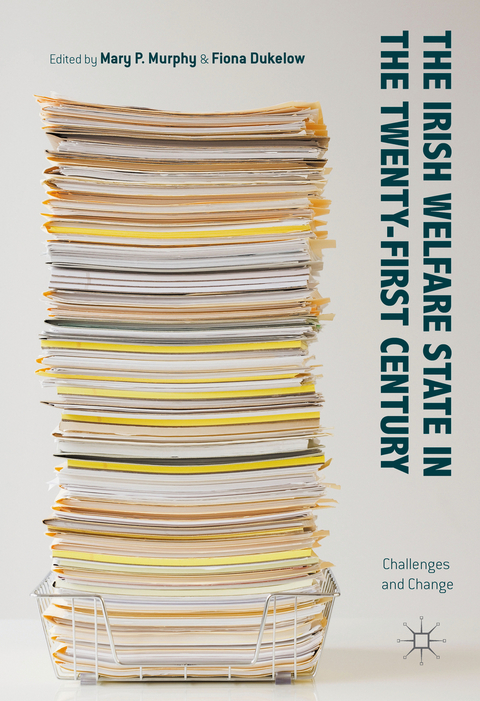
The Irish Welfare State in the Twenty-First Century (eBook)
337 Seiten
Palgrave Macmillan UK (Verlag)
978-1-137-57138-0 (ISBN)
Mary P. Murphy is Lecturer in Irish Politics and Society at Maynooth University, Ireland
This book provides a critical and theoretically-informed assessment of the nature and types of structural change occurring in the Irish welfare state in the context of the 2008 economic crisis. Its overarching framework for conceptualising and analysing welfare state change and its political, economic and social implications is based around four crucial questions, namely what welfare is for, who delivers welfare, who pays for welfare, and who benefits. Over the course of ten chapters, the authors examine the answers as they relate to social protection, labour market activation, pensions, finance, water, early child education and care, health, housing and corporate welfare. They also innovatively address the impact of crisis on the welfare state in Northern Ireland. The result is to isolate key drivers of structural welfare reform, and assess how globalisation, financialisation, neo-liberalisation, privatisation, marketisation and new public management have deepened and diversified their impact on the post-crisis Irish welfare state. This in-depth analysis will appeal to sociologists, economists, political scientists and welfare state practitioners interested in the Irish welfare state and more generally in the analysis of welfare state change.
Mary P. Murphy is Lecturer in Irish Politics and Society at Maynooth University, IrelandFiona Dukelow is a Lecturer in the Department of Applied Social Studies, University College Cork, Ireland
Introduction; Mary P. Murphy and Fiona Dukelow.- Chapter 1. Welfare states: how they change and why; Fiona Dukelow and Mary P. Murphy.- Chapter 2. The Irish social protection system: change in comparative context; Mel Cousins.- Chapter 3. Activation: solving unemployment or supporting a low pay economy?; Micheál L. Collins and Mary P. Murphy.- Chapter 4. Redistribution in the Irish pension system: upside down?; Gerard Hughes and Michelle Maher.- Chapter 5. Personal finance: financial services, access, credit and debt management; Stuart Stamp.- Chapter 6. Irish water services reform: past, present and future; Fiona Dukelow.- Chapter 7. Reform of the Irish healthcare system: what reform?; Sara Burke.- Chapter 8. Early childhood education and dare: a neglected policy arena?; Nóirín Hayes.- Chapter 9. New managerialism: a political project in Irish education; Bernie Grummell and Kathleen Lynch.- Chapter 10.- Social housing policy and provision: a changing regime?; Joe Finnerty, Cathal O’Connell and Siobhan O’Sullivan.- Chapter 11. Crisis and corporate welfare; Nat O’Connor and Paul Sweeney.- Chapter 12. Ireland and crisis: one island, two different experiences; Féilim Ó hAdhmaill.- Conclusion; Mary P. Murphy and Fiona Dukelow.
| Erscheint lt. Verlag | 4.10.2016 |
|---|---|
| Zusatzinfo | XXV, 337 p. 26 illus., 5 illus. in color. |
| Verlagsort | London |
| Sprache | englisch |
| Themenwelt | Sozialwissenschaften ► Pädagogik ► Sozialpädagogik |
| Sozialwissenschaften ► Politik / Verwaltung ► Staat / Verwaltung | |
| Sozialwissenschaften ► Soziologie ► Makrosoziologie | |
| Sozialwissenschaften ► Soziologie ► Mikrosoziologie | |
| Sozialwissenschaften ► Soziologie ► Spezielle Soziologien | |
| Wirtschaft ► Allgemeines / Lexika | |
| Wirtschaft ► Volkswirtschaftslehre | |
| Schlagworte | Corporate Welfare • Early child education and care • Economic crisis • Finance • Health • Housing • Labour market activation • Pensions • Reform • Retrenchment • social politics • Social protection • Structural Change • Water |
| ISBN-10 | 1-137-57138-1 / 1137571381 |
| ISBN-13 | 978-1-137-57138-0 / 9781137571380 |
| Informationen gemäß Produktsicherheitsverordnung (GPSR) | |
| Haben Sie eine Frage zum Produkt? |
 PDF (Wasserzeichen)
DRM: Digitales Wasserzeichen
Dieses eBook enthält ein digitales Wasserzeichen und ist damit für Sie personalisiert. Bei einer missbräuchlichen Weitergabe des eBooks an Dritte ist eine Rückverfolgung an die Quelle möglich.
Dateiformat: PDF (Portable Document Format)
Mit einem festen Seitenlayout eignet sich die PDF besonders für Fachbücher mit Spalten, Tabellen und Abbildungen. Eine PDF kann auf fast allen Geräten angezeigt werden, ist aber für kleine Displays (Smartphone, eReader) nur eingeschränkt geeignet.
Systemvoraussetzungen:
PC/Mac: Mit einem PC oder Mac können Sie dieses eBook lesen. Sie benötigen dafür einen PDF-Viewer - z.B. den Adobe Reader oder Adobe Digital Editions.
eReader: Dieses eBook kann mit (fast) allen eBook-Readern gelesen werden. Mit dem amazon-Kindle ist es aber nicht kompatibel.
Smartphone/Tablet: Egal ob Apple oder Android, dieses eBook können Sie lesen. Sie benötigen dafür einen PDF-Viewer - z.B. die kostenlose Adobe Digital Editions-App.
Buying eBooks from abroad
For tax law reasons we can sell eBooks just within Germany and Switzerland. Regrettably we cannot fulfill eBook-orders from other countries.
aus dem Bereich