



This Fissured Land
Ecological History of India
Seiten
1994
OUP India (Verlag)
978-0-19-563341-2 (ISBN)
OUP India (Verlag)
978-0-19-563341-2 (ISBN)
- Titel erscheint in neuer Auflage
- Artikel merken
Zu diesem Artikel existiert eine Nachauflage
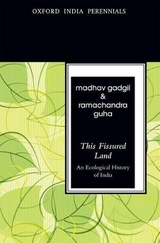
This book represents the first systematic attempt to write an ecological history of India. Madhav Gadgil, a professor of ecological sciences, and Ramachandra Guha, a professor of sociology who writes history, present in this volume a collaborative perspective on the subcontinent which is rare, pathbreaking, and overdue.
In the first part of the book, the authors present a general theory of ecological history which attempts a paradigm shift from Weberian and Marxian theories of human society. Here they ask under what conditions humans exercise prudence in their use of natural resources; they examine infrastructures, property systems, political ideologies, religions, social idioms and the belief structures that characterize human interactions with resource bases; they analyse the varieties of social conflict that appear over the exploitation of natural resources; and, finally, they explore the impact of changing patterns of resource use upon human societies. In the second part the authors provide a fresh interpretive history of pre-modern India. They also provide, in this section, an ecological interpretation of the caste system which adds a significant dimension to existing ideas on caste. In the third part the authors draw on a huge wealth of source material to offer a socioecological analysis of the modes of resources use which were introduced by the British, and which continued, with modifications, after Independence in 1947. (This is a paperback edition of the HB issued in 1992.)
In the first part of the book, the authors present a general theory of ecological history which attempts a paradigm shift from Weberian and Marxian theories of human society. Here they ask under what conditions humans exercise prudence in their use of natural resources; they examine infrastructures, property systems, political ideologies, religions, social idioms and the belief structures that characterize human interactions with resource bases; they analyse the varieties of social conflict that appear over the exploitation of natural resources; and, finally, they explore the impact of changing patterns of resource use upon human societies. In the second part the authors provide a fresh interpretive history of pre-modern India. They also provide, in this section, an ecological interpretation of the caste system which adds a significant dimension to existing ideas on caste. In the third part the authors draw on a huge wealth of source material to offer a socioecological analysis of the modes of resources use which were introduced by the British, and which continued, with modifications, after Independence in 1947. (This is a paperback edition of the HB issued in 1992.)
| Erscheint lt. Verlag | 27.1.1994 |
|---|---|
| Reihe/Serie | Oxford India Paperbacks |
| Zusatzinfo | bibliography |
| Verlagsort | New Delhi |
| Sprache | englisch |
| Maße | 141 x 215 mm |
| Gewicht | 276 g |
| Themenwelt | Naturwissenschaften ► Biologie ► Ökologie / Naturschutz |
| Wirtschaft ► Volkswirtschaftslehre | |
| ISBN-10 | 0-19-563341-5 / 0195633415 |
| ISBN-13 | 978-0-19-563341-2 / 9780195633412 |
| Zustand | Neuware |
| Informationen gemäß Produktsicherheitsverordnung (GPSR) | |
| Haben Sie eine Frage zum Produkt? |
Mehr entdecken
aus dem Bereich


aus dem Bereich
Methoden – Lösungen – Anwendungen
Buch | Hardcover (2025)
Hanser (Verlag)
CHF 69,95


