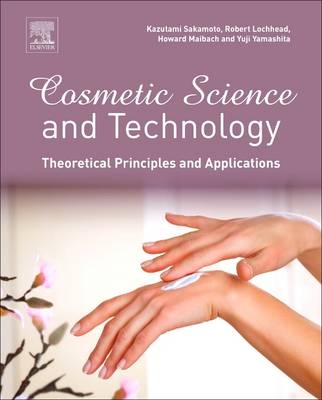
Cosmetic Science and Technology: Theoretical Principles and Applications
Elsevier Science Publishing Co Inc (Verlag)
978-0-12-802005-0 (ISBN)
- Titel erscheint in neuer Auflage
- Artikel merken

As the cosmetics field quickly applies cutting-edge research to high value commercial products that have a large impact in our lives and on the world's economy, this book is an indispensable source of information that is ideal for experienced researchers and scientists, as well as non-scientists who want to learn more about this topic on an introductory level.
Kazutami Sakamoto is a Guest Professor at the Department of Pure & Applied Chemistry, Faculty of Science & Technology, at Tokyo University of Science (TUS), Japan and former professor of Faculty of Pharmacy at Chiba Institute of Science (CIS), Japan. He is a Fellow of the Chemical Society of Japan and was a Chairman of Division of Colloid and Surface Chemistry at The Chemical Society of Japan for 2007-2008. In these capacities he conducts fundamental research in the field of cosmetic science. He has 37 years of industrial carrier for the R&D and international marketing of cosmetic ingredients and products at Ajinomoto Co., Inc. (33 years), Shiseido Res. Cent. (3 years), and Seiwa Kasei (2 years). As well as working in industry, Dr Sakamoto has been active in research and educations at Universities as Yokohama National University, Shinsyu University then Tokyo University of Science as an adjunct professor. After retiring from industry in 2008, he has been expanding academic activities. His study “Self-Organization of Amino Acid Based Chiral Surfactants: Evaluation of Organized Structures and Interactions with Biological System was awarded by Japan Oils Chemists’ Society in 2005. He has been actively participating in many international conferences as an invited speaker over the past decade and more. Robert Y. Lochhead is Professor and Director Emeritus of Polymer Science and High-Performance Materials at the University of Southern Mississippi, USA. Following a 25-year career with I.C.I., Unilever, and BF Goodrich, Bob Joined academia and served as Professor, Chair and Director of the School of Polymers and High-Performance Materials at the University of Southern Mississippi. After retirement from the university in 2016, Bob founded Robert Lochhead Consulting LLC. Bob has served twice as the President of the SCC, and as President of the International Association of Formulation Chemists. Bob is a fellow of the SCC and a Fellow of the Royal Society of Chemistry. Among other honors, he is a recipient of the SCC’s Maison G. DeNavarre Medal Award, the SCC’S Merit Award, the AIC’s Chemical Pioneer Award, and the Society of Plastics Engineers’ Education Award. Bob received the SCC’s Lifetime Service Award in December 2019 and was named one of the first three Fellows of the IFSCC in 2020. Howard Maibach is a Professor at the Department of Dermatology at UCSF, USA. He is an expert in contact and occupational dermatitis and sees patients at the Environmental Dermatosis Clinic, which is part of the Dermatology Clinic. His specialty is dermatotoxicology, or skin exposure toxicity; allergies and skin disorders; and dermatopharmacology or the study of medications for skin disorders. Maibach has been on the editorial board of more than 30 scientific journals and is a member of 19 professional societies including the American Academy of Dermatology, San Francisco Dermatological Society, and the Internal Commission on Occupation Health. His current research programs include defining the chemical-biologic faces of irritant dermatitis and the study of percutaneous penetration. When Dr Maibach is not in the lab conducting research or in the classroom teaching, he is seeing patients at the Environmental Dermatoses Clinic (of the Dermatology Clinic), mostly providing second opinions on allergic contact dermatitis. Yuji Yamashita is an Associate Professor at the Faculty of Pharmacy, Chiba Institute of Science (CIS), Japan. He received his Ph.D. in natural science from Bayreuth University, Germany, in 2005, plus an M. S. and B. S. from Yokohama National University, Japan. After several years of research work on the thermotropic liquid crystals in industry laboratory at Chisso Petrochemical Co., Japan, he began to study dermatology, especially transdermal drug delivery system, as a post-doc at St. Marianna University, Japan. Since October 2011, he has been engaged in teaching and research concerning cosmetic science as an assistant professor at Chiba Institute of Science, Japan. The area of his expertise is the surfactant science such as phase behavior and self-assembly which is related to formulation technology.
Part I. General View of Cosmetic Science and Technology
1. General Aspects of Cosmetics in Relation to Science and Society: Social, Cultural, Science, and Marketing Aspects
2. Global Cosmetic R&D Trends Unveiled From Past IFSCC Award-Winning Papers
3. Basic Physical Sciences for the Formulation of Cosmetic Products
4. Scouting to Meet Unmet Needs
5. New Aspects of Cosmetics and Cosmetic Science
6. Psychology of Cosmetic Behavior
7. Dermatological Benefits of Cosmetics
8. Development of Cosmetics and Intellectual Property Rights
9. Regulations on Cosmetics
Part II. Fundamental Resources for Cosmetics
10. Introduction to Cosmetic Materials
11. Nomenclature of Ingredients
12. Water
13. The Use of Polymers in Cosmetic Products
14. Powders and Inorganic Materials
15. Surfactants
16. Emollients
17. Bioactive Ingredients: Benefits of Cosmetics Stimulated Through Biological Aspects
18. Fragrance
19. Amino Acids, Peptides, and Proteins
20. Botanical Ingredients
21. Functional Materials for Hair
22. Nanotechnology in Cosmetics
Part III. Physicochemical Aspects and Formulations
23. Wetting and Surface Characterization
24. Molecular Structure and Phase Behavior of Surfactants
25. Lamellar Gel Network
26. Polymer–Surfactant Interactions
27. Rheology of Cosmetic Formulations
28. Emulsion and Emulsification Technology
29. Microemulsions and Nano-emulsions for Cosmetic Applications
30. Effect of Molecular Assembly for Emulsion and Gel Formulations
31. Liposomes for Cosmetics
32. Skin Care Cosmetics
33. Body Care Cosmetics
34. Makeup Cosmetics
35. Ultraviolet Care Cosmetics
36. Hair Care Cosmetics
37. Sensory Measurement—Evaluation and Testing of Cosmetic Products
38. Structural Analysis of Formulations
39. Increasing Productivity by Reducing Carbon Footprint in Cosmetics Processing
Part IV. Physiological and Dermatological Aspects
40. Structure and Function of Skin From a Cosmetic Aspect
41. Skin Lipids
42. Structural Aspects of Stratum Corneum
43. Skin Aging
44. Melanogenesis
45. Sensitive Skin
46. Skin Penetration
47. Effects of Air Pollution on Skin: Dermatologic Options
48. Hair Physiology (Hair Growth, Alopecia, Scalp Treatment, etc.)
49. Clinical Evaluation and Instrumental Techniques in Dermatology
50. Safety Evaluation
51. Safety Assessment of Cosmetic Ingredients
| Erscheinungsdatum | 31.03.2017 |
|---|---|
| Sprache | englisch |
| Maße | 216 x 276 mm |
| Gewicht | 2630 g |
| Themenwelt | Naturwissenschaften ► Chemie ► Physikalische Chemie |
| Technik | |
| Wirtschaft | |
| ISBN-10 | 0-12-802005-9 / 0128020059 |
| ISBN-13 | 978-0-12-802005-0 / 9780128020050 |
| Zustand | Neuware |
| Informationen gemäß Produktsicherheitsverordnung (GPSR) | |
| Haben Sie eine Frage zum Produkt? |
aus dem Bereich