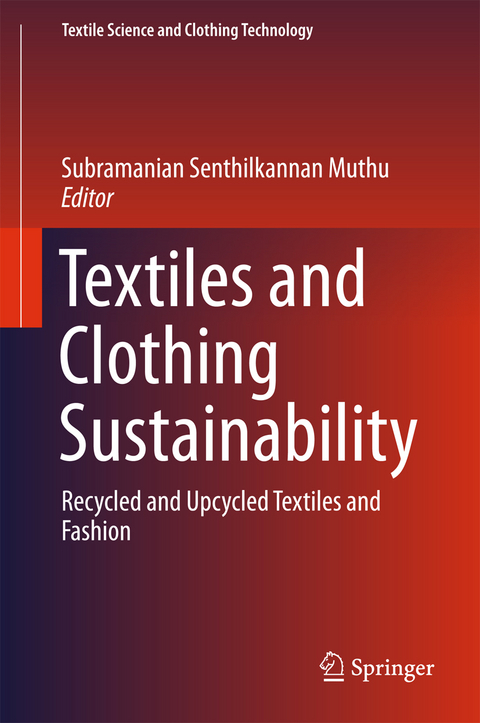
Textiles and Clothing Sustainability (eBook)
VII, 125 Seiten
Springer Singapore (Verlag)
978-981-10-2146-6 (ISBN)
This book discusses in detail the concepts of recycling and upcycling and their implications for the textiles and fashion sector. In addition to the theoretical concepts, the book also presents various options for recycling and upcycling in textiles and fashion. Although recycling is a much-developed and widely used concept, upcycling is also gaining popularity in the sector.
Dr. Subramanian Senthilkannan Muthu currently works for SGS as a global sustainability consultant, based at Hong Kong. He gained his diploma, bachelors and masters in Textile Technology from leading institutes in India. He was awarded his doctorate by The Institute of Textiles and Clothing of The Hong Kong Polytechnic University for his dissertation entitled, 'Eco-functional Assessment of Grocery Shopping Bags'. He has more than seven years of industrial experience in textile manufacturing, textile testing and sustainability evaluation of various materials. He was an outstanding student and received numerous awards and gold medals during his studies. He has more than 80 academic publications in various textiles and environmental journals to his name. Additionally he has 2 patents, and has written 6 book chapters and over 25 scientific books and numerous conference publications. He is also an editor, editorial board member and reviewer for many international peer-reviewed journals in the field of textiles and environmental science.
This book discusses in detail the concepts of recycling and upcycling and their implications for the textiles and fashion sector. In addition to the theoretical concepts, the book also presents various options for recycling and upcycling in textiles and fashion. Although recycling is a much-developed and widely used concept, upcycling is also gaining popularity in the sector.
Dr. Subramanian Senthilkannan Muthu currently works for SGS as a global sustainability consultant, based at Hong Kong. He gained his diploma, bachelors and masters in Textile Technology from leading institutes in India. He was awarded his doctorate by The Institute of Textiles and Clothing of The Hong Kong Polytechnic University for his dissertation entitled, ”Eco-functional Assessment of Grocery Shopping Bags”. He has more than seven years of industrial experience in textile manufacturing, textile testing and sustainability evaluation of various materials. He was an outstanding student and received numerous awards and gold medals during his studies. He has more than 80 academic publications in various textiles and environmental journals to his name. Additionally he has 2 patents, and has written 6 book chapters and over 25 scientific books and numerous conference publications. He is also an editor, editorial board member and reviewer for many international peer-reviewed journals in the field of textiles and environmental science.
Contents 6
1 Fashion Renovation via Upcycling 9
Abstract 9
1 Introduction 9
2 Fast Fashion 10
3 Textile Waste and Recycling 11
3.1 Classification of Textile Waste 11
3.2 Recycling Technologies 11
4 Textile Upcycling 12
4.1 History of Upcycling 12
4.2 Global Scenario 12
4.2.1 Kallio 12
4.2.2 Sword & Plough
4.2.3 Reformation 13
4.2.4 Looptworks 13
4.2.5 Seamly.co 14
4.2.6 Reclaimed 14
4.3 Indian Scenario 14
4.3.1 Trmtab 14
4.3.2 BlueMadeGreen 14
4.4 Framework for Upcycling 15
5 Case Studies on Textile Upcycling 15
5.1 Case Study 1—Conversion of Ladies T-shirt into Kid’s Nightwear 15
5.2 Case Study 2—Conversion of Ladies T-shirt and Tank Top into Kid’s Frock 20
5.3 Case Study 3—Conversion of T-shirt into Kid’s a-Line Skirt 24
5.4 Case Study 4—Conversion of Nighty and Frock into Kid’s Frock 29
5.5 Case Study 5—Conversion of T-shirt into Kid’s Frock 33
5.6 Case Study 6—Conversion of T-shirt into Baby Frock 35
5.7 Case Study 7—Conversion of T-shirt into Kid’s Fancy Frock 44
5.8 Case Study 8—Conversion of Ladies T-shirt into Kid’s T-shirt 48
5.9 Case Study 9—Conversion of Ladies T-shirt into Teenage T-shirt with Lace Neck 50
5.10 Case Study 10—Conversion of Ladies T-shirt into Kid’s Night Pant 53
6 Customer Feedback 61
7 Conclusions 61
References 62
2 The Use of Recycled Fibers in Fashion and Home Products 63
Abstract 63
1 Introduction 63
2 The Textile and Apparel Industry 64
3 Textile Recycling Aligned with the Circular Economy 66
4 Open- and Closed-Loop Recycling 66
5 Recycling and Reuse 68
6 The Textile and Apparel Supply Chain 70
7 Recycling in the Textile and Apparel Industry 72
8 Mechanical Recycling 72
9 Chemical Recycling 73
10 Textile and Apparel Recycling Programs in the Industry 74
11 Raw Materials—Fibers/Yarns 74
12 Unifi 75
13 Tenjin 75
14 Aquafil 76
15 Martex Fiber 76
16 Evrnu 76
17 EcoAlf 77
18 Timberland 77
19 Nike 77
20 Speedo 78
21 Adidas 78
22 Hanes 79
23 H& M
24 The North Face 80
25 Patagonia 80
26 Cone Denim 81
27 Levi Straus & Co
28 Conclusion 82
References 83
3 Denim Recycling 86
Abstract 86
1 The Denim Background 87
1.1 History of Blue Jeans 87
1.2 Interesting Facts About Blue Jeans 87
1.3 Soft Value of Denim Jeans 88
1.4 Social and Cultural Value of Denim Jeans 89
1.5 Individualistic Intimacy of Blue Jeans 89
1.6 Life Cycle of Denim Jeans 91
2 Problems with Textile Waste—Denim Waste and Associated Issues 93
2.1 Types of Waste 94
2.2 Denim Waste and Associated Issues 95
2.3 Indigo Dyes 96
2.4 Dyeing Pollution—Savar, Bangladesh 97
2.5 Pollution in Xintang, South West China 98
2.6 Problems Associated with Waste Management 99
3 Reuse and Recycling of Denim—Technology of Denim Recycling 100
3.1 Source of Denim Waste 102
3.2 Repurpose and Reuse Denim Jeans 102
3.3 Upcycling of Denim Jeans 103
3.4 Constraints in Denim Jean Recycling 104
3.5 Mechanical Recycling of Denim Jeans 105
3.6 Chemical Recycling in Denim Manufacturing Process 108
4 Economics of Denim Recycling 109
4.1 Efforts for a Circular Economy 110
4.2 Evaluation of Jeans for Sustainability 111
4.3 GSTAR—RAW Project 112
4.4 Iris Industries—Denimite 113
4.5 Levi Strauss—Jean Manufacturing with Recycled Water 113
4.6 Bonded Logic—UltraTouch Denim Insulation 114
5 Scenario of Denim Recycling—Past, Present and Future 115
5.1 Latest Trends Toward Sustainable Denim Jean Manufacturing 116
5.2 Case Studies in Denim Recycling 117
6 Challenges, Prospects in Denim Recycling—Roadmap to Denim Recycling 120
6.1 Methods to Reduce Environmental Impact of Denim Jeans 120
6.2 Roadmap to Denim Recycling 125
6.3 Conclusion 126
References 127
| Erscheint lt. Verlag | 6.8.2016 |
|---|---|
| Reihe/Serie | Textile Science and Clothing Technology | Textile Science and Clothing Technology |
| Zusatzinfo | VII, 125 p. 102 illus., 70 illus. in color. |
| Verlagsort | Singapore |
| Sprache | englisch |
| Themenwelt | Naturwissenschaften ► Biologie ► Ökologie / Naturschutz |
| Naturwissenschaften ► Chemie | |
| Technik ► Bauwesen | |
| Technik ► Maschinenbau | |
| Wirtschaft | |
| Schlagworte | Clothing Sustainability • Economic Sustainability • Recycling of Textiles • textile engineering • Textile Remanufacturing • Textile waste • Upcycling in Textiles |
| ISBN-10 | 981-10-2146-5 / 9811021465 |
| ISBN-13 | 978-981-10-2146-6 / 9789811021466 |
| Informationen gemäß Produktsicherheitsverordnung (GPSR) | |
| Haben Sie eine Frage zum Produkt? |
 PDF (Wasserzeichen)
DRM: Digitales Wasserzeichen
Dieses eBook enthält ein digitales Wasserzeichen und ist damit für Sie personalisiert. Bei einer missbräuchlichen Weitergabe des eBooks an Dritte ist eine Rückverfolgung an die Quelle möglich.
Dateiformat: PDF (Portable Document Format)
Mit einem festen Seitenlayout eignet sich die PDF besonders für Fachbücher mit Spalten, Tabellen und Abbildungen. Eine PDF kann auf fast allen Geräten angezeigt werden, ist aber für kleine Displays (Smartphone, eReader) nur eingeschränkt geeignet.
Systemvoraussetzungen:
PC/Mac: Mit einem PC oder Mac können Sie dieses eBook lesen. Sie benötigen dafür einen PDF-Viewer - z.B. den Adobe Reader oder Adobe Digital Editions.
eReader: Dieses eBook kann mit (fast) allen eBook-Readern gelesen werden. Mit dem amazon-Kindle ist es aber nicht kompatibel.
Smartphone/Tablet: Egal ob Apple oder Android, dieses eBook können Sie lesen. Sie benötigen dafür einen PDF-Viewer - z.B. die kostenlose Adobe Digital Editions-App.
Buying eBooks from abroad
For tax law reasons we can sell eBooks just within Germany and Switzerland. Regrettably we cannot fulfill eBook-orders from other countries.
aus dem Bereich