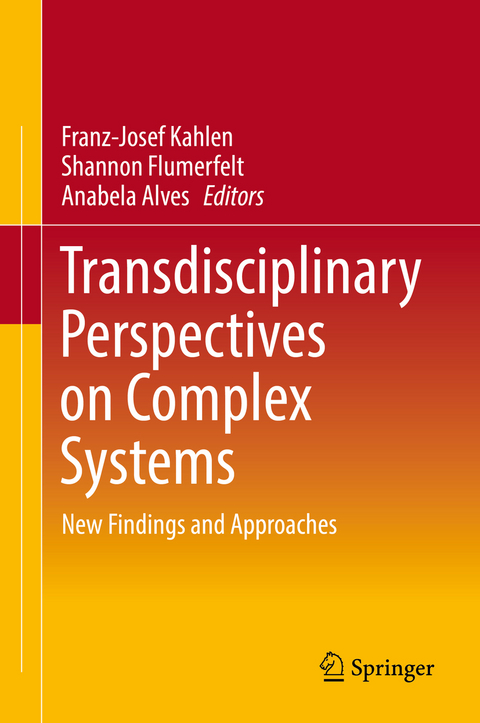
Transdisciplinary Perspectives on Complex Systems (eBook)
X, 327 Seiten
Springer International Publishing (Verlag)
978-3-319-38756-7 (ISBN)

Franz-Josef Kahlen founded his company Kahlen Global Professional Solutions in 2015, focusing on complexity management and competency development. His main research interests are in the areas of Manufacturing and Operational Excellence, Lean and Systems Engineering, Project Management, Competency Development, and the evolution of Engineering Professional Practice. Before returning to private industry, he was an Associate Professor in the Department of Mechanical Engineering at the University of Cape Town, South Africa. He has extensive industry experience in printing, disk drive, biomedical, optics, healthcare service delivery, telecom and several other industries with a customer base in Asia, Europe, US, and Australia. He is author/co-author of ca. 60 publications, and is asked regularly to present keynotes and invited presentations at conferences.
Shannon Flumerfelt is a tenured Associate Professor of Organizational Leadership at Oakland University, Rochester, Michigan, USA. She is also an Endowed Professor of Lean and the Director of Lean Thinking for Schools at The Pawley Lean Institute at Oakland University and holds a PhD in leadership. She has pioneered the CX Framework, a transformative tool that promotes lean and systems thinking applications in organizations. Dr. Flumerfelt is the founder of a lean consultancy, training/coaching and analytics firm and she has worked widely in government service and education organizations. She has published numerous scholarly and practitioner publications, including books such as, Lean Essentials for School Leaders and Lean Essentials: Transforming the Way We Do Business. She speaks and trains widely on the topics of lean, organizational development, management practices and leadership development.
Anabela C. Alves is a tenured Assistant Professor at the Department of Production and Systems/School of Engineering/University of Minho. She holds a PhD in Production and Systems Engineering, being affiliated with the Centre ALGORITMI. Her main research interests are in the areas of Production Systems Design and Operation, Lean Manufacturing, Production Planning and Control, Project Management and Engineering Education, with particular interest in active learning methodologies such as Project/Problem-Based Learning (PBL) and Lean Education. She is author/coauthor of more than 100 publications in international journals, conferences publications or communications, including the editions of conference proceedings, book chapters and books..Franz-Josef Kahlen founded his company Kahlen Global Professional Solutions in 2015, focusing on complexity management and competency development. His main research interests are in the areas of Manufacturing and Operational Excellence, Lean and Systems Engineering, Project Management, Competency Development, and the evolution of Engineering Professional Practice. Before returning to private industry, he was an Associate Professor in the Department of Mechanical Engineering at the University of Cape Town, South Africa. He has extensive industry experience in printing, disk drive, biomedical, optics, healthcare service delivery, telecom and several other industries with a customer base in Asia, Europe, US, and Australia. He is author/co-author of ca. 60 publications, and is asked regularly to present keynotes and invited presentations at conferences. Shannon Flumerfelt is a tenured Associate Professor of Organizational Leadership at Oakland University, Rochester, Michigan, USA. She is also an Endowed Professor of Lean and the Director of Lean Thinking for Schools at The Pawley Lean Institute at Oakland University and holds a PhD in leadership. She has pioneered the CX Framework, a transformative tool that promotes lean and systems thinking applications in organizations. Dr. Flumerfelt is the founder of a lean consultancy, training/coaching and analytics firm and she has worked widely in government service and education organizations. She has published numerous scholarly and practitioner publications, including books such as, Lean Essentials for School Leaders and Lean Essentials: Transforming the Way We Do Business. She speaks and trains widely on the topics of lean, organizational development, management practices and leadership development. Anabela C. Alves is a tenured Assistant Professor at the Department of Production and Systems/School of Engineering/University of Minho. She holds a PhD in Production and Systems Engineering, being affiliated with the Centre ALGORITMI. Her main research interests are in the areas of Production Systems Design and Operation, Lean Manufacturing, Production Planning and Control, Project Management and Engineering Education, with particular interest in active learning methodologies such as Project/Problem-Based Learning (PBL) and Lean Education. She is author/coauthor of more than 100 publications in international journals, conferences publications or communications, including the editions of conference proceedings, book chapters and books..
Foreword 6
Preface 8
Contents 10
Mathematical Characterization of System-of-Systems Attributes 12
1 Introduction 12
2 Background: Review of Attributes and Taxonomy 14
3 Discussion: Development of System Attribute Characteristic Expressions 17
3.1 Objectives of the Present Development 17
3.2 Premise 18
3.3 Principles of Systems Theory 18
3.4 Autonomy 19
3.5 Systems of Systems 20
3.6 Diversity 20
3.7 Connectivity 21
3.8 Belonging 22
4 Discussion: Belonging in the National Airspace System: A Practical Example 24
5 Foundations for Future Work: Our Understanding of Complex Systems 27
5.1 The Critical Role of Emergence 27
5.2 Epistemology Versus Ontology 30
6 Conclusions 31
7 Addendum: An Additional Example from the First Responder System 33
References 34
So It´s Complex, Why Do I Care? 36
1 Introduction 36
1.1 The Rising Cost of Aerospace Systems with Complexity 38
1.2 What to Do About Complexity 40
2 Complexity 40
2.1 A Survey of Complexity Definitions 40
2.2 The Consequences of Complexity 42
3 Ideas to Build on 45
3.1 Process of Design and Design of Process 47
3.2 The Cynefin Framework 48
3.3 Agile Development 52
3.4 Risk and Uncertainty 54
4 Common Threads 55
4.1 Implications of Complexity Definitions 55
4.2 Recommendations 55
5 Summary 57
References 58
Designer Systems of Systems: A Rational Integrated Approach of System Engineering to Tailored Aerodynamics, Aeroelasticity, Ae... 60
1 Introduction 60
2 General Considerations 63
3 System Engineering Influence on Designer SoS: Flight Vehicle Synthesis and Analysis 64
4 Identification of Systems, State Variables, Parameters, Constraints, etc. 66
4.1 Materials and Structures 66
4.2 Aerodynamics 68
4.3 Propulsion, Stability and Control, etc. 68
5 Designer SoS Analysis: A Generalized System Engineered Synthesis Case 68
6 Designer/Tailored/Engineered SoS Protocol 71
7 Structural/Material/Sizing Examples 72
8 A FGM Manufactured to Order 75
9 Cause and Effect: A Brief Case Study of a Structural Weight Change 76
10 Probability of Failure, Redundancies and Weghing Functions 76
11 Approaches to SoS Cost Estimation 77
11.1 Components of Cost 77
11.2 Approaches to Cost Estimation 78
11.3 Cost Functions in Economics 78
11.4 Specification of Cost Functions 79
12 Discussion 81
13 Future Expansions to Entire Vehicles: Designer SoS 84
14 Conclusions 85
References 86
Digital Twin: Mitigating Unpredictable, Undesirable Emergent Behavior in Complex Systems 96
1 Introduction 96
2 Conventional Approaches and Current Issues 97
2.1 Defining Complex Systems 97
2.2 Complex Systems and Associated Problems 98
2.3 Defining Emergence and Emergent Behavior 100
2.4 Four Categories of System Behavior 101
2.5 Emergence, Emergent Behavior, and the Product Lifecycle 102
3 The Digital Twin Concept 103
3.1 Origins of the Digital Twin Concept 104
3.2 Defining the Digital Twin 105
3.3 The Digital Twin Model Throughout the Lifecycle 106
3.4 System Engineering Models and the Digital Twin 109
3.5 The Digital Twin and Big Data 111
4 Value of the Digital Twin Model 112
4.1 Evaluating Virtual Systems 114
4.2 Virtuality Test Progress 116
4.2.1 Visual Tests 116
4.2.2 Performance Tests 116
4.2.3 Reflectivity Tests 118
5 Digital Twin Obstacles and Possibilities 118
5.1 Obstacles 119
5.2 Possibilities 120
6 A NASA Approach to the Digital Twin 121
7 Conclusion 122
References 123
Managing Systems Complexity Through Congruence 125
1 Introduction 125
2 Background and Motivation for Better Systems Management 126
2.1 Systems and People 126
2.2 Systems Defined 128
2.3 Organizational Learning and Systems Management 131
2.4 System Congruence of Organizational Thinking and Doing 132
2.5 Testing Congruence Through System Metrics 135
3 The CX Tool 136
3.1 The Need for the CX Tool 136
3.2 The CX Tool and Continuous Improvement 136
3.3 The CX Tool Design and Method 137
4 Case Studies of the CX Tool 140
4.1 Midwestern University Tier 1 CX Tool Case Studies 140
4.2 Northwest Pacific University Tier 2 CX Tool Case Studies 141
5 Conclusion 147
Appendix: The CX Tool 148
Description of the CX Tool 148
Directions for the CX Tool 149
Definitions for the CX Tool 150
Two System Areas 150
Six System Elements 150
Organizational Intelligence 150
Performance Management 150
Three Congruence Metrics 151
References 151
Additive Manufacturing: A Trans-disciplinary Experience 155
1 General Principles of Additive Manufacturing 155
1.1 Overview of Additive Manufacturing 155
1.2 Systems in AM 156
1.3 The Bigger Picture 157
2 Defining the Disciplines: Design, Materials, Processes, Qualification 158
2.1 AM Design 158
2.2 Materials 160
2.3 Process 161
2.4 Qualification 162
3 Exploring the Interactions: Systems Principles in AM 164
3.1 The Digital Spectrum 164
3.2 The Design Phase 167
3.2.1 Designing Simple Parts 167
3.2.2 Designing Complex Parts 168
3.3 Process Planning Phases 169
3.3.1 Process Planning and Part Geometry Models 170
3.3.2 Process Parameters and Material Properties 170
3.4 AM Process Control 172
3.4.1 How Does It Work 172
3.4.2 Process Control and Modeling 172
3.5 AM Qualification 173
4 Beyond the Plant Floor: The Tran-disciplinary Nature of AM 174
4.1 In the Lab 175
4.2 In the Field 176
4.3 The Maker Movement 177
4.4 At the Core 178
5 Systems for Trans-disciplinary Perspectives in AM: Moving Forward 179
6 Conclusion 180
References 181
Expanding Sociotechnical Systems Theory Through the Trans-disciplinary Lens of Complexity Theory 186
1 Introduction 186
2 Background: Early Research from the Sociotechnical Systems Perspective 187
3 Human and Social Behavioral Challenges to Organizational Design and Performance 190
4 The Organization as an Open System: Setting the Stage for Normal Accidents 194
5 New Methodological Approaches to Address Sociotechnical Complexity 196
6 Conclusion 199
References 199
On Complementarity and the Need for a Transdisciplinary Approach in Addressing Emerging Global Health Issues 202
1 Introduction 202
2 On Perspectives in Complex Problems 204
3 Emerging Diseases 205
4 Viewing the Outbreak of Emerging Diseases Through an Engineering Lens 206
5 Viewing the Outbreak of Emerging Diseases Through a Global Health Lens 208
6 Viewing the Outbreak of Emerging Diseases Through an Education Lens 210
7 A Framework for Uniting Disparate Perspectives Through a Transdisciplinary Perspective 213
8 Illustrative Example 214
8.1 Examining the Ebola Virus Disease through an Engineering Lens 214
8.2 Examining the Ebola Virus Disease through a Global Health Lens 215
8.3 Examining the Ebola Virus Disease through an Education Lens 216
8.4 Examining CMs Across Disciplines 217
9 Conclusions 218
References 219
On the Perception of Complexity and Its Implications 222
1 Executive Summary 222
2 Chapter Roadmap 224
3 On Complexity and the Deep-Rooted Assumption 224
3.1 On Complexity in System Design 225
3.2 On the Change-Prevention System and the Deep-Rooted ``Big Assumption´´ of the System Design Community 228
3.2.1 On the Change-Prevention System 228
3.2.2 Historical Example: The Geocentric Solar System Model 230
3.2.3 Synthesis: The System Design Community´s Deep-Rooted ``Big Assumption´´ 231
3.3 On a Comparative Study Approach to Assess the Validity of the Deep-Rooted Assumption 233
3.3.1 A Normative Comparative Study Approach 234
3.3.2 On the Consequences of the Assessment of the Deep-Rooted Assumption 235
4 Framework for the Normative Comparative Study to Assess the Validity of the Deep-Rooted Assumption 236
4.1 The Evaluation Criteria 236
4.1.1 Generalizing the Intent of Systems Design 236
4.1.2 Understanding Facilitation to Meet the Intent of Systems Design 237
4.1.3 Deriving the Minimally Sufficient Form of Design Approach and Its Success Criteria 237
4.1.4 Deriving the Minimally Sufficient Form of Design Solution and It Success Criteria 238
4.2 The Basis of Similarity: A Viewpoint Pattern Directed Toward Meeting the Intent of System Design 238
4.3 Defining and Applying the Prevailing Viewpoint 240
4.3.1 Querying the Prevailing Viewpoint 240
4.3.2 On the Form of the Design Approach Within the Prevailing Viewpoint 240
4.3.3 On the Form of the Design Solution Within the Prevailing Viewpoint 243
4.4 Defining and Applying the Alternative Viewpoint 243
4.4.1 Defining the Alternative Viewpoint 243
4.4.2 On the Form of the Design Approach Within the Alternative Viewpoint 245
4.4.3 On the Form of the Design Solution Within the Alternative Viewpoint 249
5 Comparative Study of the Viewpoints to Facilitate System Design 250
5.1 Comparative Analysis of the Viewpoints and Their General Forms 250
5.1.1 Agreement with Comparative Study Evaluation Criteria: Disposition Towards Meeting Intent 250
The Prevailing Viewpoint 250
The Alternative Viewpoint 251
5.1.2 Agreement with Comparative Study Evaluation Criteria: Assurance 252
General Form of the Prevailing Viewpoint 252
Conditions for Sufficiency or Insufficiency to Satisfy Criteria and Meet Intent 253
General Form of the Alternative Viewpoint 254
Conditions for Sufficiency or Insufficiency to Satisfy Criteria and Meet Intent 255
5.1.3 On the Agreement with Comparative Study Evaluation Criteria: Correct and Complete 256
General Form of the Prevailing Viewpoint 256
The General Form of the Alternative Viewpoint 257
5.2 Assessment of the Validity of the Deep-Rooted Assumption 258
5.2.1 On the Validity of the Deep-Rooted Assumption 258
5.2.2 On the Nature of Complexity in System Design 259
5.2.3 On the Viewpoints and Their Relationships 259
5.2.4 On the Potential for Additional Viewpoints 260
6 Suppositions Concerning the Evolution of the Observed Misalignment 261
6.1 On the Trajectory of Growing Misalignment 262
6.1.1 A Brief History of Technology Development 262
Level 1: Passive Extension Development 262
Level 2: Amplifying Extension Development 263
Level 3: Collaborative Extension Development 263
6.1.2 On the Emergence of the ``Craftsman´´ Mentality 264
6.1.3 On Comprehension of Natural Systems and the Perception of Complexity 265
6.1.4 Brief Summary of Evidence in Support of Suppositions 266
6.2 On Two Potentially Harmful Mental Constructs for ``Complex´´ System Design 268
6.2.1 Systems Are Defined by Boundaries 268
6.2.2 Systems Have Emergent Behavior 271
7 The Path Forward 272
7.1 Principles and Practices to Improve Alignment 273
7.1.1 Coupling and Cohesion Principles 273
7.1.2 Proper Sufficiency Principle 274
7.1.3 The Surgeon Principle 274
7.2 Concluding Remarks 275
References 276
Early Phase Estimation of Variety Induced Complexity Cost Effects: A Study on Industrial Cases in Germany 279
1 Variety Induced Complexity: Causes and Effects 279
1.1 Complexity Is Induced by Different Causes 279
1.2 The Challenges of Individualization and Globalization in Mechanical and Plant Engineering 280
1.3 Trans-disciplinary Complexity Cost Effects 280
2 Scientific Contributions on Reducing Internal Variety 281
2.1 Complexity Management and Variant Management 281
2.2 Development of Modular Product Families and Platforms 282
2.3 Complexity Cost Analysis 283
3 Hypotheses on the Reduction of Variety Induced Complexity Cost 284
4 Industrial Application of the Integrated PKT-Approach for Developing Modular Product Families 285
4.1 General Means to Enable Industrial Application 285
4.2 As Is Analysis 286
4.3 Product Program Integration 288
4.4 Design for Variety 289
4.5 Life Phases Modularization 291
4.6 Complexity Cost Effect Estimation 292
5 Insights on the Nature of Variety Induced Complexity Cost: Industrial Cases 294
5.1 Hypothesis 1: Modularization Is a Useful Approach to Reduce Complexity Cost 294
5.2 Hypothesis 2: Modularization Can Influence Production Cost Positively or Negatively 295
5.3 Hypothesis 3: Modular Concepts Show Different Cost Effects in Different Disciplines 297
5.4 Hypothesis 4: The Cost Effects of Modularization Depend on the Lot Size and Are Thus Different for Different Segments and ... 298
5.5 Resulting Need for Improvement 299
6 Proposal for a Method to Estimate Trans-disciplinary Complexity Cost of Modular Concepts 299
6.1 Factors to Be Reconsidered for a Trans-disciplinary Complexity Cost Estimation 300
6.2 Enhanced Breakeven Analysis of Complexity Cost 301
6.3 Product Life Induced Complexity Cost 302
6.4 Holistic Approach for an Early Phase Estimation of Complexity Cost 304
6.5 Discussion of the Proposed EPECC Approach 305
7 Success Factors of Modularization in Branches and Segments with High Lot Sizes 306
8 Success Factors of Modularization in Branches and Segments with Low Lot Sizes 306
8.1 Modularization Factors for Plant Engineering 306
8.2 Modularization Factors for Small and Medium-Sized Enterprises 307
9 Summary and Conclusion 308
References 310
Problem Solving and Increase of Ideality of Complex Systems 312
1 Introduction 312
2 Theory of Inventive Problem Solving (TRIZ) 314
3 Complex Systems Problem Solving in Trans-disciplinary Context 316
4 Law of Systems Evolution and Ideality of Complex Systems 325
5 Case Study: Ideality and Problem Solving of a Process for Complex Projects Management 329
6 Case Study: Ideality and Application of Ideality Matrix to a Complex Product Problem Solving 332
7 Conclusions 333
References 333
| Erscheint lt. Verlag | 16.8.2016 |
|---|---|
| Zusatzinfo | X, 327 p. 89 illus., 55 illus. in color. |
| Verlagsort | Cham |
| Sprache | englisch |
| Themenwelt | Mathematik / Informatik ► Mathematik |
| Technik ► Bauwesen | |
| Wirtschaft ► Allgemeines / Lexika | |
| Schlagworte | competency development • Complexity • Complex Systems • Decision Making • Organizational Systems • Systems Engineering |
| ISBN-10 | 3-319-38756-1 / 3319387561 |
| ISBN-13 | 978-3-319-38756-7 / 9783319387567 |
| Informationen gemäß Produktsicherheitsverordnung (GPSR) | |
| Haben Sie eine Frage zum Produkt? |
 PDF (Wasserzeichen)
DRM: Digitales Wasserzeichen
Dieses eBook enthält ein digitales Wasserzeichen und ist damit für Sie personalisiert. Bei einer missbräuchlichen Weitergabe des eBooks an Dritte ist eine Rückverfolgung an die Quelle möglich.
Dateiformat: PDF (Portable Document Format)
Mit einem festen Seitenlayout eignet sich die PDF besonders für Fachbücher mit Spalten, Tabellen und Abbildungen. Eine PDF kann auf fast allen Geräten angezeigt werden, ist aber für kleine Displays (Smartphone, eReader) nur eingeschränkt geeignet.
Systemvoraussetzungen:
PC/Mac: Mit einem PC oder Mac können Sie dieses eBook lesen. Sie benötigen dafür einen PDF-Viewer - z.B. den Adobe Reader oder Adobe Digital Editions.
eReader: Dieses eBook kann mit (fast) allen eBook-Readern gelesen werden. Mit dem amazon-Kindle ist es aber nicht kompatibel.
Smartphone/Tablet: Egal ob Apple oder Android, dieses eBook können Sie lesen. Sie benötigen dafür einen PDF-Viewer - z.B. die kostenlose Adobe Digital Editions-App.
Buying eBooks from abroad
For tax law reasons we can sell eBooks just within Germany and Switzerland. Regrettably we cannot fulfill eBook-orders from other countries.
aus dem Bereich