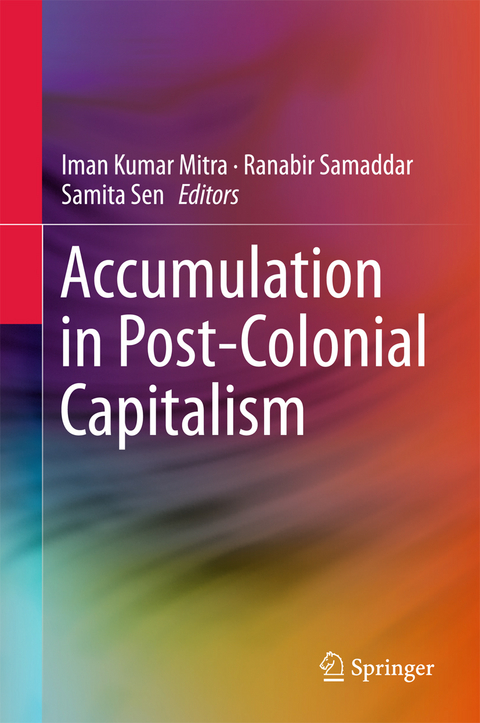
Accumulation in Post-Colonial Capitalism (eBook)
XI, 260 Seiten
Springer Singapore (Verlag)
978-981-10-1037-8 (ISBN)
This volume looks at how accumulation in postcolonial capitalism blurs the boundaries of space, institutions, forms, financial regimes, labour processes, and economic segments on one hand, and creates zones and corridors on the other. It draws our attention to the peculiar but structurally necessary coexistence of both primitive and virtual modes of accumulation in the postcolony. From these two major inquiries it develops a new understanding of postcolonial capitalism. The case studies in this volume discuss the production of urban spaces of capital extraction, institutionalization of postcolonial finance capital, gendering of work forms, establishment of new forms of labour, formation of and changes in caste and racial identities and networks, and securitization-and thereby confirm that no study of contemporary capitalism is complete without thoroughly addressing the postcolonial condition.
By challenging the established dualities between citizenship-based civil society and welfare-based political society, exploring critically the question of colonial and postcolonial difference, and foregrounding the material processes of accumulation against the culturalism of postcolonial studies, this volume redefines postcolonial studies in South Asia and beyond. It is invaluable reading for students and scholars of South Asian studies, sociology, cultural and critical anthropology, critical and praxis studies, and political science.Iman Kumar Mitra has studied economics and is a research associate at the Calcutta Research Group. His doctoral dissertation explores the history of dissemination of economic knowledge in colonial Bengal through various pedagogical and institutional networks. His research interests include history of economics, migration, urbanization, and labour issues. He is currently involved in a research project on the interconnectedness between rural-urban migration, urbanization, and social justice in post-liberalization India.
Ranabir Samaddar is Distinguished Chair in Migration and Forced Migration Studies, Calcutta Research Group. He has worked extensively on issues of forced migration, the theory and practices of dialogue, nationalism and post-colonial statehood in South Asia, and new regimes of technological restructuring and labour control. His most recent publication in the form of a co-authored volume on new town and new forms of accumulation Beyond Kolkata: Rajarhat and the Dystopia of Urban Imagination (Routledge, 2013) takes forward urban studies in the context of post-colonial capitalism.
Samita Sen, the first Vice-Chancellor of the Women's University at Diamond Harbour, West Bengal, teaches at the School of Women's Studies, Jadavpur University. She has worked extensively on labour and gender issues. Her publication includes Women and Labour in Late Colonial India: The Bengal Jute Industry (Cambridge University Press, 1999) and the co-authored monograph Domestic Days: Women, Work, and Politics in Contemporary Kolkata (Oxford University Press, 2015). She is a member of the Calcutta Research Group.
This volume looks at how accumulation in postcolonial capitalism blurs the boundaries of space, institutions, forms, financial regimes, labour processes, and economic segments on one hand, and creates zones and corridors on the other. It draws our attention to the peculiar but structurally necessary coexistence of both primitive and virtual modes of accumulation in the postcolony. From these two major inquiries it develops a new understanding of postcolonial capitalism. The case studies in this volume discuss the production of urban spaces of capital extraction, institutionalization of postcolonial finance capital, gendering of work forms, establishment of new forms of labour, formation of and changes in caste and racial identities and networks, and securitization-and thereby confirm that no study of contemporary capitalism is complete without thoroughly addressing the postcolonial condition. By challenging the established dualities between citizenship-based civil society and welfare-based political society, exploring critically the question of colonial and postcolonial difference, and foregrounding the material processes of accumulation against the culturalism of postcolonial studies, this volume redefines postcolonial studies in South Asia and beyond. It is invaluable reading for students and scholars of South Asian studies, sociology, cultural and critical anthropology, critical and praxis studies, and political science.
Iman Kumar Mitra has studied economics and is a research associate at the Calcutta Research Group. His doctoral dissertation explores the history of dissemination of economic knowledge in colonial Bengal through various pedagogical and institutional networks. His research interests include history of economics, migration, urbanization, and labour issues. He is currently involved in a research project on the interconnectedness between rural-urban migration, urbanization, and social justice in post-liberalization India.Ranabir Samaddar is Distinguished Chair in Migration and Forced Migration Studies, Calcutta Research Group. He has worked extensively on issues of forced migration, the theory and practices of dialogue, nationalism and post-colonial statehood in South Asia, and new regimes of technological restructuring and labour control. His most recent publication in the form of a co-authored volume on new town and new forms of accumulation Beyond Kolkata: Rajarhat and the Dystopia of Urban Imagination (Routledge, 2013) takes forward urban studies in the context of post-colonial capitalism. Samita Sen, the first Vice-Chancellor of the Women’s University at Diamond Harbour, West Bengal, teaches at the School of Women’s Studies, Jadavpur University. She has worked extensively on labour and gender issues. Her publication includes Women and Labour in Late Colonial India: The Bengal Jute Industry (Cambridge University Press, 1999) and the co-authored monograph Domestic Days: Women, Work, and Politics in Contemporary Kolkata (Oxford University Press, 2015). She is a member of the Calcutta Research Group.
Chapter 1. Introduction: A Post-Colonial Critique of Capital Accumulation Today.- Part I: New Dynamics of Accumulation.- Chapter 2. Flexible Labour and Capital Accumulation in a Post-Colonial Country Byasdeb Dasgupta.- Chapter 3. Law, Statistics, Public Private Partnership and the Emergence of a New Subject Mithilesh Kumar.- Chapter 4. S ecurity and the City: Postcolonial Accumulation, Securitization and Urban Development in Kolkata Ilia Antenucci.- Chapter 5. Accumulation by Possession: The Social Processes of Rent Seeking in Urban Delhi Sushmita Pati.- Chapter 6. Accumulation at Margins: The Case of Khora Colony Shruti Dubey.- Chapter 7. The Politics of Bank Nationalization in India Suhit K. Sen.- Part II: Caste, Gender, Race: Axes of Accumulation.- Chapter 8. Life, Labour, Recycling: A Study of Waste Management Practices in Contemporary Kolkata Debarati Bagchi and Iman Kumar Mitra.- Chapter 9. Ayurveda Tourism: Issues of Development and Gender in Contemporary Kerala Rashmi Gopi.- Chapter 10. Caste and the Frontiers of Post-Colonial Capital Accumulation Ritajyoti Bandyopadhyay and Ranabir Samaddar.- Chapter 11. Governmentalizing NRI Philanthropy in Andhra Pradesh: A Transregional Approach to India’s Development Sanam Roohi.- Chapter 12. The Postcolony and Racy Histories of Accumulation Atig Ghosh.
| Erscheint lt. Verlag | 29.7.2016 |
|---|---|
| Zusatzinfo | XI, 260 p. |
| Verlagsort | Singapore |
| Sprache | englisch |
| Themenwelt | Geisteswissenschaften ► Geschichte |
| Sozialwissenschaften ► Politik / Verwaltung | |
| Sozialwissenschaften ► Soziologie ► Makrosoziologie | |
| Wirtschaft ► Volkswirtschaftslehre ► Wirtschaftspolitik | |
| Schlagworte | Accumulation and primitive accumulation • artisan-entrepreneurs • ayurveda tourism • bank nationalization in India • Biopolitics • caste and entrepreneurship • caste politics and philanthropy • Cultural Racism • discourse on diabetes in India • gender and migrant labour • homeless urban population • Kammas of Andhra • kinship capital • migrant labour and NGOs • Migrant labour in India • Postcolonialism • postwar Jaffna • urban villages in India |
| ISBN-10 | 981-10-1037-4 / 9811010374 |
| ISBN-13 | 978-981-10-1037-8 / 9789811010378 |
| Informationen gemäß Produktsicherheitsverordnung (GPSR) | |
| Haben Sie eine Frage zum Produkt? |
 PDF (Wasserzeichen)
DRM: Digitales Wasserzeichen
Dieses eBook enthält ein digitales Wasserzeichen und ist damit für Sie personalisiert. Bei einer missbräuchlichen Weitergabe des eBooks an Dritte ist eine Rückverfolgung an die Quelle möglich.
Dateiformat: PDF (Portable Document Format)
Mit einem festen Seitenlayout eignet sich die PDF besonders für Fachbücher mit Spalten, Tabellen und Abbildungen. Eine PDF kann auf fast allen Geräten angezeigt werden, ist aber für kleine Displays (Smartphone, eReader) nur eingeschränkt geeignet.
Systemvoraussetzungen:
PC/Mac: Mit einem PC oder Mac können Sie dieses eBook lesen. Sie benötigen dafür einen PDF-Viewer - z.B. den Adobe Reader oder Adobe Digital Editions.
eReader: Dieses eBook kann mit (fast) allen eBook-Readern gelesen werden. Mit dem amazon-Kindle ist es aber nicht kompatibel.
Smartphone/Tablet: Egal ob Apple oder Android, dieses eBook können Sie lesen. Sie benötigen dafür einen PDF-Viewer - z.B. die kostenlose Adobe Digital Editions-App.
Buying eBooks from abroad
For tax law reasons we can sell eBooks just within Germany and Switzerland. Regrettably we cannot fulfill eBook-orders from other countries.
aus dem Bereich