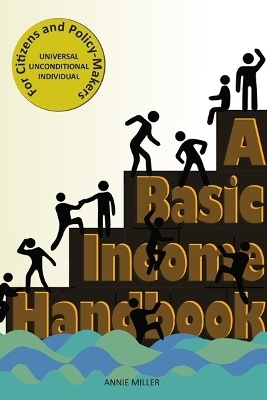
A Basic Income Handbook
Luath Press Ltd (Verlag)
978-1-910745-78-6 (ISBN)
- Titel wird nachgedruckt
- Portofrei ab CHF 40
- Auch auf Rechnung
- Artikel merken
In this informative book, Annie Miller does not only explore the idea of basic
income: she exhaustively explains what it is and what it would mean to
implement, using extensive economic data. Miller starts off from a broad,
existential position, outlining why the current system is no longer suitable
for the times and needs to change. Her proposed solution is a society with
BI, which she first outlines abstractly before diving into its internal workings,
explaining who would be eligible for BI, what would happen to the rest of
the welfare system, and other crucial details. Miller backs up her statements
with substantive economic research and analysis. She ends with a section on
how to achieve a society with BI, giving examples of pilot schemes
elsewhere and discussing the politics behind implementation. Thus she
brings the reader full circle from aspiring to a BI society, to seeing what it
would take to reach it.
ANNIE MILLER was born in England to a Scottish father. She is very proud of her Scottish heritage, and has lived in Scotland since 1969. Though she is now retired, she spent over 20 years lecturing in the Department of Economics at Heriot-Watt University in Edinburgh and during that time co-edited A Modern Guide to Economic Thought: an introduction to Comparative Schools of Thought in Economics. Through her long career, Miller has dedicated much of her time and research to Basic Income (also known as Citizen’s Income), becoming an expert in the field. She has presented papers on the issue at eight of the Basic Income Earth Network (BIEN)’s biannual congresses, including ones in Barcelona, Munich and Montreal. She also co-founded in 1984 the Basic Income Research Group, now the Citizen’s Income Trust (CIT), of which she has been Chair since 2001. As recently as 2014 Miller was a keynote speaker at a round-table discussion in the Scottish Parliament on BI. Miller lives in Edinburgh.
List of Figures 12
List of Tables 13
List of Abbreviations 16
A note about terminology 18
Preface – how this book came to be written 20
The structure of the book 25
Acknowledgements 28
part i philosophical and political arguments
chapter 1 Introduction: How did we get from there to here? 31
Imagine… 31
Why we need a bi system to replace the current Social
Security System 32
The post World War ii consensus welfare reforms –
how did we get from there to here? 33
Why not just improve the current social security
system? 41
Our social security system is not fit for purpose –
cut the Gordian knot 43
chapter 2 Values and vision: the objectives 45
What sort of society? 45
Justification for a social security system 46
What objectives and outcomes could an income
maintenance system help to achieve? 46
The case for vertical redistribution of income 48
Who are the rich? 50
part ii theory and evidence
chapter 3 The internal structure and design features of income
maintenance systems 55
Townsend’s three principles 55
The design features of income maintenance systems 55
Comparison of some different income maintenance
systems 58
Basic Incomes 60
chapter 4 The effects of individual assessment on women’s lives:
the unit for assessment and delivery of benefits –
joint or individual? 65
The Marriage laws 65
Financial dependents 66
Household Economies of Scale – incentive to share
accommodation 68
Effect of bi on women’s lives 69
INDIA 2011–13 70
chapter 5 Migration – and giving a bi to rich people 75
Defining the population 75
Migration 77
Giving a bi to rich people to protect the poor:
Eligibility – targeted or universal? 79
Why benefits should not be means-tested 80
ALASKA 1976 – 82
chapter 6 When is discrimination justified?
Entitlement: selective or non-selective benefits 85
Selectivity 85
Discrimination against couples 85
Can a case be made for selective benefits? 87
More on economies of scale 87
Housing costs 90
The needs of disabled people 91
Childcare costs and other public services 92
IRAN 2010 – 94
chapter 7 More control over our lives
Contingency: conditionality or unconditionality? 97
Conditionality and sanctions 97
Free riders and reciprocity 98
Participation Incomes (pi) 100
Effects of unconditionality on incentives to work 101
Macroeconomic effects of a bi scheme 104
Mincome program, Dauphin, Manitoba, Canada
1974–79 105
chapter 8 Simplifying the administration system 108
Defining the population and criteria for eligibility 108
Alternative methods of assessment and delivery 109
Other effects of a bi on administration 111
chapter 9 Chronology of evidence from around the world 113
Overview 113
Income maintenance experiments in the usa, 1968–80 114
Brazil 2004– 115
Namibia 2008–9 116
European Citizens’ Initiative on Unconditional Basic
Income, 2012–14 119
Switzerland 2012–16 121
Finland 2015– 122
Netherlands, France and Germany 123
Update on bi projects in May 2017 124
Scotland 125
part iii economic viability – facts and figures
chapter 10 Deciding on the bi levels 132
Measures of prosperity in society 132
Poverty 134
A floor and two poverty benchmarks 135
Current uk means-tested benefit levels 135
The eu’s official poverty threshold 135
Minimum Income Standards 139
The timing of publication of information 141
An alternative poverty benchmark 144
chapter 11 Costing a Basic Income Scheme 148
A note about costs 148
Costing an illustrative sample scheme 150
Which benefits to replace with a bi, and which to
retain? 150
chapter 12 How to finance a bi scheme? 163
Alternative sources for funding a bi scheme 163
uk taxes and their yields 166
Why income tax is the best source 168
Financing a bi scheme through the benefit and income
taxation systems 170
Tax expenditures and structural reliefs 171
Sleights of hand with the Personal Allowance 175
chapter 13 A restructured income tax system 180
A restructured income tax system 180
An alternative method for calculating the cost of a
bi scheme 181
Even though progressive taxes are more redistributive,
a proportionate tax (flat tax), has some advantages 184
An income / earnings disregard (edr) 186
The structure of the income tax schedule 188
Will it cost too much? Can we afford it? 190
chapter 14 Sample bi schemes for Scotland and the uk 192
No single optimum bi scheme 192
Clearly-stated prioritised objectives, assumptions and
constraints 194
The first set of sample bi schemes, compared with
current means-tested benefits 198
The second set of sample bi schemes, compared with
the official eu poverty benchmark (ahc version) 199
Comparison of a set of three bi schemes 206
The third set of sample bi schemes, compared with the
mis poverty benchmark (ahc version) 208
Summary of the illustrative sample bi schemes 212
part iv how do we get from here to there?
chapter 15 How do we get from here to there? 219
Implementation 219
The sector approach 220
The gradual approach, increasing the amounts of the
bis over time 223
The political process 225
How might the scheme to be implemented be chosen? 229
chapter 16 Conclusion 231
Recap: features of income maintenance systems –
definition of a bi – broad objectives 231
Current problems that bi schemes could help to solve
– criticisms of bi schemes addressed 232
Illustrative bi schemes 234
Hope for the future 235
appendices
appendix a Figures for the uk 2011–15 and Scotland 2012–15 239
appendix b Hypothetical bi schemes 244
Measures of inequality 244
Calculation of the Gini coefficient by linear
interpolation 245
Mathematical proof 245
A hypothetical example of an international bi 246
Constructing an income distribution for individuals 251
Comparison of different progressive income tax
schedules 252
appendix c Design and cost your own bi scheme 258
appendix d Chronology of Basic Income with respect to the uk 261
Sources of Data 269
Bibliography 279
Organisations (Information and Contacts) 295
Index 297
| Erscheinungsdatum | 11.08.2017 |
|---|---|
| Verlagsort | Edinburgh |
| Sprache | englisch |
| Maße | 156 x 234 mm |
| Gewicht | 10 g |
| Themenwelt | Geisteswissenschaften ► Philosophie |
| Wirtschaft ► Volkswirtschaftslehre ► Makroökonomie | |
| ISBN-10 | 1-910745-78-2 / 1910745782 |
| ISBN-13 | 978-1-910745-78-6 / 9781910745786 |
| Zustand | Neuware |
| Informationen gemäß Produktsicherheitsverordnung (GPSR) | |
| Haben Sie eine Frage zum Produkt? |
aus dem Bereich