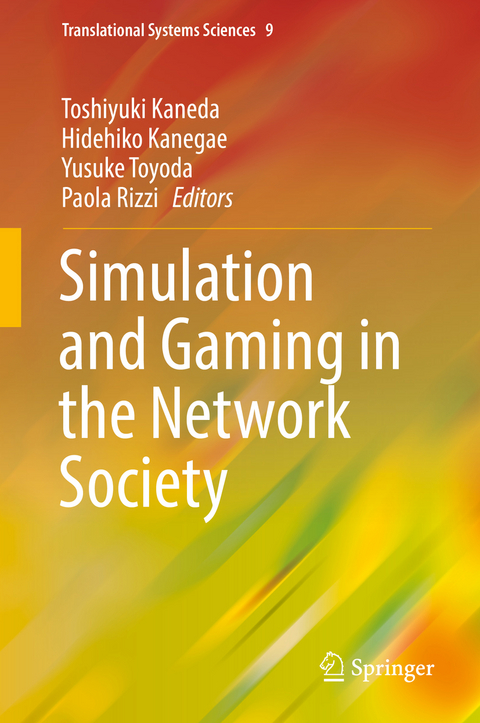
Simulation and Gaming in the Network Society (eBook)
XVI, 474 Seiten
Springer Singapore (Verlag)
978-981-10-0575-6 (ISBN)
This book provides the state of the art in the simulation and gaming study field by systematically collecting excellent papers presented at the 46th International Simulation and Gaming Association annual conference held in Kyoto 17-25 July 2015. Simulation and gaming has been used in a wide variety of areas ranging from early childhood education and school-age children, universities, and professional education, to policy exploration and social problem solving. Moreover, it now been drastically changing its features in the Internet Of Things (IOT) society while taking over a wide variety of aliases, such as serious games and gamification. Most of the papers on which this book's chapters are based were written by academic researchers, both up-and-coming and well known. In addition, simulation and gaming is a translational system science going from theory to clinical cross-disciplinary topics. With this book, therefore, graduate students and higher-level researchers,educators, and practitioners can become familiar with the state-of-the-art academic research on simulation and gaming in the network society of the twenty-first century.
Toshiyuki Kaneda , Professor, Dr., Nagoya Institute of Technology, kaneda@nitech.ac.jp, Gokiso, Showa, Nagoya, 466-8555, JapanHidehiko Kanegae, Professor, Dr., Ritsumeikan University, hkanegae@SPS.ritsumei.ac.jp, Kitamachi 58Rits-DMUCH, Komatsubara, Kita-ku,Kyoto.6038341, JapanYusuke Toyoda, Associate Professor Dr., Ritsumeikan University, toyoday@fc.ritsumei.ac.jp, Ritsumeikan Univ. The Calle of Policy Sciences, 1 Nishinokyo-Suzaku cho, Nakagyo-ward, Kyoto 604-8415, Japan Paola Rizzi, Professor Dr., University of Sassari, rizzi@uniss.it, University of Sassari, Department of Architecture, Design and Urban Planning, Palazzo del Pou Salit, Piazza Duomo 6, 07041 Alghero (SS), Italia
Part I: History, Theory and Methodology.- 1. The Origins of Board Games and Ancient Game Boards.- 2. Bending Time – Using Simulation to Warp Perceptions of Time For Learning Purposes.- 3. Eat the Cabbage, Kill the Wolf. When a Game Becomes a Useful Tool for the Simulation of Communication, Information and Decision Making Processes.- 4. Live-Action Roleplay; or the Performance of Realities.- 5. Participants’ Perceptions of Gaming Simulation.- 6. Ecological Psychology – A Framework for Wargame Design.- Part II: Classroom Fields.- 8. Simulation and Gaming in Virtual Language Learning Literacy.- 9. Comparing Live-Action and Computer-Mediated Educational Games for Engineering Studies.- 10. Development of Gaming Material and Design Framework for Integrating Entrepreneurship Education into Problem-based Learning in Mathematics.- 11. Understanding the History of International Politics- A Retrospective and Repeated Type of Gaming and Simulation in the Classroom.- 12. Gamification in Education: “American Dream” Game.- Part III: Business Fields.- 13.Japanese CreativeServices and Its Competitive , Value Co-operation Process.- 14. Implementaion Model for the Gamification of Business Processes: A Study from the Field of Material Handling.- 15. ColPMan: A Serious Game for Practicing Collaborative Production Management.- 16. Massively Multiplayer Online Games as Information Systems Implications for Organizational Learning.- 17. An Experiment: An International Comparison of the Decision- Making Process Using a Business Game.- 18. Experiential Artefact for Cross- Cultural Learning in Business Games: First Results.- Part IV: Policy and Planning Fields.- 19. Urban Planning Games and Simulations: From Board Games to Artificial Environments.- 20. Between Game and Reality: Using Serious Games to Analyze Complex Interaction Processes in Air Traffic Management.- 21. Gaming Simulation Hybrids in the Railway Domain: How Games Impact the Volatility of Innovation Processes.- 22. A Feasbility Study of Land Readjustment Projects in Afganistan by Developing and Applying Gaming Simulation.- 23. Development of SASKE-NABLE: A Simulation Game Utilizing Lessons from the Great East Japan Earthquake.- 24. A Simulation of Economic Loss Impact and Recovery: A Case Study of Shima City Assuming Nankai Trough Earthquake.- Part V: Emerging Research Fields.- 25. Environmental Education by Playing an Industrial Waste Game: A Comparison between Chinese, Korean, and Japanese University Students.- 26. Even Unreliable Information Disclosure Makes People Cooperate in A Social Dilemma: Development of the “Industrial Waste Illegal Dumping game”.- 27. Cormas, an Agent-Basedsimulation Platform for Coupling Human Decisions with Computerized Dynamics.- 28. The Fab Safe Game Preparing Fab Labs and Maker Spaces for Occupational Health and Safety.- 29. Knowledge Brokers in Action: A Game Based Approach for Strengthening Evidence- Based Policies.- 30. Simulation of an Organization as a Complex System: Agent – Based Modeling and a Gaming Experiment for Evolutionary Knowledge Management.
| Erscheint lt. Verlag | 2.8.2016 |
|---|---|
| Reihe/Serie | Translational Systems Sciences | Translational Systems Sciences |
| Zusatzinfo | XVI, 474 p. 133 illus., 85 illus. in color. |
| Verlagsort | Singapore |
| Sprache | englisch |
| Themenwelt | Mathematik / Informatik ► Informatik ► Theorie / Studium |
| Mathematik / Informatik ► Mathematik ► Angewandte Mathematik | |
| Mathematik / Informatik ► Mathematik ► Wahrscheinlichkeit / Kombinatorik | |
| Sozialwissenschaften ► Politik / Verwaltung | |
| Technik | |
| Wirtschaft ► Volkswirtschaftslehre | |
| Schlagworte | Cross-disciplinary • Policy Exercise • Simulation and gaming • Social Sciences • Translational System Science |
| ISBN-10 | 981-10-0575-3 / 9811005753 |
| ISBN-13 | 978-981-10-0575-6 / 9789811005756 |
| Informationen gemäß Produktsicherheitsverordnung (GPSR) | |
| Haben Sie eine Frage zum Produkt? |
 PDF (Wasserzeichen)
DRM: Digitales Wasserzeichen
Dieses eBook enthält ein digitales Wasserzeichen und ist damit für Sie personalisiert. Bei einer missbräuchlichen Weitergabe des eBooks an Dritte ist eine Rückverfolgung an die Quelle möglich.
Dateiformat: PDF (Portable Document Format)
Mit einem festen Seitenlayout eignet sich die PDF besonders für Fachbücher mit Spalten, Tabellen und Abbildungen. Eine PDF kann auf fast allen Geräten angezeigt werden, ist aber für kleine Displays (Smartphone, eReader) nur eingeschränkt geeignet.
Systemvoraussetzungen:
PC/Mac: Mit einem PC oder Mac können Sie dieses eBook lesen. Sie benötigen dafür einen PDF-Viewer - z.B. den Adobe Reader oder Adobe Digital Editions.
eReader: Dieses eBook kann mit (fast) allen eBook-Readern gelesen werden. Mit dem amazon-Kindle ist es aber nicht kompatibel.
Smartphone/Tablet: Egal ob Apple oder Android, dieses eBook können Sie lesen. Sie benötigen dafür einen PDF-Viewer - z.B. die kostenlose Adobe Digital Editions-App.
Buying eBooks from abroad
For tax law reasons we can sell eBooks just within Germany and Switzerland. Regrettably we cannot fulfill eBook-orders from other countries.
aus dem Bereich