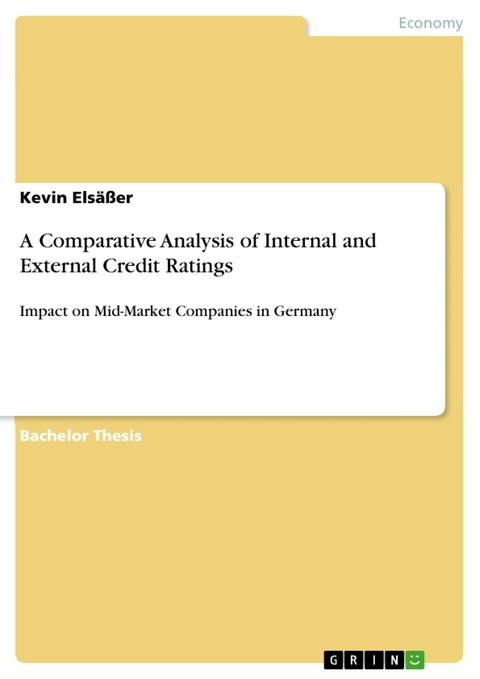
A Comparative Analysis of Internal and External Credit Ratings (eBook)
113 Seiten
GRIN Verlag
9783668236646 (ISBN)
In 2012, mid-market companies (KMU) based in Germany generated revenues of 2,149.0 billion Euros. They are responsible for 35,3% of all revenues generated in Germany. These mid-market companies employed 15.97 million people, a workforce of 59,6% of all employees in Germany (IFM Bonn, 2014). Clearly, mid-market companies are elementary for the German economy. To continue to be a primary motor of the economy, they need sufficient funding. Nevertheless, financing for mid-market companies in Germany will become more difficult. Standard & Poor’s Ratings Services (2015, pp. 2-3) estimated that European mid-market companies are going to have difficulties to meet their financing needs, as banks reduce their lending to the mid-market sector as consequence of stricter regulations. Especially, smaller mid-market companies face problems to access credit loans (Standard & Poor's Financial Services LLC, 2014, p. 3). The reason for these difficulties is the implementation of Basel III. Financial institutions have to deleverage their business during the next years (Zainzinger, 2013). The problem is that mid-market companies traditionally relied on bank funding. Especially German mid-market companies relied on credit loans from financial institutions (Huber & Simmert, 2007, p. 167-196). The new regulations for deleveraging create a “scarcity of finance for European companies”; it will generate an acute financing problem for mid-market companies (Dimitrijevic & Wade, 2014, pp. 1-2). In 2013, the German mid-market financing gap already amounted to 38,9 billion Euros (KfW, 2014, p. 7). Therefore, these companies have to find new funding sources. They have to find solutions to improve the access to external financing. Credit ratings provide an opportunity to help in this process.
The existence of credit ratings is widely known. They often appear in several newspapers, and magazines (Handelsblatt, 2014). Nevertheless, various mid-market companies cannot estimate the impact and importance of credit ratings. Specifically, differences between internal credit and external ratings are often unclear. [...]
| Erscheint lt. Verlag | 8.6.2016 |
|---|---|
| Verlagsort | München |
| Sprache | englisch |
| Themenwelt | Wirtschaft ► Betriebswirtschaft / Management ► Finanzierung |
| Schlagworte | credit ratings • Finanzierung • Kreditrating • kreditratings • Mid-Market • Mittelstand |
| ISBN-13 | 9783668236646 / 9783668236646 |
| Informationen gemäß Produktsicherheitsverordnung (GPSR) | |
| Haben Sie eine Frage zum Produkt? |
 EPUB (Ohne DRM)
Digital Rights Management: ohne DRM
Dieses eBook enthält kein DRM oder Kopierschutz. Eine Weitergabe an Dritte ist jedoch rechtlich nicht zulässig, weil Sie beim Kauf nur die Rechte an der persönlichen Nutzung erwerben.
Dateiformat: EPUB (Electronic Publication)
EPUB ist ein offener Standard für eBooks und eignet sich besonders zur Darstellung von Belletristik und Sachbüchern. Der Fließtext wird dynamisch an die Display- und Schriftgröße angepasst. Auch für mobile Lesegeräte ist EPUB daher gut geeignet.
Systemvoraussetzungen:
PC/Mac: Mit einem PC oder Mac können Sie dieses eBook lesen. Sie benötigen dafür die kostenlose Software Adobe Digital Editions.
eReader: Dieses eBook kann mit (fast) allen eBook-Readern gelesen werden. Mit dem amazon-Kindle ist es aber nicht kompatibel.
Smartphone/Tablet: Egal ob Apple oder Android, dieses eBook können Sie lesen. Sie benötigen dafür eine kostenlose App.
Geräteliste und zusätzliche Hinweise
Buying eBooks from abroad
For tax law reasons we can sell eBooks just within Germany and Switzerland. Regrettably we cannot fulfill eBook-orders from other countries.
aus dem Bereich