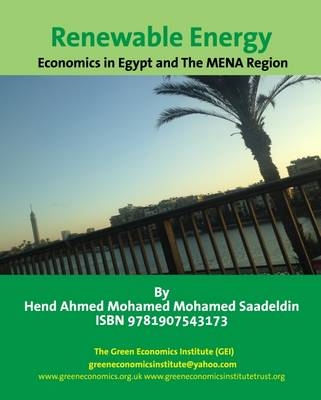
The Renewable Energy in Egypt and the Mena Region
The Green Economics Institute (Verlag)
978-1-907543-17-3 (ISBN)
- Titel nicht im Sortiment
- Artikel merken
In light of the immense energy problems facing MENA region, countries find themselves forced to the wall in meeting and increasing energy demand while responding to climate preservation calls and attaining high growth rates. As such, a number of promising scenarios have been proposed in the literature paving the way for a potential transformation to a more sustainable energy-driven MENA. However, an open-ended question of where to start is present. Shall priority be given to installing efficient energy technologies or renewable energy projects or both at the same time? Using a panel data from 1980 untill 2011 covering 18 MENA countries, this paper attempts to answer this question by investigating the impact of deploying energy efficiency technologies vis-a-vis renewable energy on economic growth. The long-run effects exhibited in the fixed-effects panel data model showed that attempts to reduce energy use will have negative impact on GDP growth. Several interpretations are presented, the most notable was that growth is led by energy-intensive industries in most developing countries.On the other hand, renewables exhibited no significant impact over the sampling period in line with the neutrality hypothesis owing to its tiny share in total primary energy supply.
Hend Saadeldin is a professional economist from Cairo, Egypt. She has a working experience in Economic Research across a wide range of topics including climate change, energy, market competition, public finance ..., etc. She is an academic environmental/climate change activist. Her Master of Science degree in Economics of the Middle East is from Philipps University in Marburg- Germany. She has an immense interest in green energy and environmental sustainability
Introduction 1. The Energy problem in MENA region 1.1 Dynamics of the Energy Problem in MENA region 1.2 The main reasons behind the Energy problem in MENA 1.2.1 Fuel subsidies and low energy prices 1.2.2 Increasing domestic demand 1.2.3 Lack of infrastructure 1.3 Economic spillovers of Energy problem in MENA: 1.3.1 The direct impact: 1.3.1.1 Crowding-out expenditures 1.3.1.2 Increasing inequality 1.3.1.3 High opportunity costs 1.3.2: The indirect impact 2. Energy market in MENA region: Overview and potentials 2.1 Energy profile in MENA region 2.2 Potential sustainable energy in MENA region: 2.2.1 Energy efficiency 2.2.2 Renewable energy 2.3 Unexploited Sustainable energy benefits in MENA region 3. Quantitative impact of sustainable energy deployment on MENA economic growth 3.1 Data and empirical specification 3.2 Main results 3.3 Comments Conclusion References
| Erscheinungsdatum | 19.07.2016 |
|---|---|
| Zusatzinfo | 25 |
| Verlagsort | Reading |
| Sprache | englisch |
| Themenwelt | Technik ► Elektrotechnik / Energietechnik |
| Technik ► Umwelttechnik / Biotechnologie | |
| Wirtschaft ► Volkswirtschaftslehre ► Makroökonomie | |
| ISBN-10 | 1-907543-17-1 / 1907543171 |
| ISBN-13 | 978-1-907543-17-3 / 9781907543173 |
| Zustand | Neuware |
| Informationen gemäß Produktsicherheitsverordnung (GPSR) | |
| Haben Sie eine Frage zum Produkt? |
aus dem Bereich