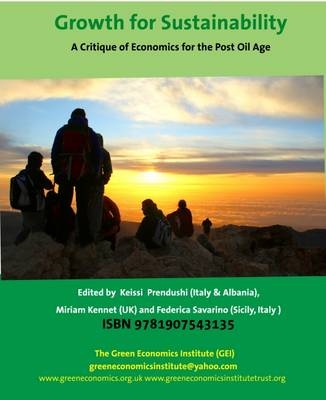
Growth for Sustainability: A Critique of Economics for the Post Oil Age
The Green Economics Institute (Verlag)
9781907543135 (ISBN)
- Keine Verlagsinformationen verfügbar
- Artikel merken
Keissi Prendussi is an economist interested in finance and econometrics from Piedmont in Italy and qualifying from the University of Sterling in Scotland. Of Albanian descent she is passionate about development economics and making the world a better place. Miriam Kennet (UK) is a specialist in Green Economics. She is the Co-Founder and is CEO of the Green Economics Institute. She also founded and edits the first Green Economics academic journal in the world, The International Journal of Green Economics, and she has been credited with creating the academic discipline of Green Economics. Green Economics has been recently described by the Bank of England as one of the most vibrant and healthy areas of economics at the moment. Having researched at Oxford and South Bank Universities, she is a member of the Environmental Change Institute, Oxford University. She has been featured in the Harvard Economics Review and Wall Street Journal as a leader. Ban Ki Moon invited her to his Global Leaders Conference on Climate Change at the United Nations. Recently she was named one of 100 most powerful unseen global women by the Charity One World action for her global work and won the Honour Award from the Luxembourg Ministry. Federica Oriana Savarino (Italy) is an economist, qualified from the University of Pisa, Business and Economics department. She also studied at the Yildiz Technical University, in Istanbul, where she analysed the European framework programmes from a Turkish prospective and collaborated with the 'Food not booms' NGO. She specializes in environmental economics, economics of development and international economics,. Her research covers 'The myth of unlimited growth and the physical limits to development'. She is intereested in the impact of economics on environment and people.
Contents ( may vary slightly during production) About the Contributors8 Part 1: Introduction: Alternatives to Growth and Designing a Post-Growth Society13 Chapter 1.1: Alternatives to growth: Cross-disciplinary concept for Socio-Ecological Transition13 by Enrico Tezza (Italy)13 Chapter 1.2: What do we mean by "growth", problems with growth and is a return to "growth" possible in the long term?24 by Steven Mandel24 Chapter 1.3:46 by Federica Savarino (Italy) 46 Chapter 1.4:46 by Mel Beckerleg 46 Part 2: Debating Economic growth and Development39 Chapter 2.1: The economics of the anthropocene39 by Sir Crispin Tickell39 Chapter 2.2 Deconstructing the concept of Economic Growth42 by Ann Palmer 42 Chapter 2.3: Green Growth: reconciling Economic Growth and Environmental Protection by Martin Koehring44 Chapter 2.4: The Green Economy: Rethinking Growth51 by Miriam Kennet and Volker Heinemann (UK and Germany) 51 Chapter 2.5: Why it is important to change the current Economic System59 by Bente Teglgard Madeira (UK and Denmark)59 Chapter 2.6: Sustainability and Permanence of Economic Growth64 by Brivers Ivars (Latvia) 64 Chapter 2.7: Economic Growth and Economic Development-Is GDP a right indicator for a country's well being? 71 by Eileen Peck 71 Chapter 2.8: Has Unbalanced Growth led to rapid urbanization?75 by Max Basta 75 Part 3: Limits to Growth Chapter 3.1: Towards 9 billion-infinte economy on a finite planet 78 by Joss Tantram78 Chapter 3.2: What is the point of capitalism?82 by Joss Tantram82 Part 4: Critical Methodology84 Chapter 4.1: Discounting the discount rate: how can we value a sustainable future?84 by Joss Tantram84 Chapter 4.2: Reinventing the Weal88 by Joss Tantram88 Chapter 4.3: Is the world actually making progress towards sustainability? 96 by Geurt Van De Kerk (The Netherlands)96 Chapter 4.4: Suggestion for a comprehensive approach of development towards a sustainable world109 by Geurt Van De Kerk (The Netherlands) 109 Part 5: Green Alternative Critiques to Growth116 Chapter 5.1: Introducing Green Economics: Renaissance, Reform and Methodology. Green Economics a global movement for Change 116 by Miriam Kennet116 Chapter 5.2: Green Economics: Its recent development and background 120 by Miriam Kennet and Michelle S. Gale de Oliveira (USA and Brazil)120 Chapter 5.3: Method, tools and Instruments130 by Volker Heinemann, Miriam Kennet and Michelle S. Gale de Oliveira130 Chapter 5.4:The Ten Key Values of Green Economics 134 by Miriam Kennet, Jeffrey Turk (Slovenia and Belgium), Michelle S. Gale de Oliveira Chapter 5.5: Good Jobs: the double dividend of Green Employment135 by Enrico Tezza (Italy) 135 Part 6: Growth; An Environmental Justice Critique146 Chapter 6.1: Governing for sustainability 146 by Annabella Wainer146 Chapter 6.2: Economic crises needs Ecological solutions 150 by M. Shipely 150 Chapter 6.3:Live Sustainably153 by Alan Cunningham 153 Chapter 6.4: Post Growth Policies for a Fossil Fuel Free Future 160 by By John Ranken 160 Chapter 6.5: Unveiling the great economic growth paradox-A sustainable point of view165 by Stephen Ternyik165 Chapter 6.6: Fragments on Sustainable Development 170 by Tommaso Luzzati (Italy)170 Part 7: Growth; A Social Justice Critique174 Chapter 7.1: Our pseudo-democratic servant-plutocracy: an exploration of our current political state, how we're governed in the interests of the super-rich, ad how gender balance rules might overturn the status quo174 by Natalie Bennett (Australia and UK) 174 Chapter 7.2: Growth creates poverty180 by Vandana Shiva (India) 180 Chapter 7.3: Maternal Health in India182 by Katherine Kennet182 Chapter 7.4: How can economic growth contribute more to the well-being? The case of Turkey between 2004-2014 191 by Ahmet Atil Asici and Kazim Anil Eren (Turkey) 191 Part 8: Critiques of today's real world Financialization and Economic Growth204 Chapter 8.1: Financialization, pension funds and generation challenges204 by Maria Madi (Brazil and Argentina)204 Chapter 8.2: The shadow market: The powerhouse of the sovereign wealth funds and the new economic world order213 by Miriam Kennet213 Chapter 8.3: Is green fiscal policy as a driver for green energy economy: empirically evidence from developing countries217 by Olimjon Saidmamatov and Bahtiyor Eshchanov (Khazakstan) 217 Part 9: Critiques of Corporate and Intra-firm Economic Growth226 Chapter 9.1: Psychopaths, Inc.: On Corporate Personhood226 by Joel Bakan226 Part 10: A couple of Practical Alternative Actions:230 Chapter 10.1: Five ways to slash London pollution 230 by John Weeks230 Chapter 10.2: How I made my home 100 % chemical detergent free235 by Poormina B Joshi (India)235 Publications of the Green Economics Institute242
| Erscheinungsdatum | 19.07.2016 |
|---|---|
| Verlagsort | Reading |
| Sprache | englisch |
| Themenwelt | Wirtschaft ► Allgemeines / Lexika |
| Wirtschaft ► Volkswirtschaftslehre | |
| ISBN-13 | 9781907543135 / 9781907543135 |
| Zustand | Neuware |
| Informationen gemäß Produktsicherheitsverordnung (GPSR) | |
| Haben Sie eine Frage zum Produkt? |
aus dem Bereich