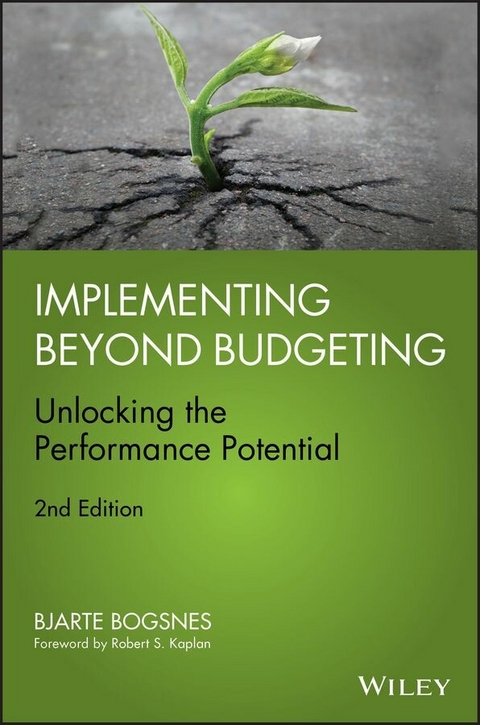
Implementing Beyond Budgeting (eBook)
John Wiley & Sons (Verlag)
978-1-119-22227-9 (ISBN)
The future of management is here!
Traditional management was invented for very different times and is today in serious trouble. The level of volatility, uncertainty, complexity and ambiguity in business environments is record high. People's expectations towards their employers and leaders have also radically changed. A number of organizations are exploring management innovation that can help them not just coping but thriving and out-performing in these new and different realities. Beyond Budgeting may be the most important new idea out there addressing these radical changes, due to its broad scope and coherent approach. Abolishing the traditional, detailed annual budget is necessary, but not sufficient. Organizations on the journey are questioning their old leadership beliefs and are tearing up their old command-and-control management models, with 'agile' and 'human' as the foundation for a new start.
Implementing Beyond Budgeting is both a theoretical introduction and a practical guide to bringing such a more empowered and adaptive management model to life. Drawing on the author's twenty years of Beyond Budgeting experience, this book not only demonstrates the serious problems with traditional management through numerous practical examples. It also follows several companies on their Beyond Budgeting journey, including Scandinavia's largest company Statoil where the author has been heading up implementation since 2005. You'll get a first-hand glimpse at the reality of transitioning a large multinational company, and gain a real-world perspective on what successful implementation entails.
This new second edition has been significantly revised and expanded. It covers the amazing development of the Beyond Budgeting movement and how the Statoil implementation journey has continued since the first edition of this book was published in 2009, sustaining major events like for instance the 2015 oil price crash. A new chapter on 'Beyond Budgeting and Agile' has also been added. New implementation experiences, great new case stories, new management innovation examples and management metaphors (traffic controls!) are introduced, as well as the author's latest reflections on a range of management issues including target setting, forecasting, performance evaluation and incentives.
Bjarte Bogsnes has a long international career, both in Finance and HR. He has been advocating Beyond Budgeting for more than twenty years and led its implementation at two large European companies, Statoil and Borealis. Bjarte is the chairman of Beyond Budgeting Roundtable (BBRT) and is a popular international business speaker. He is the winner of a Harvard Business Review/McKinsey Management Innovation award.
The future of management is here! Traditional management was invented for very different times and is today in serious trouble. The level of volatility, uncertainty, complexity and ambiguity in business environments is record high. People s expectations towards their employers and leaders have also radically changed. A number of organizations are exploring management innovation that can help them not just coping but thriving and out-performing in these new and different realities. Beyond Budgeting may be the most important new idea out there addressing these radical changes, due to its broad scope and coherent approach. Abolishing the traditional, detailed annual budget is necessary, but not sufficient. Organizations on the journey are questioning their old leadership beliefs and are tearing up their old command-and-control management models, with agile and human as the foundation for a new start. Implementing Beyond Budgeting is both a theoretical introduction and a practical guide to bringing such a more empowered and adaptive management model to life. Drawing on the author s twenty years of Beyond Budgeting experience, this book not only demonstrates the serious problems with traditional management through numerous practical examples. It also follows several companies on their Beyond Budgeting journey, including Scandinavia s largest company Statoil where the author has been heading up implementation since 2005. You'll get a first-hand glimpse at the reality of transitioning a large multinational company, and gain a real-world perspective on what successful implementation entails. This new second edition has been significantly revised and expanded. It covers the amazing development of the Beyond Budgeting movement and how the Statoil implementation journey has continued since the first edition of this book was published in 2009, sustaining major events like for instance the 2015 oil price crash. A new chapter on Beyond Budgeting and Agile has also been added. New implementation experiences, great new case stories, new management innovation examples and management metaphors (traffic controls!) are introduced, as well as the author s latest reflections on a range of management issues including target setting, forecasting, performance evaluation and incentives.
BJARTE BOGSNES has had a long international career, both in Finance and HR. He has been advocating Beyond Budgeting for more than twenty years and led its implementation at two large European companies, Statoil and Borealis. Bjarte is the chairman of Beyond Budgeting Roundtable (BBRT) and is a popular international business speaker. He is the winner of a Harvard Business Review/McKinsey Management Innovation award.
Foreword xi
Acknowledgments xiii
About the Author xv
Introduction xvii
Chapter 1 Problems with Traditional Management 1
Introduction 1
Which Way in a New Business Environment? 4
The Trust and Transparency Problem 7
The Cost Management Problem 14
The Control Problem 22
The Target-Setting Problem 26
The Performance Evaluation Problem 30
The Bonus Problem 34
The Rhythm Problem 45
The Quality Problem 49
The Efficiency Problem 52
Chapter 2 Beyond Budgeting 55
The Philosophy 55
Beyond Budgeting Roundtable 65
The Beyond Budgeting Principles 69
Handelsbanken--the Pioneer 74
Miles--a Master of Servant Leadership 80
The Reitan Group--Values at the Core 84
Chapter 3 The Borealis Case 91
Introduction 91
Creation of Borealis 92
The Journey Begins 94
The Borealis Model 99
Implementation Experiences and Lessons Learned 115
Borealis Today 119
Chapter 4 The Statoil Case 123
Introduction 123
Creating the Foundation 126
Starting Out 130
The Statoil Model 134
A Dynamic Ambition to Action 190
What Could Be Next? 199
The Beyond Budgeting Research Program 210
How Are We Doing? 212
A New Start for Statoil? 217
Chapter 5 Beyond Budgeting and Agile 221
Chapter 6 Making the Change: Implementation Advice 229
Create the Case for Change 232
Handle Resistance 238
Design to 80 Percent and Jump 240
Keep the Cost Focus 241
Don't Start with Rolling Forecasting Only 243
Involve Human Resources and Agile IT 244
You Can't Get Rid of Command and Control through Command and Control 246
Do Not Become a Fundamentalist 249
Balanced Scorecard Pitfalls 250
Revolution or Evolution? 260
Closing Remarks 263
Index 265
"Budgeting, which lies at the heart of management, is typically backward-looking, inflexible, politicized, and overly conservative -- in other words, it's a drag on organizational vitality. But in this provocative book, Bjarte Bogsnes shows you how to radically retool the budgeting process in your organization. Based on his experience in large and complex organizations, he takes you through a step-by-step process for transforming the way your organization is managed. This is essential reading if you want to build an organization that is fit for the future."
--Professor Gary Hamel, London Business School
"This book is about how to create the right conditions to liberate people from traditional management practices, which organizations build as they grow, but which usually lead to reduced agility, employee disengagement, and ultimately decline. Since his 2009 book, Bjarte has journeyed a lot further beyond budgeting, gaining substantial new insights from practical experience, told in this edition as ever with great readability, authenticity, and enthusiasm."
-- Robin Fraser, co-founder of the Beyond Budgeting Roundtable; co-author with the late Jeremy Hope of Beyond Budgeting
"While it is common to hear managers complain about budgeting activities, too few are aware that the problems with budget management are more insidious. Budget management is a major cause of sub-optimisation; in simple terms, it makes performance worse. As with many human inventions, it solved problems of its time, but as time has moved on the problems and opportunities have changed. This book charts the development of better methods, balancing purpose and practice; improving the effectiveness of decision making; and, hence, organisation performance."
--John Seddon, Vanguard
Praise for the First Edition
"At last, Bjarte Bogsnes has made his experience and enthusiasm for Beyond Budgeting available for a wider audience with this remarkable book. I have appreciated his engagement in these important management issues for many years, and his knowledge and leadership have been critical in the transformation of our organization."
--Eldar Sætre, CFO (now CEO), Statoil
"This is an excellent book for those who want to grapple with the difficult task of radically changing conventional ways of running a company to more effective ways of doing it and ways more in accordance with human nature."
--Jan Wallander, Honorary Chairman of Handelsbanken
CHAPTER 1
Problems with Traditional Management
“Most of what we call management consists of making it difficult for people to get their work done.”
Peter Drucker
Introduction
In this chapter, we take a closer look at the many problems with traditional management, which I have only been hinting at so far. This is where we have to start. If there are no problems, why should we bother changing? Why fix something that is not broken? There has to be a case for change. Some of the problems we will discuss are directly linked to budgets and budgeting. Others are more indirectly linked, but often rooted in the budgeting mindset of command and control.
Let us start with the budget. It is not the only problem, but still a major one. Over the last 20 years, I have asked thousands of managers across the world (and many employees, too) what they think of the budgeting process. It is just like pushing a button. Everybody has a view. The vast majority is very critical, and many are extremely negative. These are the problems they typically bring up:
- Weak links to strategy
The strategy and the budget are developed in isolated processes, facilitated by different functions without much mutual respect and contact. - A very time-consuming process
Budgeting consumes a scary amount of time and energy, both when made and when followed up. - Stimulates unethical behaviors
The gaming, lowballing, and hidden agendas that normally would not be accepted are seen as normal and unavoidable in a budget regime. - Assumptions quickly outdated
Many, and sometimes most, of the budget assumptions turn out to be wrong. - Provides illusions of control
Most of the controls the budget offers are nothing but illusions of control. - Decisions are made too early
Decisions about activities, projects, and spending are typically made too early, without fresh enough information to make the right decision. - Decisions are made too high up
Lack of autonomy forces decisions upstairs, often making them worse, not better. - Often prevents the rights things from getting done
“I can't do the blindingly obvious, because it's not in my budget!” - Often leads to the wrong things being done
The flipside is people doing what they shouldn't, because it is in the budget: “Spend it or lose it!” - The world ends December 31
The budget year creates shortsightedness and a start/stop rhythm, which is often artificial from a business perspective. - A language ill-suited for performance evaluation
“Hitting the budget number” is a narrow and often meaningless way of defining performance.
That is a pretty long list of problems, representing a massive level of frustration. What I find just as problematic, however, is that while so many complain, the vast majority of organizations continue budgeting, year after year. When so many are so critical, why haven't more done something about it? Where is the revolution, when there is so much dissatisfaction boiling among people?
I have thought long and hard about why. I see only two possible reasons. Maybe managers see no alternative: “What shall we then do instead?” They haven't heard of Beyond Budgeting. Fortunately, this group is getting smaller as Beyond Budgeting finally has entered the global management vocabulary.
Those who have heard of Beyond Budgeting may not regard these problems as big enough to justify the long and hard change journey required. They are seen more as irritating itches than as symptoms of any serious disease.
They are dead wrong. These problems are much more than irritating itches. They are symptoms of something much bigger and deeper. The management technology “budgeting” was invented a hundred years ago, with the best of intentions, to help organizations perform better. It probably worked well back then and maybe even 50 years ago. Today, however, we are in very different times. Not only have our business environments become much more dynamic and unpredictable, but they are just as much about people: the birth of the knowledge worker and the demise of organizations as obedient machines. In this environment, budgeting has become more of a barrier than a support for great performance, something that instead prevents organizations from performing to their full potential.
This serious problem is not fixed by addressing budgeting only. The purpose of Beyond Budgeting is therefore not just, or not necessarily, to get rid of budgets. The purpose is to create organizations that are more agile and more human, because this is both good and necessary for great performance today. This requires radical change in traditional management. At the core of this kind of management we find the budgeting process and the budgeting mindset, which seldom can be left untouched and unchanged.
You might hesitate to buy into this massive attack on traditional management and budgets without supporting evidence. If you are skeptical, I hope we at least can agree that any process should from time to time be reviewed and pressure-tested. There is always a better way. So if your guard is up right now, the only thing I ask for is to let it down during the next pages, where we examine more in depth whether we have a problem. I promise to provide hard evidence. Maybe you won't be convinced. Fair enough. But please give me a chance!
Which Way in a New Business Environment?
What is it that really drives great performance in organizations? What is it that makes people get up in the morning, go to work, wanting to do their best? How do we release creativity and innovation? How do we sense and respond faster than the competition? Why should people work for us and not for someone else?
These kinds of questions have probably been asked from the very early days of organizations and leadership. The questions are the same. It is the answers that have changed. The old answers were quite simple and included strong doses of hierarchical command and control. Much of it probably did work well in the past. Today, there is so much more VUCA out there: Volatility, Uncertainty, Complexity, and Ambiguity. In addition, the expectations from employees, customers, shareholders, and society have also increased dramatically. So has the transparency of business. There are few places to hide anymore.
It is almost as if we have been through a “global warming” of the entire business climate. The “climate changes” are faster, more unpredictable, and more violent than in those reliable summers and winters we might recall from our childhood. Just look at the volatility of oil prices. Many businesses, not just oil companies, have the oil price as a key variable in their business performance. They try to make short- and long-term projections, and keep failing miserably, as the 2014 price crash once again demonstrated. Look at the pace of technology innovation. Making a five-year business plan for a record company today must be a nightmare compared to the days before digital formats, downloading, and streaming. And why should it stop here?
The real global warming still has its skeptics, but no one seems to dispute this one. The evidence of change is everywhere. We are almost overwhelmed with uncertainty. The only thing that has become more certain is that our predictions about what lies ahead most likely are wrong. “The future ain't what it used to be,” as the American baseball player Yogi Berra once put it.
At the same time, life inside organizations has also changed dramatically. The massive difference between market and book value in most companies is tangible proof that something has happened. The value of human capital: innovation, creativity, passion, and people's desire to contribute and make a difference is often the only value that exists, and it can walk out the door any day. Actually it does, every afternoon, often becoming even more valuable as many then mobilize and reveal additional talents. Employees do not see themselves as “workers” in such organizations, and they cannot be managed as “workers.” They have different and higher expectations than earlier generations. Traditional management struggles when people regard leadership as something that must be earned and not assigned through stars and stripes. I learned that lesson the hard way during my short military career.
Companies are not deaf and blind. Most do respond, but in very different ways. Some believe the answer lies in “even more of what we already do.” Their response is to pull harder and tougher on existing management levers. They go for longer budget processes, more analysis, more number-crunching, tougher targets, tighter follow-up, and higher bonuses. The strategy is simple: more of the old answers in order to get back into the “control” they had or believed they had in the past.
This is a tempting strategy. It also represents a major paradox. The more VUCA out there and the more urgent need there is to break with the past and go for radical management innovation, the stronger the fear of letting go and leaving what is perceived as a safe and calm harbor in stormy weather, namely, those familiar and well-tested management practices, including the good old budget.
Some realize that there are problems with the old way, but they lack the insight or the courage...
| Erscheint lt. Verlag | 1.7.2016 |
|---|---|
| Sprache | englisch |
| Themenwelt | Wirtschaft ► Betriebswirtschaft / Management ► Finanzierung |
| Wirtschaft ► Betriebswirtschaft / Management ► Unternehmensführung / Management | |
| Schlagworte | Adaptive management • Agility • annual budget methodology • Beyond Budgeting action steps • Beyond Budgeting change initiative • Beyond Budgeting implementation • Beyond Budgeting Roundtable • Beyond Budgeting strategy • Beyond Budgeting transition • Bjarte Bogsnes • budget models • Business & Management • Corporate Agility • Implementing Beyond Budgeting: Unlocking the Performance Potential, Second Edition • leading organizational change • Management models • management performance indicators • Management training • Organizational Performance • Performance Management • performance management practices • practical Beyond Budgeting • Strategic Management • Strategisches Management • Transparency • Trust • Unternehmensstrategie • Wirtschaft u. Management |
| ISBN-10 | 1-119-22227-3 / 1119222273 |
| ISBN-13 | 978-1-119-22227-9 / 9781119222279 |
| Informationen gemäß Produktsicherheitsverordnung (GPSR) | |
| Haben Sie eine Frage zum Produkt? |
 EPUB (Adobe DRM)
Kopierschutz: Adobe-DRM
Adobe-DRM ist ein Kopierschutz, der das eBook vor Mißbrauch schützen soll. Dabei wird das eBook bereits beim Download auf Ihre persönliche Adobe-ID autorisiert. Lesen können Sie das eBook dann nur auf den Geräten, welche ebenfalls auf Ihre Adobe-ID registriert sind.
Details zum Adobe-DRM
Dateiformat: EPUB (Electronic Publication)
EPUB ist ein offener Standard für eBooks und eignet sich besonders zur Darstellung von Belletristik und Sachbüchern. Der Fließtext wird dynamisch an die Display- und Schriftgröße angepasst. Auch für mobile Lesegeräte ist EPUB daher gut geeignet.
Systemvoraussetzungen:
PC/Mac: Mit einem PC oder Mac können Sie dieses eBook lesen. Sie benötigen eine
eReader: Dieses eBook kann mit (fast) allen eBook-Readern gelesen werden. Mit dem amazon-Kindle ist es aber nicht kompatibel.
Smartphone/Tablet: Egal ob Apple oder Android, dieses eBook können Sie lesen. Sie benötigen eine
Geräteliste und zusätzliche Hinweise
Buying eBooks from abroad
For tax law reasons we can sell eBooks just within Germany and Switzerland. Regrettably we cannot fulfill eBook-orders from other countries.
aus dem Bereich