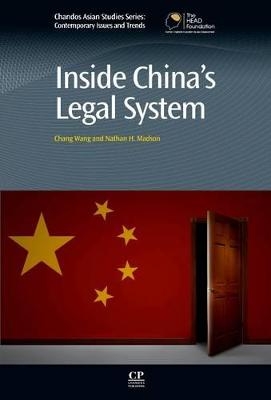
Inside China's Legal System
Chandos Publishing (Oxford) Ltd (Verlag)
978-0-08-101341-0 (ISBN)
- Titel wird leider nicht erscheinen
- Artikel merken
Chang Wang is associate professor of law at College of Comparative Law, China University of Political Science and Law in Beijing, as well as Chief Research and Academic Officer for China for Thomson Reuters. He also serves as adjunct professor of law at the University of Minnesota Law School and William Mitchell College of Law in the United States, guest professor of law at the University of Lucerne Faculty of Law in Switzerland, and Guest Lecturer on American Law and Culture at Beijing Royal School in China. Chang holds a B.F.A. in Filmmaking from Beijing Film Academy, an M.A. in Comparative Literature and Comparative Cultural Studies from Peking (Beijing) University, an M.A. in American Art History from University of Illinois at Urbana-Champaign, and a Juris Doctor from the University of Minnesota Law School. Chang has been admitted into law practice in Minnesota, the District of Columbia, and federal courts. He has published a book on comparative cultural studies and more than 100 academic articles on law, critical theory, and art history. Nathan H. Madson is an attorney living in St. Paul, Minnesota. He has an extensive background in international and domestic human rights, working and volunteering with such organizations as the Queer Legal Aid Society, The Center for Victims of Torture, The Advocates for Human Rights, OutFront Minnesota, and the U.S. Committee for Refugees and Immigrants. Nathan has guest lectured on Chinese law and Chinese ethnic minorities at the University of Minnesota Law School and the William Mitchell College of Law, USA. In addition, his research includes non-normative methods of legal and public policy reform. Nathan received his B.A. in International Affairs from The George Washington University and his Juris Doctor from the University of Minnesota Law School, USA. He has been admitted into law practice in Minnesota.
Dedication
List of abbreviations
Acknowledgments
Foreword 1
Foreword 2
About the authors
Introduction: justice with a Chinese face
A 'socialist system of laws with Chinese characteristics'
Historical reforms in Chinese law
Comparing Chinese and American legal systems
American perspectives on Chinese law
Human rights commentary and the Chinese response
Questions raised by the Chinese legal system
Positive developments
This book
Part I: Historical views
1: Philosophical underpinnings of the Chinese legal system
Abstract
Confucianism
Confucius's view of law
Confucius's view of history
Critical thinking on Confucius
The resurgence of Confucianism in China
Mencius
Legalism
Qin and the first emperor
Hidden rules and law in imperial China
Law versus morality
Penal codes
No lawyers or legal profession
2: China and the Western influence
Abstract
'100 years of humiliation'
Unequal treaties between 1842 and 1949 and extraterritoriality
Nationalism
The Foreign Affairs Movement and the ti-yong dichotomy
The failed '100 days reform' in 1898 and late Qing reforms
Republic of China
'The People's Republic'
Anti-Rightist Movement, Great Leap Forward and Great Famine
Cultural Revolution
The trial of the Gang of Four
The case of Yu Luoke
The case of Zhang Zhixin
Tiananmen
Part II: The players
3: The judiciary
Abstract
The party and the judiciary
Non-independent judiciary
Structure
Supreme People's Court
Are fayuan courts?
'Judges'
Judicial examination
Judicial corruption
Procuratorates
Access to court information
4: The police
Abstract
Definitions
Overview
Governing law
Re-education through labor
Maintaining stability or weiwen
'Guobao' and 'drinking tea'
Internet police
Detention, torture and extrajudicial killings
Yang Jia case
Wen Qiang case
Wang Lijun case
5: The lawyers
Abstract
Lawyers as a 'bad element'
History of the legal profession in China
Lawyers in the PRC
Legal education
Regulating lawyers
New rules for the punishment of lawyers
'They came for lawyers'
Lawyers, law professors and troublemakers: Zhang Sizhi, Jiang Ping, Pu Zhiqiang
Li Zhuang case
Part III: Case studies
6: Civil laws and cases
Abstract
General principles of civil law
Selected civil laws
Commercial law
Civil procedure
Representative cases
7: Criminal laws and criminal cases
Abstract
Criminal law
Criminal procedure
Criminal Procedure Law amendments
The case of Liu Xiaobo
Representative cases in criminal law
The CPC and criminal law
8: The curious case of Ai Weiwei and administrative law
Abstract
Timeline
Procedure
The 'tax' case
Administrative law in China
Petition
Part IV: Conclusion
Afterword
Is constitutionalism incommensurable with Chinese socialism?
Important updates
Conclusion
Appendix 1: Constitution of the People's Republic of China
Preamble
Chapter I: General Principles
Chapter II: The Fundamental Rights and Duties of Citizens
Chapter III: The Structure of the State
Chapter IV: The National Flag, the National Anthem, the National Emblem and the Capital
Appendix 2: The socialist legal system with Chinese characteristics
Foreword
I Establishment of the socialist system of laws with Chinese characteristics
II Composition of the socialist system of laws with Chinese characteristics
III Features of the socialist system of laws with Chinese characteristics
IV Improvement of the socialist system of laws with Chinese characteristics
Concluding remarks
Appendix 3: Charter '08
I Foreword
II Our fundamental principles
III What we advocate
Selected readings and resources for further research in Chinese law and history
Index
| Erscheinungsdatum | 07.07.2016 |
|---|---|
| Reihe/Serie | Chandos Asian Studies Series |
| Verlagsort | OXford |
| Sprache | englisch |
| Themenwelt | Sachbuch/Ratgeber ► Geschichte / Politik ► Allgemeines / Lexika |
| Geisteswissenschaften ► Geschichte ► Regional- / Ländergeschichte | |
| Recht / Steuern ► Allgemeines / Lexika | |
| Recht / Steuern ► EU / Internationales Recht | |
| Wirtschaft ► Betriebswirtschaft / Management | |
| ISBN-10 | 0-08-101341-8 / 0081013418 |
| ISBN-13 | 978-0-08-101341-0 / 9780081013410 |
| Zustand | Neuware |
| Informationen gemäß Produktsicherheitsverordnung (GPSR) | |
| Haben Sie eine Frage zum Produkt? |
aus dem Bereich