


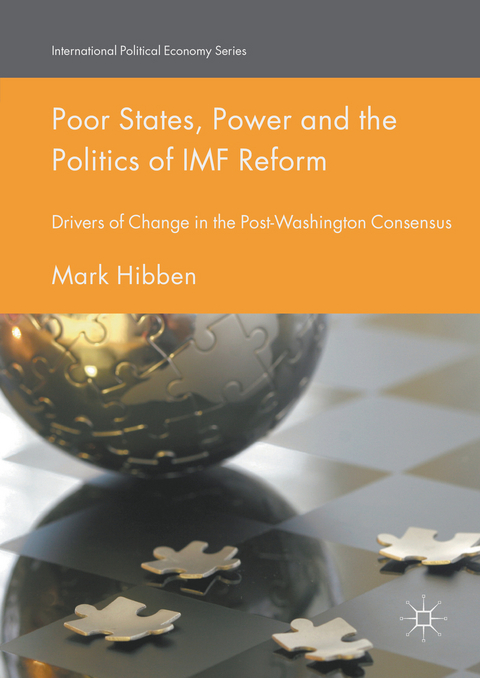
Poor States, Power and the Politics of IMF Reform (eBook)
185 Seiten
Palgrave Macmillan UK (Verlag)
978-1-137-57750-4 (ISBN)
Mark Hibben is Assistant Professor of Political Science at Saint Joseph's College of Maine, USA.
This books provides a timely comparative case study that reveals the factors driving the International Monetary Fund's policy reform in Low Income Developing Countries (LIDCs), as a resurgent IMF expands its footprint in the world's poorest states. Through a research design that employs both mainstream and critical IPE theory, Mark Hibben uncovers three major tendencies. Principal-agent analysis, he argues, demonstrates that coalition formation among powerful states, IMF staff and management, and other influential actors is necessary for policy reform. At the same time, he uses constructivist analysis to show that ideational frameworks of what merits appropriate macroeconomic policy response also have an impact on reform efforts, and that IMF management and staff seek legitimacy in their policy choices. In response to the crises in 1999 and 2008, the author maintains, poverty and inequality now 'matter' in IMF thinking and serve as an opportunity for policy insiders and external actors to deepen the institution's new commitment to 'inclusive' growth. Finally, Hibben draws on neo-Gramscian analysis to highlight how the IMF looked to soften the destabilizing effects of globalization through reforms focused on stakeholder participation in poor states and will continue to do so in its support of the new United Nation Sustainable Development Goals. This means that the 2015-2030 time period will be a critical juncture for IMF LIDC reform. By drawing from diverse theoretical traditions, the author thus provides a unique framework for the study of contemporary IMF change and how best those interested in LIDC policy reform can meet this objective.
Mark Hibben is Assistant Professor of Political Science at Saint Joseph’s College of Maine, USA.
1. The IMF, LIDC Reform and the post Washington Consensus1.1. What drives post Washington Consensus IMF LIDC reform and why does it matter1.2. Contested areas of IMF LIDC policy in the post 2008 era1.3Who are the LIDCs 1.4Organization, research design, and findings 2. The IMF and LIDCs2.1Mandate, quota system, and organizational structure2.2Organizational structure2.3Lending facilities, FSAPs and the PSI 2.4Operational culture 2.51944-1952: The Bretton Woods framework and the rise of IMF conditionality 2.61953-1961: IMF ‘common sense’, the Polak Model, and SBAs2.71962- 1971: Push back, early concessionary lending, and LIDC technical assistance 2.81971-1996: Breakdown of Bretton Woods and the Washington Consensus2.9Conclusion3. Theorizing post Washington Consensus LIDC Reform3.1What influences IMF policy?3.2Theorizing IMF LIDC reform: A rationalist approach3.3Theorizing IMF LIDC reform: A constructivist approach3.4Theorizing IMF LIDC reform: A historical structural approach3.5Conclusion4. The HIPC and HIPC II Initiatives4.1Setting the stage for HIPC and HIPC II: The breakdown of Bretton Woods hegemony4.2The Mexican Debt crisis, demand compression, and structural market reform4.3From bilateral debt restructuring to debt reduction4.4Rethinking IMF LIDC debt forgiveness: the HIPC initiative4.5‘Faster, deeper, and broader debt relief’ with poverty reduction: the HIPC II4.6Conclusion5. ‘Pro-Poor’ Concessionary Lending: The PRGF5.
| Erscheint lt. Verlag | 2.6.2016 |
|---|---|
| Reihe/Serie | International Political Economy Series | International Political Economy Series |
| Zusatzinfo | XV, 185 p. 10 illus., 7 illus. in color. |
| Verlagsort | London |
| Sprache | englisch |
| Themenwelt | Naturwissenschaften |
| Sozialwissenschaften ► Politik / Verwaltung ► Europäische / Internationale Politik | |
| Sozialwissenschaften ► Politik / Verwaltung ► Vergleichende Politikwissenschaften | |
| Wirtschaft ► Volkswirtschaftslehre ► Wirtschaftspolitik | |
| Schlagworte | constructivist analysis • development aid • Low Income Developing States • Macroeconomic Policy • Neo-Gramscian analysis • Principal-agent analysis • Reform |
| ISBN-10 | 1-137-57750-9 / 1137577509 |
| ISBN-13 | 978-1-137-57750-4 / 9781137577504 |
| Informationen gemäß Produktsicherheitsverordnung (GPSR) | |
| Haben Sie eine Frage zum Produkt? |
 PDF (Wasserzeichen)
DRM: Digitales Wasserzeichen
Dieses eBook enthält ein digitales Wasserzeichen und ist damit für Sie personalisiert. Bei einer missbräuchlichen Weitergabe des eBooks an Dritte ist eine Rückverfolgung an die Quelle möglich.
Dateiformat: PDF (Portable Document Format)
Mit einem festen Seitenlayout eignet sich die PDF besonders für Fachbücher mit Spalten, Tabellen und Abbildungen. Eine PDF kann auf fast allen Geräten angezeigt werden, ist aber für kleine Displays (Smartphone, eReader) nur eingeschränkt geeignet.
Systemvoraussetzungen:
PC/Mac: Mit einem PC oder Mac können Sie dieses eBook lesen. Sie benötigen dafür einen PDF-Viewer - z.B. den Adobe Reader oder Adobe Digital Editions.
eReader: Dieses eBook kann mit (fast) allen eBook-Readern gelesen werden. Mit dem amazon-Kindle ist es aber nicht kompatibel.
Smartphone/Tablet: Egal ob Apple oder Android, dieses eBook können Sie lesen. Sie benötigen dafür einen PDF-Viewer - z.B. die kostenlose Adobe Digital Editions-App.
Buying eBooks from abroad
For tax law reasons we can sell eBooks just within Germany and Switzerland. Regrettably we cannot fulfill eBook-orders from other countries.


