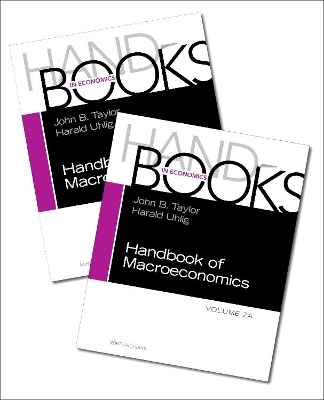
Handbook of Macroeconomics
North-Holland
978-0-444-59487-7 (ISBN)
- Titel ist leider vergriffen;
keine Neuauflage - Artikel merken
John B. Taylor is the Mary and Robert Raymond Professor of Economics at Stanford University and the George P. Shultz Senior Fellow in Economics at Stanford’s Hoover Institution. He is also the director of Stanford's Introductory Economics Center. His research focuses on macroeconomics, monetary economics and international economics. He co-edited Volume 1 of the Handbook of Macroeconomics and recently wrote Getting Off Track, one of the first books on the financial crisis, and First Principles: Five Keys to Restoring America’s Prosperity. He served as senior economist and Member of the President’s Council of Economic Advisers. From 2001 to 2005, he served as undersecretary of the U.S. Treasury for international affairs. Taylor was awarded the Hoagland Prize and the Rhodes Prize by Stanford University for excellence in undergraduate teaching and the Stanford Economics Department Distinguished Faculty Teaching Award. He received the Truman Medal for Economic Policy for extraordinary contribution to the formation and conduct of economic policy, the Bradley Prize for his economic research and policy achievements, the Adam Smith Award from the National Association for Business Economics, the Alexander Hamilton Award and the Treasury Distinguished Service Award for his policy contributions at the US Treasury, and the Medal of the Republic of Uruguay for his work in resolving the 2002 financial crisis. Taylor received a BA in economics summa cum laude from Princeton and a PhD in economics from Stanford. Harald Uhlig, born 1961, is Professor at the Department of Economics of the University of Chicago since 2007, and was chairman of that department from 2009 to 2012. Previously, he held positions at Princeton, Tilburg University and the Humboldt Universität Berlin. His research interests are in quantitative macroeconomics, financial markets and Bayesian econometrics. He served as co-editor of Econometrica from 2006 to 2010 and as editor of the Journal of Political Economy since 2012 (head editor since 2013). He is a consultant of the Bundesbank, the European Central Bank and the Federal Reserve Bank of Chicago. He is a fellow of the Econometric Society and a recipient of the Gossen Preis of the Verein für Socialpolitik, awarded annually to an economist in the German-language area whose work has gained an international reputation.
Section 1: The Facts of Economic Growth and Economic Fluctuation
1. RBC Methodology and the Development of Aggregate Economic Theory
2. The Facts of Economic Growth
3. Macroeconomic Shocks and Their Propagation
4. Macroeconomic Regimes and Regime Shifts
5. The Macroeconomics of Time Allocation
6. Who Bears the Cost of Recessions? The Role of House Prices and Household Debt
7. Allocative and Remitted Wages: New Facts and Challenges for Keynesian Models
8. Financial and Fiscal Crises
Section 2: The Methodology of Macroeconomics
9. Factor Models and Structural Vector Autoregressions in Macroeconomics
10. Solution and Estimation Methods for DSGE Models
11. Recursive Contracts and Endogenously Incomplete Markets
12. Macroeconomics and Household Heterogeneity
13. Natural Experiments in Macroeconomics
14. Accounting for Business Cycles
15. Incomplete Information in Macroeconomics: Accommodating Frictions in Coordination
16. New Methods for Macro-Financial Model Comparison and Policy Analysis
Section 3: Financial-Real Connections
17. Wholesale Banking and Bank Runs in Macroeconomic Modelling of Financial Crises
18. Housing and Credit Markets: Bubbles and Crashes
19. Macro, Money and Finance: A Continuous-Time Approach
20. Housing and Macroeconomics
21. Term Structure of Uncertainty in the Macroeconomy
22. Quantitative Models of Sovereign Debt Crises
Section 4: Models of Economic Growth and Fluctuations
23. Families in Macroeconomics
24. Environmental Macroeconomics
25. The Staying Power of Staggered Wage and Price Setting Models in Macroeconomics
26. Neoclassical Models in Macroeconomics
27. Macroeconomics of Persistent Slumps
28. Macroeconomics and the Labor Market
Section 5: Macroeconomic Policy
29. Challenges for Central BanksMacro Models
30. Liquidity requirements, liquidity choice and financial stability
31. Understanding Inflation as a Joint Monetary-Fiscal Phenomenon
32. Fiscal Multipliers: Liquidity Traps and Currency Unions
33. What is a Sustainable Public Debt?
34. The Political Economy of Government Debt
| Reihe/Serie | Handbook of Macroeconomics |
|---|---|
| Sprache | englisch |
| Maße | 191 x 235 mm |
| Gewicht | 4620 g |
| Themenwelt | Wirtschaft ► Volkswirtschaftslehre ► Makroökonomie |
| ISBN-10 | 0-444-59487-6 / 0444594876 |
| ISBN-13 | 978-0-444-59487-7 / 9780444594877 |
| Zustand | Neuware |
| Informationen gemäß Produktsicherheitsverordnung (GPSR) | |
| Haben Sie eine Frage zum Produkt? |
aus dem Bereich